


The Pace Alone Is the Story
Seven distinct releases from two companies in eleven days is not normal developer-tooling cadence. It’s closer to a mobile app in a growth phase. Here’s the compressed timeline:
- Oct. 2 — Copilot deprecates a set of older models across all experiences
- Oct. 5 — Copilot ships VS Code 1.141 and Claude Haiku 5.5
- Oct. 6 — Cursor ships remote control for local agents
- Oct. 12 — Copilot updates JetBrains with a new default model and MCP server
- Oct. 13 — Copilot makes Gemini 4 Argon generally available
- Oct. 13 — Cursor launches the Origin App Marketplace with 20+ integrations
Both companies clearly know the other’s release calendar. The Oct. 13 simultaneous launches weren’t a coincidence — they were a statement.
Gemini 4 Argon: The Frontier Model Slot
On October 13, GitHub made Gemini 4 Argon generally available inside Copilot. Google positions Argon as its newest frontier model, built for complex coding, agentic workflows, and multi-step reasoning — not quick autocomplete. The rollout is gradual, so Pro+, Max, Business, and Enterprise subscribers won’t all see it in their model picker on the same day.
What’s notable is the distribution surface: Argon landed simultaneously in VS Code, Visual Studio, JetBrains, Xcode, Eclipse, Copilot CLI, the coding agent, and the standalone app. Eight surfaces, one model, days apart. That kind of coordinated rollout would have taken GitHub months to pull off two years ago. For a broader competitive backdrop, see Claude Code vs Copilot vs Gemini.
Claude Haiku 5.5: The Fast Lane
Five days earlier, Copilot added Claude Haiku 5.5 — Anthropic’s lightweight model built for high-volume, low-latency work. Quick edits, subagent tasks, terminal commands where a three-second wait breaks flow.
Haiku 5.5 reaches a broader tier than Argon, available to Pro users rather than starting at Pro+. That distinction matters: Copilot is now running a deliberate two-speed model strategy inside a single subscription. A frontier model for hard problems, a cheap fast model for everything else. It’s the same pattern Anthropic and OpenAI use in their consumer products, transplanted into a context where latency has a direct dollar cost in engineering hours.
VS Code 1.141: The Grid View
The October 5 release introduced a UI change that’s easy to underestimate. Developers can now open an Agents window and view multiple agent sessions side by side in a grid layout — firing Argon, Haiku 5.5, and a third model against the same bug simultaneously and watching results race.
This is GitHub’s direct answer to Cursor’s tight agent-session visibility, without asking anyone to leave their existing editor. That structural advantage — shipping inside the tool millions of developers already use — remains Copilot’s most durable edge.
Local Sandboxing: Free, and That’s the Point
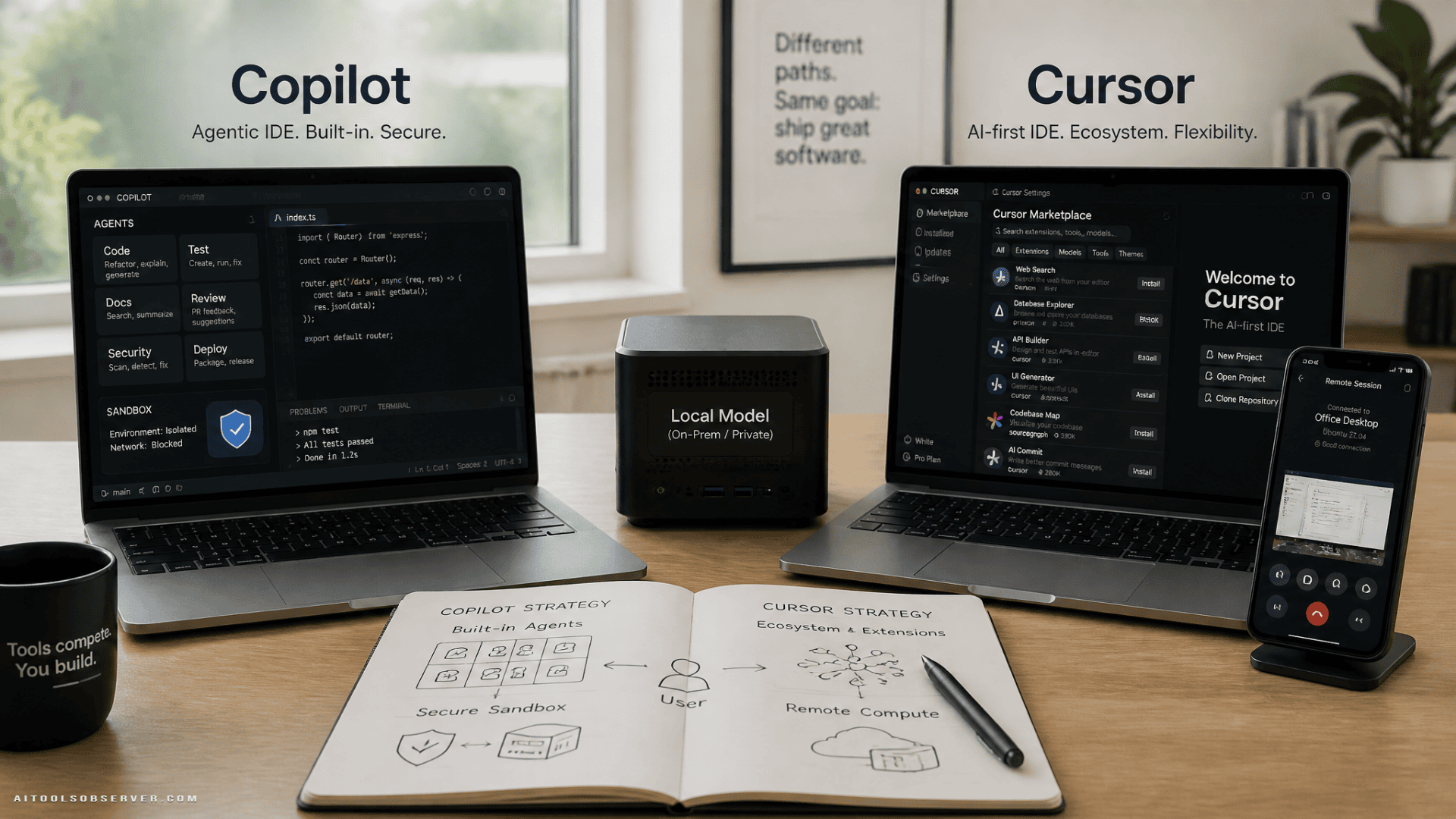
Security teams have spent two years asking what stops an agent from reading a credentials file it shouldn’t touch. GitHub’s answer is local sandboxing, now generally available across Copilot CLI, the Copilot app, and VS Code Agent Host sessions.
The sandbox restricts file access, network calls, and credential exposure by default. GitHub is not charging extra for it. Free sandboxing removes the usual trade-off between agent autonomy and blast radius — and for enterprise buyers comparing security posture, it closes a gap that previously favored more locked-down tiers.
Local Ollama Routing: A Quiet Acknowledgment
Copilot CLI can now discover and select models from a running local Ollama instance via a simple /model command. A team running a local Ollama server can route routine completions to a self-hosted model and reserve cloud calls — and the associated billing — for tasks that genuinely need a frontier model.
It’s a quiet acknowledgment that pure cloud-only agent billing is becoming a competitive liability, not a feature.
Computer-Use Preview: The Big Bet
GitHub introduced computer-use support for Copilot in public preview, available on Copilot CLI and the Copilot app for macOS and Windows. In practice, a Copilot agent can now click through a settings dialog, drive a browser window, or operate another desktop application as part of completing a coding task — not just edit files and run shell commands.
The preview stage is deliberate. GitHub is testing this with a smaller group before any general rollout, which suggests the company is aware of exactly how much trust it’s asking developers to extend.
Grok 4.7: Still the Flagship
Cursor’s current headline model is Grok 4.7, positioned for long-running coding and knowledge-work tasks — the same category Gemini 4 Argon targets inside Copilot. Grok 4.7 has been Cursor’s flagship since mid-August, and the company has kept iterating around it rather than replacing it outright.
Origin App Marketplace: The Integration Play
Cursor’s bigger October move was the Origin App Marketplace, launched October 13. Origin connects a developer’s workflow to more than 20 outside integrations — including Cloudflare and Linear — letting an agent inside Cursor trigger actions well outside the codebase: deploying a Cloudflare Worker, updating a Linear ticket, kicking off a pipeline, all without leaving the editor.
Where Copilot is expanding what an agent can touch on one machine, Cursor is expanding what an agent can reach across an entire toolchain.
Remote Control for Local Agents: The Mobile Push
On October 6, Cursor shipped remote control for local agents. A developer can kick off and monitor an agent running on their own machine from a phone, browser, or another device. Combined with existing support for running agents from terminals, scripts, editors, and browsers, Cursor is building toward genuine “fire and forget” workflows.
This is where the two companies’ approaches diverge most clearly. Copilot’s computer-use preview extends what an agent can touch on one machine. Cursor’s remote control extends how far away a developer can be while that agent works. Adjacent problems, different bets.
The Strategic Split, Side by Side
| Capability | GitHub Copilot | Cursor |
|---|---|---|
| Flagship model | Gemini 4 Argon (GA Oct. 13) | Grok 4.7 |
| Fast/cheap model tier | Claude Haiku 5.5 | No direct equivalent highlighted |
| Desktop/computer-use | Public preview (CLI, macOS, Windows) | Not indicated |
| Local model routing | Ollama via /model in CLI | Not indicated |
| Outside app integrations | Native per-IDE extensions | Origin Marketplace, 20+ integrations |
| Remote/mobile agent control | Copilot app across platforms | Explicit remote control for local agents |
| IDE reach | VS Code, Visual Studio, JetBrains, Xcode, Eclipse | Focused on its editor fork |
The split is legible. Copilot is betting on breadth: more IDEs, more model choices, more security controls, bundled into tools developers already run. Cursor is betting on depth: one editor, fewer models, but tighter integration with outside services and more flexible remote access.
Neither approach is objectively correct. They appeal to different kinds of engineering organizations.
The Gap Between Features and Trust
The feature war makes for exciting changelogs. The underlying usage data tells a more cautious story.
Stack Overflow’s 2025 Developer Survey found 84% of respondents using or planning to use AI tools in their development process — near-universal adoption on paper. Yet only 31% reported currently using AI agents, with another 17% planning to. The agent-specific capabilities both tools are racing to ship are still a minority practice even among AI-tool users.
Trust lags further still. Only 29% of respondents said they trusted the accuracy of AI output, down from the prior year despite usage climbing. That dynamic hasn’t reversed heading into Argon, Haiku 5.5, and computer-use mode all launching in the same month.
Market share inside that cautious user base still favors the incumbent by a wide margin. Stack Overflow’s data put GitHub Copilot at roughly 68% of respondents using out-of-the-box AI assistance, against roughly 18% for Cursor within the AI-enabled category. Copilot’s install-base advantage — baked into GitHub’s ownership of the dominant code-hosting platform — remains the single biggest structural factor in this fight.
A 29% trust rate sitting underneath an 84% usage rate suggests most developers are treating generated code as a draft that still needs a careful human pass. Computer-use previews and desktop-level agent control raise the stakes on that gap considerably. An agent that can only suggest code is easy to double-check. An agent that can click through a desktop application asks for a level of trust the survey data says most developers don’t yet have.
From Autocomplete to Agents to Operating Your Machine
GitHub Copilot launched in 2021 as a line-by-line autocomplete tool. Cursor arrived as a VS Code fork wrapped around chat-based editing. Both spent their first two years competing almost entirely on suggestion quality.
That era ended once agent mode became the default framing — somewhere around 2024 and 2025 — when the question shifted from can it finish my line to can it finish my ticket.
October 2026 marks the next inflection point: from can it finish my ticket to can it operate my machine. Local sandboxing, computer-use previews, and remote agent control are all responses to the same underlying shift — AI agents doing longer, less-supervised work across more of a developer’s environment.
The Useful Takeaway
If your team is already deep in the GitHub ecosystem, values IDE flexibility, and has security requirements that need documented controls, Copilot’s October releases strengthen an already strong case. The two-speed model strategy and free sandboxing are genuinely useful additions, not just marketing.
If your team works in a single editor, cares more about connecting agents to your broader toolchain than about which IDE they run in, and wants to monitor long-running tasks from your phone, Cursor’s October moves are more directly relevant.
The one thing worth tracking regardless of which tool you choose: both companies deprecated or previewed features this month that will affect workflows built on specific models or behaviors. Whatever you automate against either platform, document the model dependency. October 2026 made clear that neither company treats its model roster as permanent.








Comments (0) No comments yet
Want to join this discussion? Login or Register.
No comments yet. Be the first to share your thoughts!