


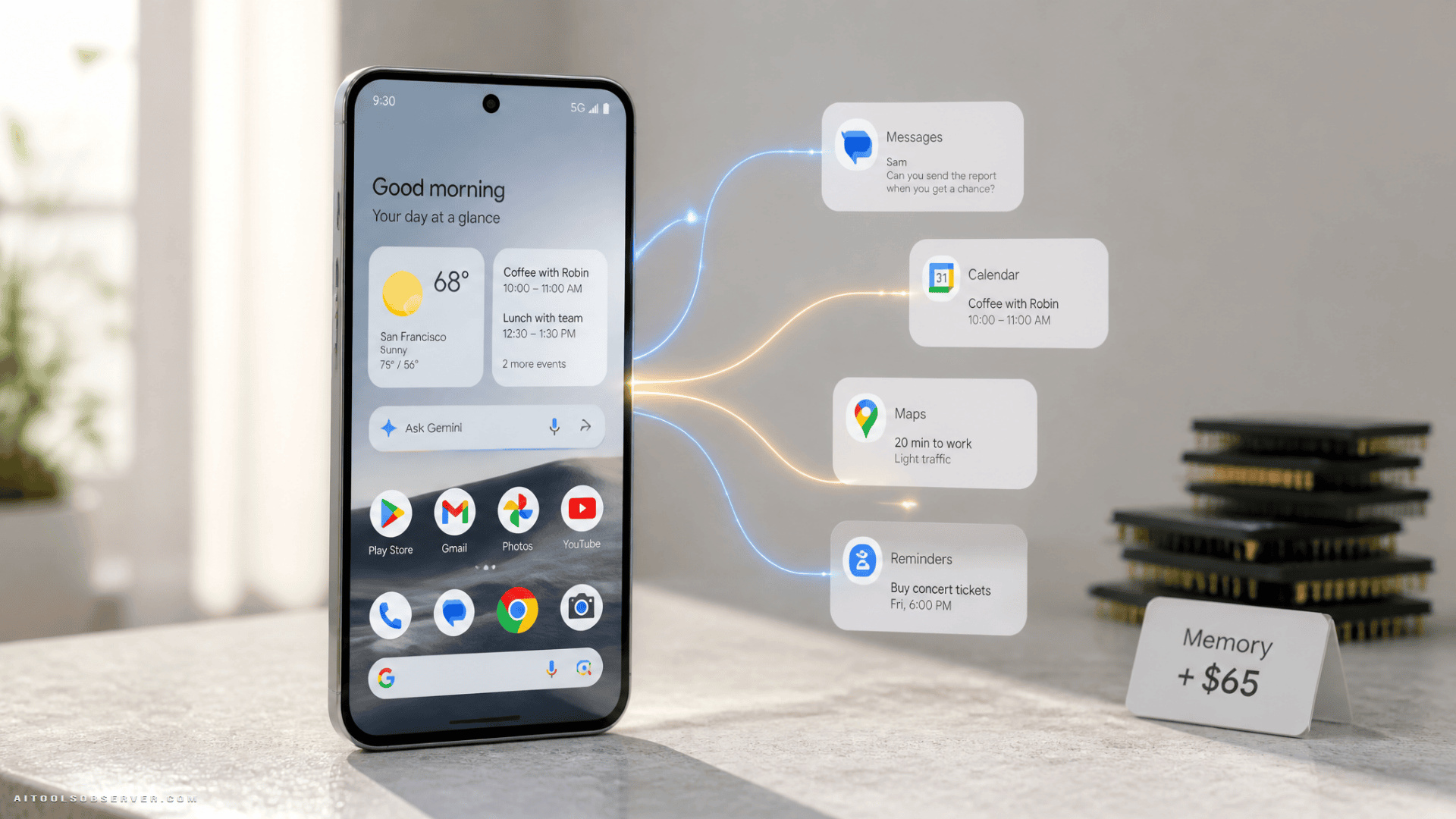
The real story behind the Pixel 11 launch
Based on the launch framing, Google wants Pixel 11 to be the clearest expression of its AI phone strategy so far. The hardware lineup is broad, but the message is simple: Gemini is supposed to help users get things done across the phone, not just answer questions in a chat box.
That is a meaningful shift. Most AI features on phones have felt additive, useful in moments but not central to the experience. Google appears to be aiming for something deeper by embedding Gemini into Android workflows and linking it with services like messages, calendars, and maps.
If that works, the phone becomes less about jumping between apps and more about describing intent.
What Gemini features appear to matter most
The most important part of the Pixel 11 story is not a single flashy feature. It is the combination of context, action, and OS-level presence.
From the available description, Gemini Intelligence is positioned to:
- Understand what a user is doing on the phone
- Pull context from multiple Google services
- Suggest next steps
- Carry out tasks across apps
- Work inside the operating system instead of only inside a standalone assistant
That sounds small on paper, but it changes the user experience in a practical way. Instead of searching manually, copying details between apps, and completing tasks step by step, the assistant is meant to help connect those steps.
A simple example is travel planning. If messages, calendar details, and maps context are connected, the assistant can move from “What are my options?” to “Here are the next actions you may want to take.”
That is where agentic AI becomes more interesting on a smartphone. The value is not in clever output. The value is in reducing friction.
Why Google keeps emphasizing “agentic” AI
Google’s pitch leans heavily on agentic behavior, and for good reason. Smartphone AI only becomes compelling when it can do more than summarize text or generate replies.
People already know how to open apps and search for information. The stronger use case is when the phone helps coordinate tasks that normally require multiple apps and repeated taps.
This is the strategic promise behind agentic Android features:
- Less app switching
- More context-aware suggestions
- Faster task completion
- A stronger reason to stay inside Google’s ecosystem
If Gemini can consistently handle these handoffs well, it gives Google something more durable than a one-off AI demo. It gives Pixel a usage model that feels different.
Pixel 11 vs iPhone is really Gemini vs Siri timing
The Apple angle is what makes this launch more than a Google hardware update. Google is pushing this AI-first smartphone story just ahead of Apple’s next Siri push.
That creates an unusual dynamic. Google appears to have an early opportunity to show what a more integrated AI phone experience looks like on its own hardware, while Apple is expected to bring similar goals to its own ecosystem.
The overlap is obvious: personal context, screen awareness, and actions across apps. But Google is clearly trying to frame Pixel and iPhone as different paths, especially around Android-level integration and Gemini-native features.
In practical terms, Apple should be watching three things.
1. Whether users actually change behavior
AI phone strategy only matters if people use it repeatedly. If Pixel owners start relying on Gemini for coordination tasks, not just novelty prompts, that is the strongest signal that AI is moving up the smartphone value chain.
2. Whether OS-level integration feels smoother than app-based AI
Standalone AI assistants are easy to demo. They are harder to turn into habits. Google’s advantage, if it has one, is making Gemini feel embedded into phone behavior rather than bolted on top.
3. Whether Android-exclusive features create real differentiation
Google is pointing to things like scam detection, voice transcription, and deeper Gemini integration as reasons to choose Pixel or Android. Apple should care if those features feel useful enough to influence buying decisions, not just reviews.
The challenge: AI still is not the top reason people upgrade phones
This is the part that keeps the launch grounded.
Even if AI is gaining importance, it still does not appear to be the main reason most consumers replace a smartphone. That means Google has two jobs at once: prove that Gemini is useful and prove that it is useful enough to drive hardware demand.
Those are very different challenges.
People may like AI features without feeling any urgency to buy a new phone. For Pixel 11, the key question is whether Gemini creates enough everyday convenience to move from “nice to have” to “worth upgrading for.”
That usually happens only when users can immediately understand the payoff:
- Save time
- Reduce repetitive actions
- Make the phone easier to use
- Help complete real-world tasks
If those benefits stay abstract, AI will remain a talking point rather than a purchase trigger.
Google’s bigger bet: Gemini as the main interface
One of the most important signals in this launch is Google’s broader ambition. The company is not treating Gemini as a feature bundle. It is treating it as a possible primary interface across devices.
That is a much bigger claim than “our assistant got better.”
If phones, laptops, and other devices shift toward intent-based interaction, then the winning platform is not just the one with the best model. It is the one that controls the most useful workflows.
For Google, Pixel is a test bed for that future. It can use its own hardware to experiment with how far people are willing to let AI mediate device use.
That makes the Pixel line strategically important even if it is smaller than Apple in overall installed base. It gives Google a live environment to shape AI behavior before competitors fully catch up.
The memory shortage adds real pricing pressure
There is also a less glamorous but very important part of the launch: hardware cost pressure.
The ongoing memory shortage appears to be pushing up costs across consumer electronics, particularly around RAM and flash memory. Google has indicated that this pressure is likely to lead to higher prices.
That changes the launch conversation in a major way. AI phones are arriving at the same moment that the cost of building them is becoming harder to ignore.
This creates a real market tension:
- Google wants consumers to see more value in AI devices
- Consumers may face higher prices at the same time
- AI still is not the primary upgrade driver for most buyers
That is not a small issue. If pricing rises before AI habits are firmly established, companies may struggle to convert interest into sales volume.
For buyers, that means the Pixel 11 decision may come down to a simple question: do the Gemini features save enough time or reduce enough friction to justify the premium?
Who this launch is really for
The Pixel 11 story will likely resonate most with a few groups first.
- Android users who already rely heavily on Google services
- Early adopters interested in AI assistants that do more than chat
- Productivity-focused users who want less app switching
- Buyers comparing Pixel 11 vs iPhone through the lens of AI, not just hardware
For casual users, the value may take longer to land. AI on smartphones still needs strong onboarding and repeatable everyday use cases. Without that, many people will not fully use what they paid for.
What to watch next
This launch matters less for what Google announced and more for what users do after setup.
Watch for signs that Gemini becomes part of normal phone behavior:
- Are people using it across messages, calendar, and maps workflows?
- Does it reduce taps and app switching in a noticeable way?
- Do Android-exclusive AI features become talking points among buyers?
- Can Google justify price increases if hardware costs keep rising?
Those are the metrics that matter more than launch-day excitement.
Bottom line
Pixel 11 makes Google’s AI phone strategy easier to understand. The company wants Gemini to move from assistant to interface, with Android as the layer that makes agentic behavior actually useful.
Apple should pay attention not just to the features, but to the usage pattern Google is trying to build. If Pixel proves that people want AI to coordinate actions across their phones, then the next battle in smartphones will not be about who has AI. It will be about whose AI becomes the default way people get things done.







Comments (0) No comments yet
Want to join this discussion? Login or Register.
No comments yet. Be the first to share your thoughts!