


Why Apple Is Playing Catch-Up Right Now
Siri launched in 2011. For most of its life, it was the most widely used voice assistant on the planet — not because it was the best, but because it came pre-installed on every iPhone.
That distribution advantage masked a deeper problem: Siri never evolved fast enough. While OpenAI shipped ChatGPT and Google relentlessly upgraded Gemini, Apple’s assistant stayed stuck in a loop of misheard commands and shallow responses.
Apple Intelligence, launched in 2024, was supposed to change that. It didn’t. Features were delayed, the rollout was fragmented, and the tools that did ship — emoji generation, on-screen search, speech translation — didn’t move the needle for users who were already using ChatGPT daily.
Gene Munster, cofounder of Deepwater Asset Management, put it plainly: Apple hasn’t done anything that really blows people away.
That’s a damaging assessment for a company that built its entire brand on doing exactly that.
What the New Siri Actually Looks Like

According to Bloomberg, the rebuilt Siri is a meaningful departure from what exists today. Key changes reportedly include:
- Multi-step task handling from a single voice command
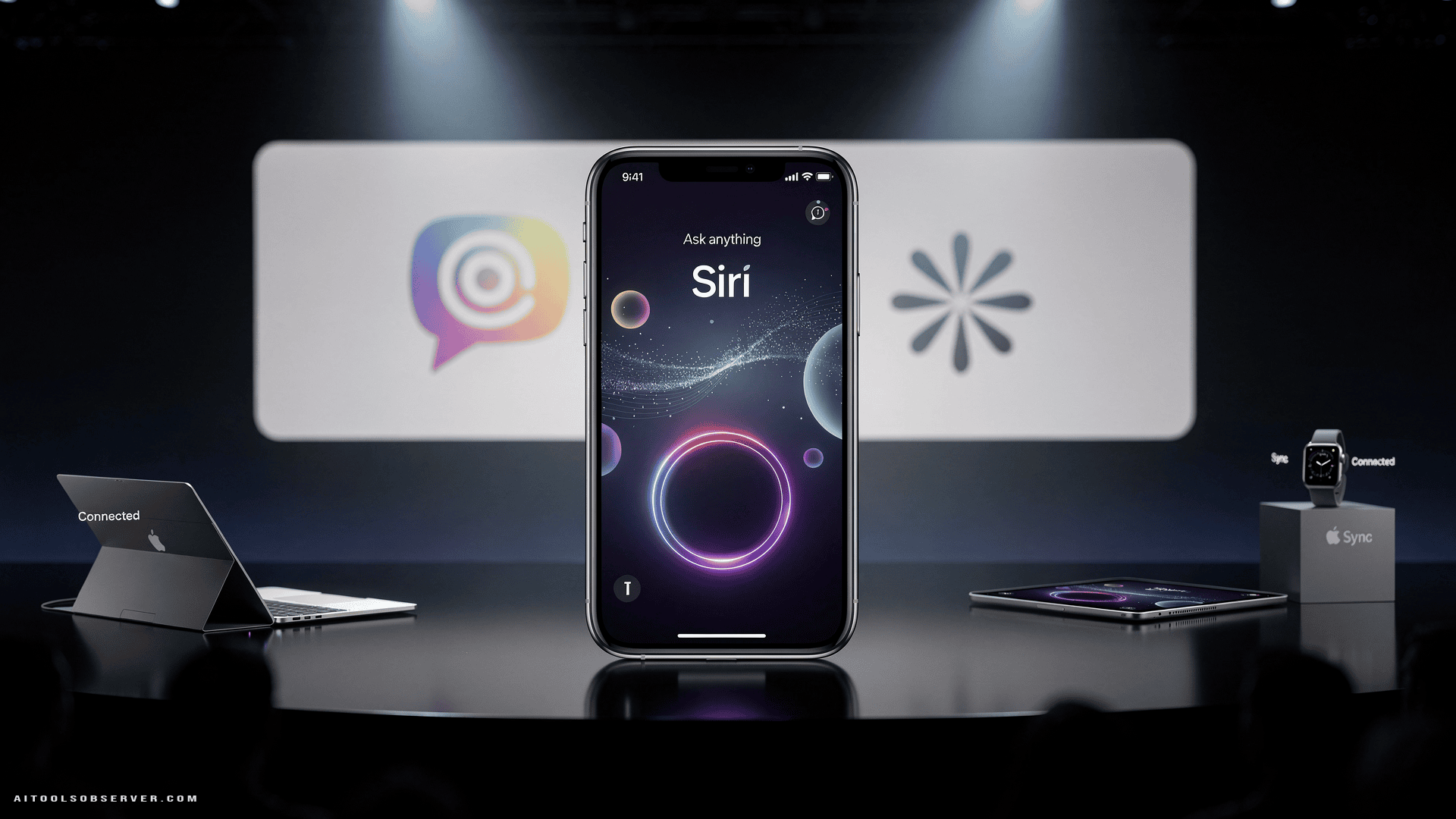
- A dedicated app with a chatbot-style interface — moving Siri closer to how people already use ChatGPT
- Deeper on-device and cloud integration to handle complex, context-aware requests
This is the shift from reactive assistant to proactive agent. Instead of answering one question at a time, the new Siri would be able to string together actions — booking a restaurant, checking your calendar, sending a message — without you having to break the task into pieces.
That’s exactly what Google and OpenAI have been building toward with their AI agent products. Apple is now entering that race directly.
The Google Partnership Changes the Equation

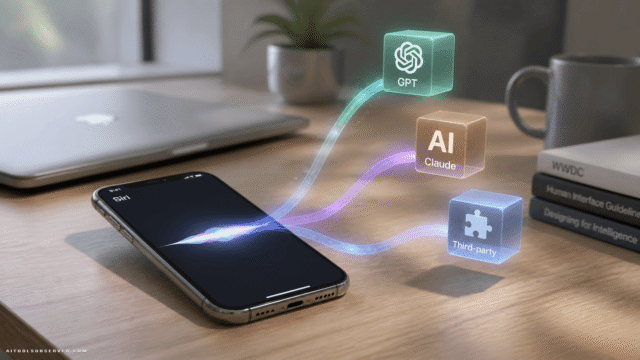
Here’s the detail that matters most for anyone tracking the AI tools ecosystem: Apple is partnering with Google to power the new Siri using Gemini models.
This was announced in January 2026, and it’s a significant strategic move. Apple has historically kept its core technologies in-house. Partnering with Google on AI infrastructure signals that Apple knows it can’t build competitive foundation models fast enough on its own.
Anurag Rana, senior equity analyst at Bloomberg Intelligence, noted that Gemini models have been on a tear lately. Plugging that capability directly into Siri could dramatically accelerate Apple’s AI performance without waiting years for internal model development to catch up.
For the broader AI tools market, this is worth watching. It suggests that even the world’s most valuable company sees model partnerships — not proprietary development — as the fastest path to competitive AI products.
The Distribution Advantage Nobody Talks About Enough
Here’s what separates Apple from every other player in the AI assistant space: it doesn’t need to acquire users. They already exist.
Over 2.5 billion Apple devices are active globally. That’s an installed base no AI startup, and arguably no AI incumbent, can match. When Apple ships a new Siri, it doesn’t need a marketing campaign to reach people — it needs a software update.
But there’s a catch. Rana estimates that more than half of iPhones in use globally — roughly 1 billion devices — don’t support Apple Intelligence because the feature is limited to iPhone 15 Pro and later models. That’s a massive addressable market that’s currently locked out.
As users upgrade their hardware over the next two to three years, Apple’s AI reach will expand automatically. That’s a compounding distribution advantage that ChatGPT and Gemini simply don’t have.
What This Means for the AI Tools Ecosystem
Apple’s WWDC announcement doesn’t just affect iPhone users. It reshapes how the entire AI tools market needs to think about competition and positioning.
For AI assistant and chatbot tools: A genuinely capable Siri with a ChatGPT-style interface will reduce the friction that currently pushes iPhone users toward third-party AI apps. If Siri can handle multi-step tasks natively, casual users may never open a separate AI app at all.
For AI agent platforms: Apple entering the agentic AI space validates the category. It also raises the bar. Agents that live inside the operating system have access to permissions, data, and context that browser-based or app-based agents simply can’t match.
For enterprise and productivity AI tools: Apple’s deep integration with iOS, macOS, and iPadOS means Siri could become a serious workflow tool — not just a consumer novelty. That’s a market currently dominated by Microsoft Copilot and Google Workspace AI.
The Leadership Transition Adds a Layer of Complexity
Tim Cook’s WWDC keynote carries extra weight this year because it may be one of his last major public moments as CEO. John Ternus, currently head of hardware engineering, takes over in September.
That transition matters for AI strategy. Cook built Apple’s current AI roadmap. Ternus will be responsible for executing it — and accelerating it — in a market that moves faster than any Apple product cycle in history.
Wall Street has been asking hard questions about Apple’s AI vision on every earnings call for the past year. The new Siri is partly a product announcement and partly an investor relations moment. Apple needs to show it has a credible long-term AI strategy, not just incremental features.
Munster’s take is cautiously optimistic: Apple has too much at stake to drop the ball.
How to Read This Moment as an AI Adopter
If you’re a founder, marketer, or power user of AI tools, here’s what to take away from Apple’s WWDC move.
Don’t underestimate platform AI. When AI gets embedded at the OS level, it changes user behavior faster than any standalone app can. Watch how quickly Siri adoption shifts if the new version actually delivers on multi-step tasks.
The Gemini partnership is a trend, not an exception. More companies will license foundation model capabilities rather than build from scratch. This accelerates the commoditization of base AI performance and shifts competition toward UX, integration depth, and trust.
Hardware upgrade cycles are AI adoption cycles. As Apple’s 1 billion unsupported iPhones gradually upgrade to newer models, AI feature penetration will grow without any additional marketing spend. That’s a slow-moving but unstoppable wave.
The Bottom Line
Apple isn’t winning the AI race today. But it has the distribution, the hardware ecosystem, and now a credible model partnership to make a serious run at it.
The new Siri isn’t just a product refresh — it’s Apple’s clearest statement yet that it intends to compete directly with ChatGPT and Gemini for the daily AI habits of over a billion people.
Whether it delivers on that promise will depend on execution. But the direction is no longer ambiguous.
Observe this one closely. The AI assistant market is about to get a lot more crowded at the top.









Comments (0) No comments yet
Want to join this discussion? Login or Register.
No comments yet. Be the first to share your thoughts!