


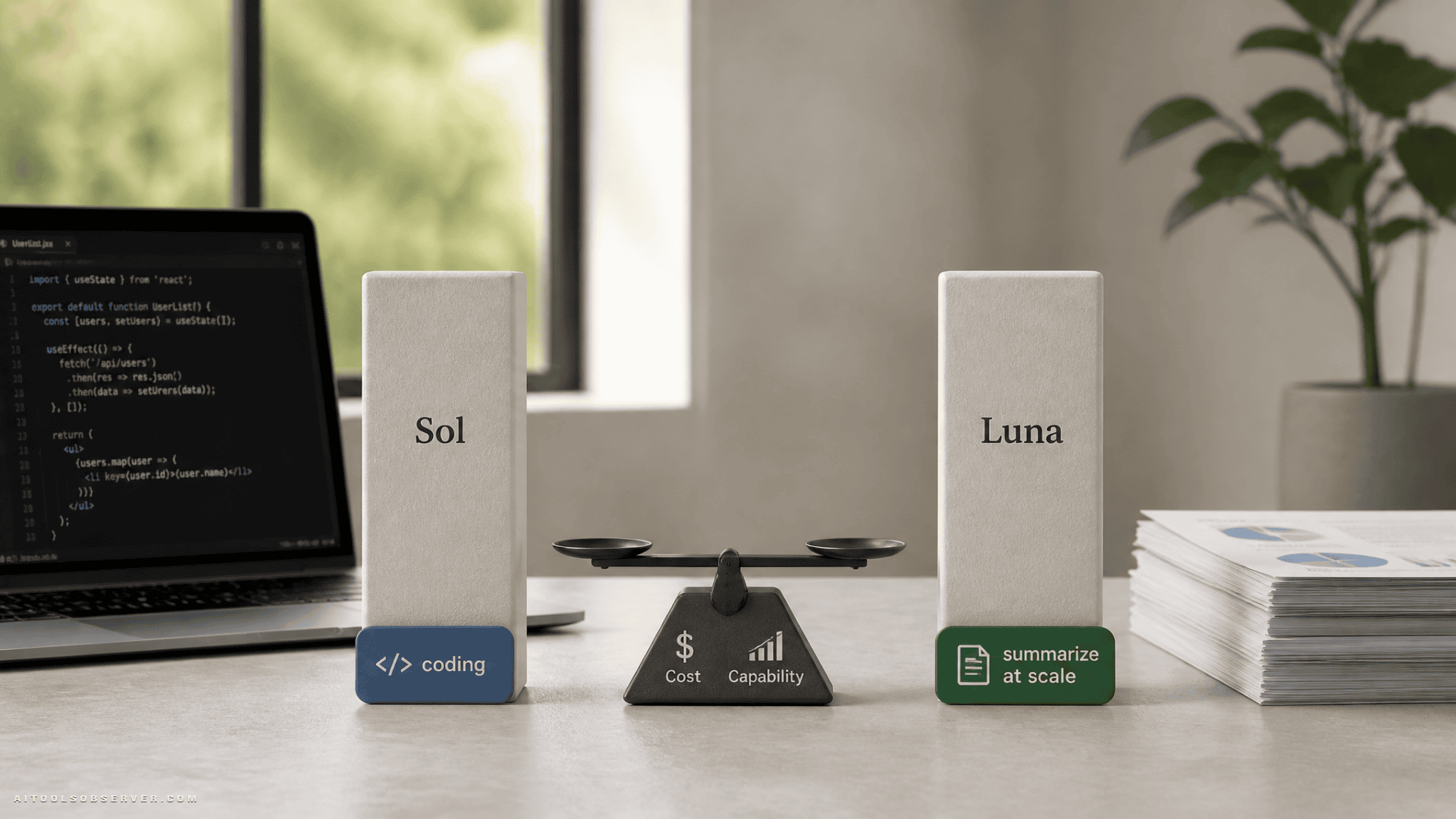
What changed
OpenAI added two lower-cost options to its GPT-6 lineup: Sol and Luna.
Based on the available description, the split is pretty practical:
- GPT-6 Sol is positioned for more complex work, especially coding
- GPT-6 Luna is aimed at high-volume tasks like information extraction and document summarization
The bigger headline is pricing. OpenAI says these models cut API costs by about 50% compared with GPT-5.6 promotional pricing.
That matters because model choice is no longer just about quality. It is about whether your AI bill survives contact with production.
Sol vs Luna in plain English
If the names sound celestial, the buying logic is very earthly.
GPT-6 Sol: for harder tasks
Sol appears to sit below Astra in the broader family, but above the “cheap and cheerful” category. The framing suggests it is built for workloads where mistakes are expensive and reasoning quality matters more, such as coding.
Think of Sol as the model you reach for when the task has structure, edge cases, and consequences.
Good fit:
- code generation and refactoring
- technical workflows
- more complex business logic
- tasks where “close enough” is not actually close enough
GPT-6 Luna: for scale
Luna is aimed at repetition-heavy work: extracting fields, summarizing documents, and other high-volume flows.
That usually means operations where throughput matters more than deep reasoning. You may not need the smartest model in the room if the job is reading invoices, pulling key details from support tickets, or producing short summaries all day.
Good fit:
- document summarization
- information extraction
- pipeline automation
- bulk processing where unit cost matters a lot
In other words: Sol for tougher thinking, Luna for bigger queues.
Why this matters more than the naming
This launch is really about cost discipline.
A lot of companies adopted powerful models first and worried about spend later. Now “later” has arrived. Teams want AI that works, but they also want predictable margins, cleaner unit economics, and fewer internal meetings that begin with “why did tokens cost this much?”
Lower-cost model tiers help with that in three ways:
- they make AI features easier to ship at scale
- they let teams route tasks more intelligently
- they narrow the gap between frontier labs and cheaper alternatives
That last point is key.
The pressure from Anthropic and open-weight rivals
OpenAI did not make this move in a vacuum. Anthropic also announced a less costly model update, describing it as more token-efficient and cheaper to run than its earlier equivalent.
The broader pattern is hard to miss: major labs are trying to make advanced model use less expensive at the same time that open-weight competitors keep applying pressure from below.
That creates a squeeze:
- premium labs need to protect quality
- buyers need lower costs
- open competitors keep raising the question of whether closed models are worth the premium
So this is not just a product launch. It is price competition with better branding.
What founders and product teams should do with this
If you are building with AI, the main takeaway is not “switch everything.” It is “stop treating all tasks the same.”
A better stack usually looks like this:
- use stronger models only where task complexity justifies the spend
- use cheaper models for repeatable, high-volume operations
- separate customer-facing quality-sensitive tasks from back-office processing
A simple example:
- use Sol for generating or checking code in a developer workflow
- use Luna for summarizing uploaded files or extracting fields from documents
- reserve more premium models for the rare workflows that truly need them
That kind of routing is becoming less of an optimization trick and more of a baseline product skill.
A small but important signal
There is also a market signal here: model vendors increasingly have to compete on efficiency, not just capability.
That includes:
- lower API prices
- better token efficiency
- clearer workload-specific positioning
The old sales pitch was “our model is smarter.” The newer one is closer to “our model is smart enough, faster to justify, and less painful to run.”
That is a much more useful conversation for actual buyers.
The real question to ask before choosing
Do not start with the model name. Start with the task.
Ask:
- Does this workflow need deep reasoning or mostly consistent processing?
- Is quality failure expensive, or just mildly annoying?
- Will this run occasionally or at massive volume?
- Is latency or cost the bigger constraint?
If the work is complex and code-heavy, Sol is the obvious model to watch. If the work is repetitive and high-volume, Luna looks like the more sensible candidate.
The practical takeaway: the cheaper model is no longer the compromise option by default. Sometimes it is just the correct one.












Comments (0) No comments yet
Want to join this discussion? Login or Register.
No comments yet. Be the first to share your thoughts!