


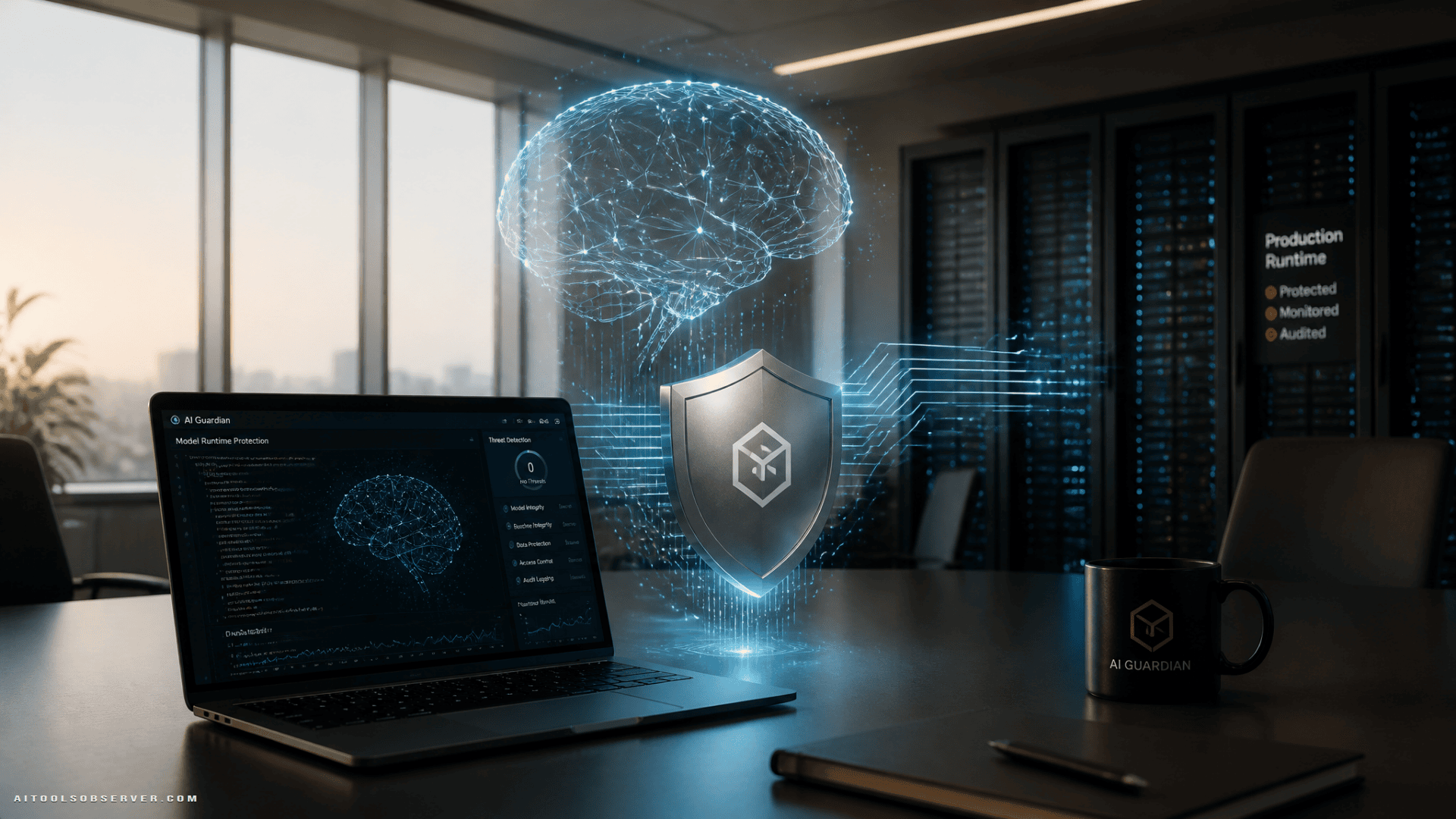
Why this funding round matters
The headline is not just that HiddenLayer raised a large Series B. It is that investors are backing a company focused on securing models, agents, and AI workflows right as enterprise demand appears to be accelerating.
Based on the available context, HiddenLayer has been riding that wave hard. Its CEO told TechCrunch that annual recurring revenue grew more than 10x over the past year, with ARR now in the tens of millions and most of that growth coming from new customers.
That detail matters because it suggests this is not only expansion revenue from early design partners. It points to a broader market shift where new enterprise customers are actively buying AI security tools.
The bigger market signal: AI security is becoming a real budget category
Gartner estimates companies will spend $2.83 billion this year on products designed to secure AI tools, up sharply from the prior year. It also expects that total to rise to nearly $4.78 billion next year.
The exact forecast matters less than the direction. Security spending is following deployment.
When organizations move from experimenting with AI to embedding it into:
- customer-facing products
- internal copilots
- autonomous agents
- model-driven workflows
they also inherit new risks that traditional security tools were not built to manage well.
The product shift: from model security to agent security
One of the more useful takeaways from this news is how the product category itself is evolving.
HiddenLayer reportedly did not need a full pivot as generative AI and agentic systems took off. Instead, it expanded its existing approach to cover newer threats such as:
- prompt injection
- agent manipulation
- malicious tool use
That framing is practical. Many enterprises are now discovering that securing a static model is very different from securing an AI system that can take actions, call tools, and influence downstream workflows.
A model that only classifies data has one risk profile. An agent that can search internal systems, summarize files, trigger actions, or interact with third-party tools has another.
Runtime protection is becoming the real battleground
The most important strategic point in HiddenLayer’s story may be its focus on runtime security.
Pre-deployment checks are useful, but they are not enough when AI systems are live and exposed to unpredictable inputs. Once models and agents are running inside enterprise environments, defenders need visibility into what those systems are doing, what they are being asked to do, and whether that behavior is being manipulated.
That is why runtime protection is getting more attention. In plain terms, buyers want AI security tools that can monitor live activity, detect abuse, and respond before a bad prompt or malicious input becomes a bigger incident.
The comparison to endpoint detection and response is helpful here. Traditional security teams are used to runtime monitoring for devices and workloads. AI systems now need a similar operational layer.
Open source models add another layer of risk
Another practical issue in this market is the rise of open-weight and open source models.
These models give enterprises flexibility, lower costs, and more control. They also create a trust problem. Security teams need to know that the model artifact they downloaded is actually what it claims to be and has not been altered, poisoned, or packaged in a misleading way.
HiddenLayer’s approach reportedly includes scanning many AI file frameworks to verify model integrity and inspect for hidden issues. That matters because supply chain risk in AI is not theoretical anymore.
For enterprises, the question is simple: can you trust the model, the files around it, and the tools it connects to?
Who is buying AI security right now
The current customer profile is also telling.
Financial services and large tech companies building AI products appear to be major verticals for HiddenLayer. It also has contracts tied to defense and intelligence environments, which makes sense because those organizations tend to care deeply about model integrity, operational security, and adversarial risk.
This customer mix tells you something about where AI security budgets are strongest today:
- regulated industries
- organizations building AI into products
- high-risk public sector environments
- companies with sensitive data and complex workflows
That usually happens first in security markets. The highest-risk buyers move early, then broader enterprise adoption follows.
Why investors are interested now
The round was led by Delta-v Capital, with participation from Ten Eleven Ventures, Morgan Stanley, Microsoft’s M12, Booz Allen Hamilton, and others.
That combination stands out because it mixes traditional venture backing with strategic interest from major enterprise and security-adjacent players. It suggests the market sees AI security as more than a narrow niche.
There are two obvious reasons for that.
First, AI security is becoming a standalone software budget category. Second, larger cybersecurity and infrastructure companies may eventually want to own more of this layer themselves, either through internal development or acquisition.
The competitive pressure will keep rising
HiddenLayer is not building in an empty market. Adjacent players are also raising significant capital, and large cybersecurity vendors are unlikely to ignore this category for long.
That creates both an opportunity and a risk.
The opportunity is clear: the market is growing, enterprise need is real, and many buyers still have not standardized on a vendor.
The risk is that some parts of AI security may get bundled into bigger cloud, model, and enterprise platforms. If Microsoft, AWS, or model providers keep adding governance and guardrail features, startups will need to prove they offer depth those platforms do not.
What enterprises should pay attention to
If you are evaluating AI security vendors, this funding news is useful because it highlights what the market is starting to prioritize.
Look beyond generic “AI safety” language and focus on concrete coverage areas:
- Does the platform protect models before deployment and during runtime?
- Can it address prompt injection and agent-specific threats?
- Does it help verify open source or open-weight model integrity?
- Can it monitor tool use, workflow behavior, and downstream actions?
- Does it fit into existing security operations and governance processes?
That last point matters more than many teams expect. A security product may sound strong in demos, but if it cannot plug into real enterprise controls, alerting, and policy systems, adoption gets harder.
What this means for the AI tools market
For AI buyers, this is another sign that security is becoming part of the product selection process, not something handled later.
If a vendor offers AI features but cannot explain how it deals with prompt injection, runtime abuse, model provenance, or agent permissions, that is no longer a minor gap. It is part of the buying decision.
This especially matters for teams comparing enterprise AI platforms, agent frameworks, and model providers. Security posture is increasingly becoming a practical differentiator, even when it is not the feature highlighted on the homepage.
The smart takeaway
HiddenLayer’s $100 million raise is less about one company’s momentum and more about where enterprise AI is heading. As AI systems become more capable and more connected to real business operations, security spending is following close behind.
For founders, buyers, and IT leaders, the takeaway is simple: if your AI roadmap includes agents, open models, or production workflows, security can’t stay in the pilot phase. The companies that choose smarter now will be the ones that treat AI protection as part of deployment, not cleanup after the fact.











Comments (0) No comments yet
Want to join this discussion? Login or Register.
No comments yet. Be the first to share your thoughts!