


From “Should We?” to “How Far?”

Brian Grazer, co-founder of Imagine Entertainment, now opens every new project with a conversation — not with a writer, but with Anthropic’s Claude. He uses it to rough out a story outline before a human screenwriter ever touches the material. What used to take a year now takes a week.
But Grazer is clear about the ceiling: the writer stays. Always.
That framing — AI as accelerant, not replacement — is where most of Hollywood’s serious players have landed. Amazon MGM, Lionsgate, Netflix, and Disney have all made significant AI investments. The conversation at UCLA’s Entertainment Symposium in June 2026 wasn’t about adoption. It was about authorization, scope, and payment.
Ron Howard put the long-term arbiter plainly: audiences. He expects AI-generated content to eventually settle into its own subgenre, with viewer behavior setting the real limits — not contracts, not executives.
That’s a useful long-term frame. But right now, the limits are being set in negotiating rooms, not theaters.
Studios Are Setting Their Own Rules — and That’s a Problem
For generative AI companies working directly with studios, the governance landscape is fragmented by design. Jamie Byrne, president of Promise, described a pattern where each studio or production company arrives with its own usage guidelines — specifying which AI models can be used, what protections apply, and how far the technology can go.
“It comes down to a risk appetite,” Byrne said.
That’s a revealing phrase. It means there’s no industry-wide standard. A production at one studio might use AI freely for background generation and synthetic extras. Another might prohibit it entirely for anything touching named talent. The rules are client-defined, not sector-defined.
Byrne also framed adoption as a competitive survival issue: studios that don’t lean into new tools tend to fall behind when technology shifts. That pressure accelerates adoption — and compresses the time available to build proper consent frameworks around it.
The risk isn’t just legal. It’s reputational. Talent who discover their likeness was used without clear authorization don’t just file grievances — they go public.
Consent Is the New Currency

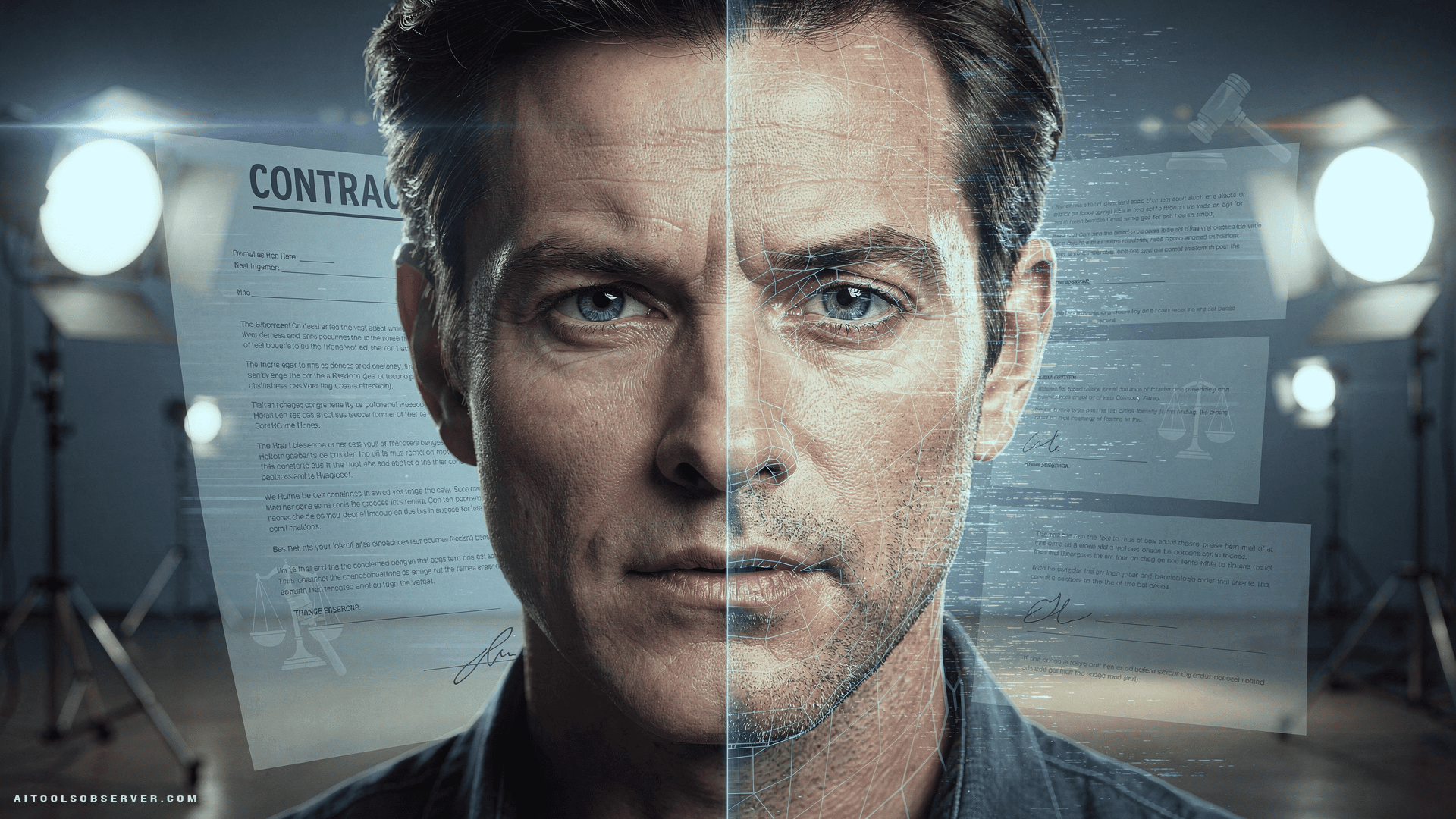
The sharpest battles in Hollywood’s AI transition aren’t about efficiency or budget. They’re about consent — specifically, who gave it, when, and for what.
SAG-AFTRA’s most recent contract draws a hard line between two categories:
- Authorized digital replicas — AI-generated likenesses created with a performer’s explicit consent
- Synthetic creations — fully AI-generated performers with no real-world counterpart
The emergence of synthetic performers like Tilly Norwood made this distinction urgent. When a studio can generate a convincing performer from scratch — or reconstruct a real one without their knowledge — the consent question stops being theoretical.
The union’s framework is a start. But contracts only protect members, and enforcement requires knowing when a violation has occurred. In a world where AI can generate a face in seconds, detection is its own challenge.
CAA’s Vault: Turning Likeness Into a Controlled Asset
Creative Artists Agency saw this coming. In recent years, CAA began digitally scanning clients into what it calls the CAA Vault — a structured archive of each client’s image, likeness, and voice. The key feature isn’t the scan. It’s the control layer on top of it.
Clients retain complete authority over how their digital replica is used. No studio gets access without explicit permission. No deal gets done without the talent’s sign-off.
Tammy Brandt, CAA’s deputy general counsel, confirmed that likeness deals are becoming more common — and more complex. The industry hasn’t fully cracked the monetization model yet, but the infrastructure is being built now, ahead of demand.
That’s smart positioning. When the market for licensed digital replicas matures — and it will — CAA’s clients will have a structured asset ready to license, rather than scrambling to assert rights after the fact.
What This Means for the Broader Market
The Vault model signals something important for the AI tools ecosystem: likeness management is becoming a product category. Agencies, studios, and eventually individual creators will need tools that can:
- Authenticate and archive digital identity
- Track where a likeness has been used
- Enforce licensing terms across AI-generated content
- Distribute payments when replicas generate revenue
This is an emerging infrastructure layer — and it’s largely unbuilt outside of a few major agencies.
The Monetization Gap Is Real
Here’s the honest state of play: Hollywood knows digital replicas have value. It doesn’t yet know how to price them, distribute revenue from them, or build sustainable deal structures around them.
Brandt put it directly — there’s “trial and error” involved. Studios are experimenting. Agencies are negotiating. Unions are enforcing what they can. But the financial models for compensating talent when their AI likeness appears in a production are still being invented.
Compare this to music royalties, which took decades to standardize. AI likeness rights are at an earlier, messier stage — with faster-moving technology and higher stakes.
The studios that figure out a workable, talent-friendly monetization model first will have a significant competitive advantage. Talent will gravitate toward partners who offer clear terms over those who offer ambiguity.
What Founders and AI Tool Builders Should Watch
If you’re building in the AI tools space — or advising companies that are — Hollywood’s likeness wars are a leading indicator, not an edge case.
The patterns emerging here will spread:
Consent infrastructure will become a compliance requirement. Any AI tool that generates, modifies, or reproduces human likenesses will face increasing pressure to demonstrate consent verification. Build for it now.
Fragmented governance creates market opportunity. The fact that every studio sets its own AI rules is unsustainable at scale. Tools that help production companies standardize consent workflows, track usage, and manage licensing will find ready buyers.
Unions and agencies are building the standards. SAG-AFTRA and CAA aren’t waiting for legislation. They’re creating frameworks through contracts and proprietary systems. The tools that align with those frameworks will win adoption faster than those that don’t.
Synthetic performers are a category, not a novelty. As AI-generated talent becomes more sophisticated, the market for managing, licensing, and compensating digital replicas will grow into a significant revenue stream — for agencies, for platforms, and potentially for the performers themselves.
The Bottom Line
Hollywood’s AI adoption is real, accelerating, and largely irreversible. But the industry is learning — sometimes painfully — that efficiency gains mean nothing if the consent and compensation frameworks aren’t in place to support them.
The studios moving fastest aren’t necessarily winning. The ones building durable frameworks around talent rights, likeness control, and transparent monetization are positioning themselves for the longer game.
Your face has always had value in Hollywood. Generative AI just made that value quantifiable, replicable, and — if the right structures exist — licensable at scale.
The question isn’t whether AI will use human likenesses. It’s whether the humans those likenesses belong to will have any say in what happens next.








Comments (0) No comments yet
Want to join this discussion? Login or Register.
No comments yet. Be the first to share your thoughts!