


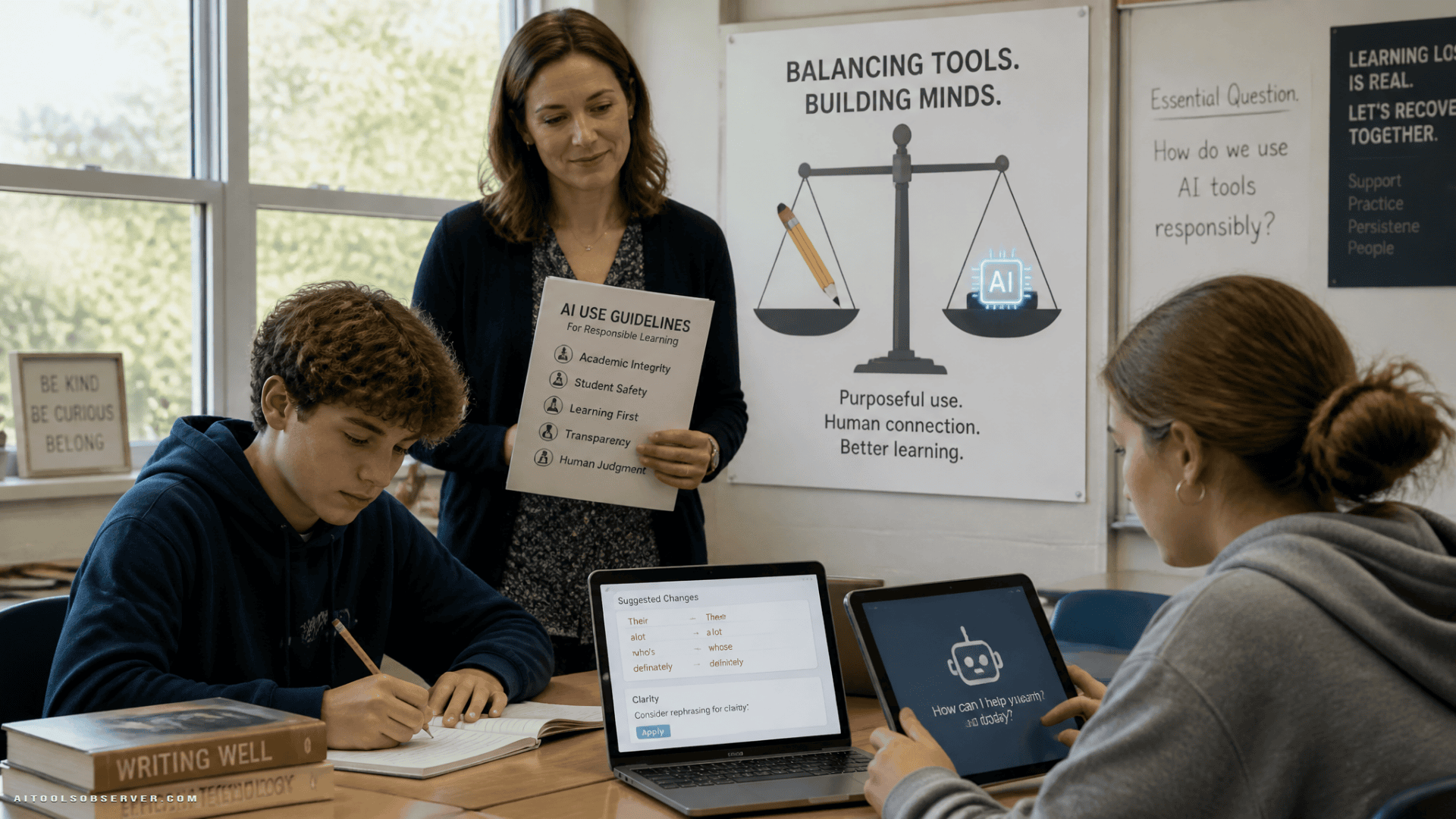
AI Is Already in Nebraska Classrooms — With or Without a Policy
Omaha Public Schools uses a fluency tool called Amira for independent reading practice. The University of Nebraska-Lincoln has an approved list of AI tools for faculty, including ALEKS, a learning platform used in chemistry courses. Teachers are using ChatGPT to build test questions. Students are using it to write essays.
The adoption is happening fast. National data suggests 83% of teachers used ChatGPT or another generative AI tool in the 2023–24 school year, up from 51% the year before. Among college students, that number climbs to around 90%.
Nebraska isn’t an outlier. It’s a snapshot of what’s happening everywhere.
The Learning Loss Question Is Real
One of the sharpest concerns raised by Nebraska educators isn’t about cheating — it’s about what students stop learning when AI does the thinking for them.
A sixth-grade teacher in the story noticed students who relied on Grammarly stopped capitalizing the beginning of sentences. They stopped capitalizing the word “I.” The tool had been correcting those errors so automatically that students never internalized the rule.
This is the quiet version of learning loss. It doesn’t show up on a test. It shows up two years later when a student can’t write a coherent paragraph without autocomplete.
The risk isn’t just that students use AI to cheat. It’s that they use it correctly — and still don’t learn.
Teachers Are Drawing Their Own Lines
Without clear district-wide or statewide policy, individual teachers are setting their own expectations. Some are doing it thoughtfully.
Jordan Martin, a business teacher at Wilber-Clatonia Public Schools, uses AI to generate wrong answers for multiple-choice tests — a legitimate, low-stakes use case. But he also raises a harder question: when a teacher uses AI to grade student essays without reviewing them, has an ethical line been crossed?
His answer is yes. And he models that boundary explicitly for students.
Other teachers are going further in the opposite direction. One sixth-grade teacher plans to go fully tech-free this year — handwritten essays, physical textbooks, Ticonderoga pencils as incentives. Her reasoning isn’t nostalgia. It’s that writing by hand forces the brain to engage in a way that typing into a text box doesn’t.
Both approaches reflect the same underlying concern: AI makes it easy to go through the motions without actually learning anything.
Students Are Skeptical Too — But for Different Reasons
Not all resistance to AI in classrooms is coming from teachers or parents.
A fashion design student at Metropolitan Community College in Omaha described generative AI as “horrendous” — not because it’s inaccurate, but because it removes the act of creation from creative work. When a classmate used ChatGPT to generate an entire fashion collection for a final project and presented it without apology, that student saw it as a fundamental misunderstanding of what the assignment was for.
A wildlife management student at UNL raised a different concern: AI tools are being deployed without adequate training for instructors on how to use them humanely. He described a chemistry course where ALEKS put him in a 15-minute timeout after three wrong answers — a rigid, inflexible response that ignored his real-world constraints as a student with a job, a family, and religious obligations.
His critique wasn’t anti-AI. It was pro-accountability.
“UNL needs to be, not just buying these tools, but also actually taking the time to teach its instructors how to, not just use them, but use them empathetically and humanize the process.”
That’s a reasonable standard. And it’s one most institutions aren’t meeting yet.
The Safety and Ethics Gap
Parents are broadly comfortable with teenagers using AI to search for information. But comfort drops sharply when the use case shifts — only about 18% of parents are okay with their child getting emotional support or advice from an AI chatbot.
That gap matters. AI tools in schools aren’t just being used for math homework. Students are interacting with chatbots in ways that can drift into personal territory quickly. Teachers like Kimberly Ramirez are already having conversations with their own teenagers about where those conversations can go wrong.
The policy infrastructure hasn’t caught up. Nebraska schools are operating with a patchwork of individual teacher rules, some district-level guidance, and limited statewide frameworks. That’s not a sustainable position as these tools become more embedded.
What’s Actually Missing
The core problem isn’t that AI is being used in Nebraska classrooms. It’s that the conditions for using it well don’t yet exist at scale.
Three things stand out as genuine gaps:
- Teacher training — not just on how to use AI tools, but on how to evaluate them critically and set appropriate boundaries for students
- Student AI literacy — helping students understand what AI can and can’t do, including its tendency to sound confident while being wrong
- Institutional accountability — schools and universities need to vet tools before deploying them, not just add them to an approved list
One teacher put it plainly: AI in schools should work like a driver’s license. You need proper training before you’re allowed behind the wheel.
The Practical Takeaway
If you’re a teacher, administrator, or parent trying to make sense of AI in K–12 or higher education, the Nebraska story offers a useful frame: the tools are already in the room. The question is whether the adults in charge have thought carefully about what they’re optimizing for.
AI can help a struggling reader get targeted feedback. It can help a new teacher build curriculum faster. It can also quietly erode the skills students are supposed to be building — if no one is paying attention.
The schools getting this right aren’t the ones banning AI or embracing it wholesale. They’re the ones treating it like any other powerful tool: with clear expectations, honest tradeoffs, and enough training to use it without causing harm.














Comments (0) No comments yet
Want to join this discussion? Login or Register.
No comments yet. Be the first to share your thoughts!