



Why this matters more than another AI headline
Plenty of companies say AI helps developers “move faster.” Fine. But faster than what, where, and by how much?
Grab’s signal stands out because it ties AI use directly to the product pipeline. If teams really are shipping 3x faster, the payoff is practical:
- features get released sooner
- experiments reach users earlier
- bugs and fixes loop back faster
- engineering time gets reused instead of repeatedly burned
For a company running multiple product lines across ride-hailing, delivery, and fintech, speed is not vanity. It is operating leverage with sneakers on.
What Grab appears to have changed
Grab did not publicly detail every tool or workflow behind the gain. But the description points to a familiar pattern in modern engineering teams: AI moved from sidekick to system.
That usually means AI is not just helping one developer write one function. It is supporting the full development loop.
The likely workflow shift
Instead of using AI only as a chat window for coding help, high-velocity teams typically weave it into steps like:
- drafting code and refactors
- writing and expanding tests
- generating internal documentation
- reviewing pull requests
- triaging bugs and issue backlogs
- suggesting patterns based on existing code
- reducing repetitive setup and glue work
This is where the real time savings usually show up. Not in magical code generation. In killing the tedious parts that slow shipping down.
The use case: AI inside engineering workflows
This is the core use case founders and product leaders should pay attention to: using AI to compress the software delivery cycle, not merely “assist developers.”
That distinction matters.
A coding assistant in isolation may save minutes. A workflow-level AI setup can save days by reducing handoffs, waiting, context switching, and review drag. The description around Grab suggests the company is closer to the second model.
In plain English: less fiddling, more shipping.
Where AI tools actually help in product delivery
If you want to copy the logic, start with the bottlenecks that consume engineering energy but do not create much strategic value.
1. Code scaffolding and first drafts
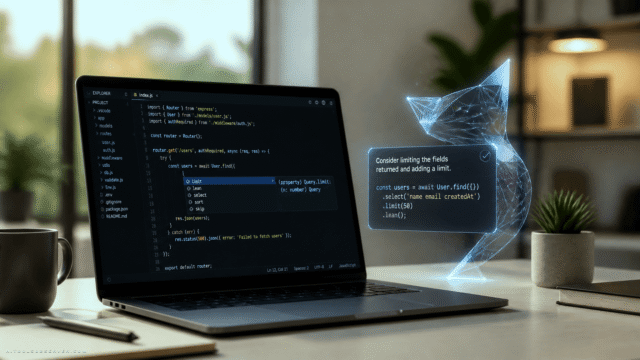
Tools like GitHub Copilot and Cursor are commonly used to generate boilerplate, autocomplete patterns, and speed up routine implementation work.
Good for:
- repetitive code
- common service patterns
- quick iteration on small features
Tradeoff:
- faster output can still create cleanup work if teams accept weak code too casually
2. Test generation
This is one of the most practical AI wins in software teams. Tests are essential, often delayed, and rarely anyone’s favorite Friday activity.
Good for:
- unit test drafting
- edge case suggestions
- improving test coverage on existing code
Tradeoff:
- generated tests can look useful while missing business logic risks
3. Code review support
AI can help summarize pull requests, flag suspicious changes, and suggest review points before another human even shows up.
Good for:
- reducing reviewer load
- catching obvious issues early
- making larger PRs easier to parse
Tradeoff:
- AI review is helpful triage, not final judgment
4. Documentation and internal knowledge
Engineering speed often dies in the swamp of “where is that thing documented?”
Good for:
- generating docs from code changes
- summarizing service behavior
- helping new team members understand internal systems
Tradeoff:
- stale or auto-generated docs still need owners
5. Bug triage and maintenance
AI is increasingly useful for sorting noisy issue queues, clustering similar bugs, and proposing likely causes.
Good for:
- reducing manual triage
- highlighting duplicate issues
- giving support and engineering a shared starting point
Tradeoff:
- misclassification is cheap until it delays the wrong fix
What tools fit this kind of workflow
Grab did not name a specific stack in the available context. But the tools most often associated with this use case usually fall into a few buckets.
AI coding assistants
Examples often discussed in this category include:
- GitHub Copilot
- Cursor
These are useful for individual developer acceleration, especially during coding and refactoring.
AI review and testing layers
Teams often add separate tools or internal systems for:
- automated code review suggestions
- test creation
- CI/CD assistance
- issue triage
- documentation generation
This is where “developer productivity” becomes “engineering workflow productivity.” Small difference in wording. Big difference in results.
Why the ROI story lands
Here is the part budget owners care about: faster shipping can affect the business without requiring a dramatic headcount increase.
If the same team can release more product work in less time, several second-order effects kick in:
- product teams can test ideas faster
- fixes hit production sooner
- engineering managers spend less time on coordination debt
- roadmap planning gets less hostage to cycle time
That helps explain why Grab’s stronger full-year outlook and its AI ROI productivity message matter together. The interesting signal is not just that AI saved time. It is that the company appears to view those gains as operationally meaningful.
That is the difference between “cool demo” and “approved budget.”
What other companies can learn from this
The lesson is not “go buy whatever coding assistant is trending this week.”
The lesson is to find where product delivery actually stalls, then apply AI there first.
A practical rollout path
If you are a founder, CTO, or product lead, the playbook is fairly simple:
- Map the software delivery workflow.
- Identify the slow, repetitive, low-leverage steps.
- Add AI where the work is frequent and standardized.
- Measure cycle time, review time, test time, and release cadence.
- Expand only after you see a workflow-level gain.
Do not start with a broad “AI strategy.” Start with a queue that annoys your developers.
The trap to avoid
Many teams adopt AI in a very human way: they buy tools, celebrate briefly, and keep the same process.
That usually produces modest gains. Helpful, sure. Not 3x-helpful.
The bigger lift comes when teams redesign how work flows:
- smaller review loops
- more automated test creation
- better internal documentation hygiene
- AI-assisted triage before humans get pulled in
- fewer manual handoffs between coding, QA, and release
In other words, AI works best when it changes the path, not just the pace.
A smarter benchmark for AI adoption
Grab’s reported outcome gives companies a more useful benchmark than vague satisfaction scores.
Instead of asking:
“Do developers like the tool?”
Ask:
- Did cycle time drop?
- Did release frequency increase?
- Did review bottlenecks shrink?
- Did the same team ship more useful work?
That is the scoreboard that matters.
The takeaway
If you want AI ROI that survives contact with finance, attach it to a workflow with a clock on it.
Grab’s example suggests the strongest AI wins in software are not about replacing engineers. They are about removing drag across code, testing, review, and release so products get out the door much faster.
The practical move: pick one ugly part of your engineering pipeline, automate the grunt work, and measure shipping speed before and after. If the number moves, keep going. If it does not, you bought a smart toy.








Comments (0) No comments yet
Want to join this discussion? Login or Register.
No comments yet. Be the first to share your thoughts!