


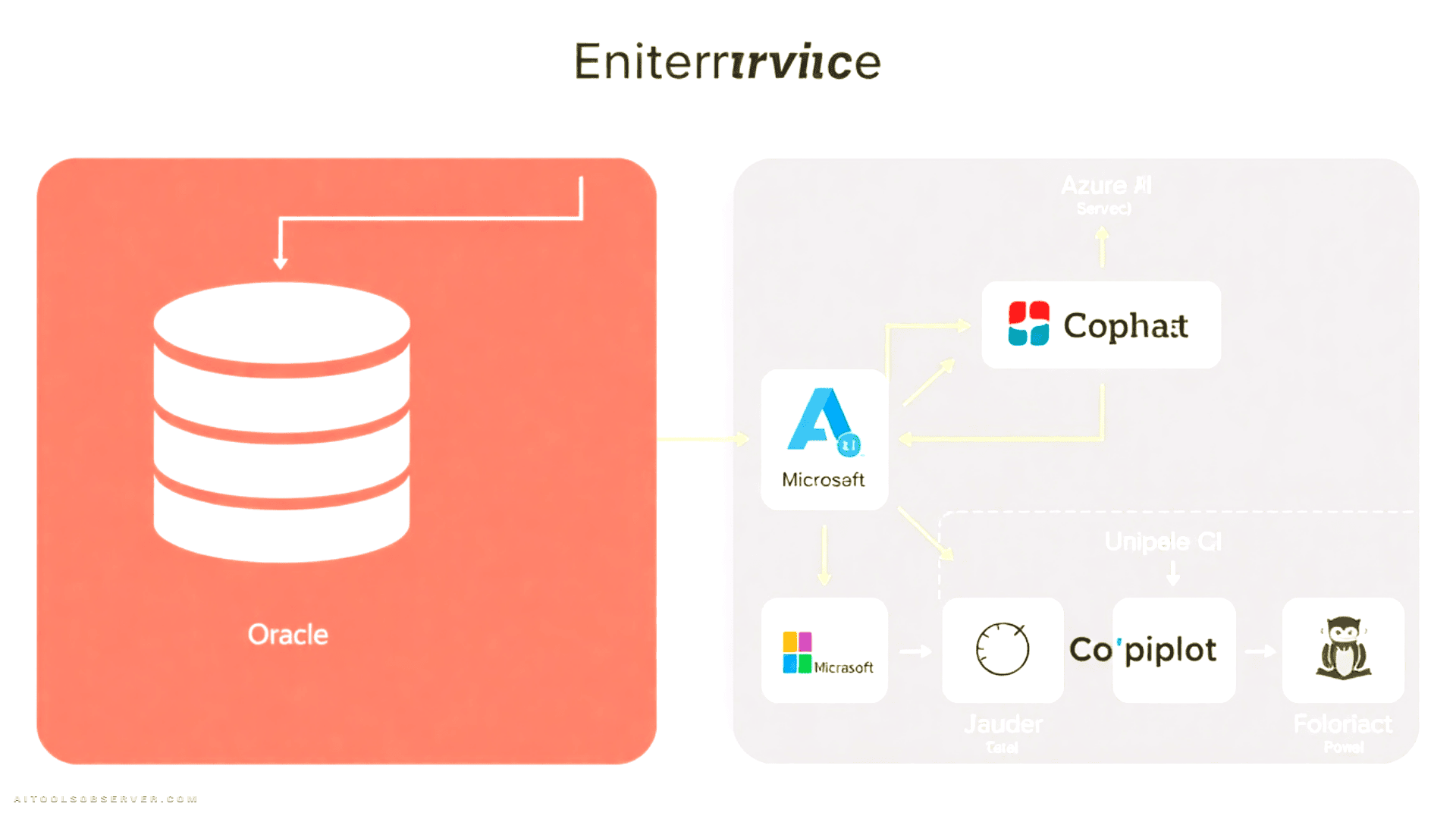
The Core Problem: Fragmented Data, Fragmented AI

Building AI-native enterprise applications requires more than connecting a language model to a data source. It demands real-time access to operational data, semantic retrieval, agentic orchestration, and enterprise-grade governance — all within the same architecture.
Most organizations struggle because these components live in separate systems. Vector infrastructure sits apart from relational databases. AI pipelines operate outside identity and authorization controls. Developer tools require manual navigation across terminals, cloud consoles, and dashboards. The result is slower development cycles, duplicated infrastructure, and governance gaps that enterprise teams cannot afford.
How Oracle AI Database@Azure Closes the Gap

Oracle AI Database@Azure brings Oracle’s managed database services into Azure-native workflows, allowing developers to build directly against enterprise data using familiar tools. The integration spans three critical layers: data access, semantic retrieval, and agentic orchestration.
Managed MCP Servers: Connecting GitHub Copilot to Oracle Data

Oracle’s OCI Managed MCP Service introduces HTTPS-based Model Context Protocol servers integrated with OCI identity, governed toolsets, validated SQL reports, and centralized administration. This is a meaningful architectural shift.
A developer working in VS Code can now ask GitHub Copilot a database question, invoke Oracle MCP tools, generate and execute SQL through Oracle SQLcl, and receive results directly inside the IDE — without leaving the development environment. The workflow eliminates the context switching that typically fragments developer attention and slows iteration.
Beyond individual developers, this same MCP infrastructure enables AI agents, Microsoft Foundry, and Microsoft IQ to interact with Oracle databases using enterprise identity and authorization controls. Governance is not bolted on afterward; it is embedded in the connection layer itself.
Oracle AI Vector Search: RAG Without Separate Infrastructure

Retrieval Augmented Generation (RAG) applications require storing and querying embeddings efficiently. The conventional approach introduces a separate vector database, which creates synchronization overhead and additional infrastructure to manage.
Oracle AI Vector Search removes this requirement by allowing developers to store embeddings directly inside Oracle AI Database, run similarity search using SQL, and combine vector search with relational enterprise data in a single query. This means GitHub Copilot, Azure OpenAI, Microsoft IQ, and AI agents can be grounded with current enterprise data without maintaining parallel data stores or managing synchronization pipelines.
The practical benefit is significant: fewer moving parts, reduced latency, and a single governance boundary covering both structured and vector data.
Microsoft IQ: Orchestrating Enterprise Intelligence at Scale

Microsoft IQ represents the orchestration layer that connects these components into coherent enterprise workflows. Rather than operating AI services in isolation, IQ enables assistants, agents, analytics tools, and databases to share context and governance across business-critical operations.
For developers, this means AI-assisted tooling and IQ orchestration can connect application workflows directly to trusted Oracle enterprise data — with shared context maintained across the entire pipeline. The architecture moves organizations from disconnected AI services toward enterprise-scale intelligence where every component operates with awareness of the others.
Getting Started: Oracle Autonomous AI Database Serverless

For teams looking for a low-friction entry point, Oracle Autonomous AI Database Serverless provides a practical starting path. Developers can provision databases in minutes through APIs or automation workflows and immediately begin building with Oracle AI Vector Search, JSON APIs, semantic retrieval, and Azure AI services.
The serverless model reduces operational overhead while preserving access to the full capability stack — making it suitable for teams prototyping AI applications as well as those modernizing existing Oracle workloads on Azure.
What This Architecture Enables in Practice

The combination of Oracle AI Database@Azure, Managed MCP Servers, AI Vector Search, and Microsoft IQ supports several concrete enterprise AI patterns:
Semantic retrieval over enterprise data — Query operational databases using natural language through GitHub Copilot or AI agents, with results grounded in current relational data rather than static snapshots.
RAG applications without vector database sprawl — Build retrieval-augmented generation workflows using SQL-native vector search, eliminating the synchronization complexity of separate vector infrastructure.
Agentic workflows with governed data access — Deploy AI agents that interact with Oracle databases through managed MCP infrastructure, with enterprise identity and authorization controls enforced at the connection layer.
Developer productivity inside familiar tooling — Keep development workflows inside VS Code and GitHub Copilot, with Oracle data accessible through natural language without switching environments.
The Broader Signal

The integration between Oracle and Microsoft reflects a deliberate convergence of two enterprise technology ecosystems. Oracle brings decades of database reliability, governance depth, and operational data management. Microsoft brings AI platform capabilities, developer tooling, and orchestration infrastructure through Azure and GitHub.
Together, they address a gap that neither ecosystem fully closes alone: the path from trusted enterprise data to intelligent, AI-native applications that meet the governance and reliability standards enterprise organizations require.
For teams building on Azure with Oracle workloads — or evaluating how to connect existing enterprise data to modern AI workflows — this architecture deserves close attention. The components are production-ready, the integration is native rather than bridged, and the governance model is designed for enterprise requirements from the ground up.
The question for most organizations is no longer whether to build AI-native applications. It is whether the data infrastructure underneath those applications is ready to support them. Oracle AI Database@Azure makes a compelling case that it is.









Comments (0) No comments yet
Want to join this discussion? Login or Register.
No comments yet. Be the first to share your thoughts!