



The Productivity Trap
AI has genuinely improved output. Content gets drafted faster. Reports get summarized. Repetitive tasks get automated. But raw output was rarely the limiting factor in enterprise workflows to begin with.
The slow part was never writing the brief. It was the ten stakeholders who needed to sign off on it.
When AI accelerates the front end of a workflow—creation, drafting, synthesis—without changing what happens downstream, the result is a faster input feeding a congested pipeline. More work enters the system. The same bottlenecks process it. Delivery slows.
This is the AI speed paradox: productivity increases while organizational velocity stagnates or declines.
Where the Friction Actually Lives
The real delays in enterprise workflows tend to cluster in predictable places:
- Approval chains involving multiple stakeholders across functions
- Cross-functional handoffs between marketing, legal, compliance, IT, and procurement
- Vendor and tool fragmentation requiring manual coordination across disconnected systems
- Governance gaps where compliance and brand review happen late, triggering rework
Each of these friction points existed before AI. AI doesn’t eliminate them. In many cases, by increasing the volume of work entering the pipeline, it makes them worse.
The Orchestration Gap
Most enterprise AI deployments are collections of point solutions. A tool for content generation here. A tool for data analysis there. An agent experiment running in one business unit. None of it connected.
Without a coordination layer that links these tools to each other—and to the humans, governance rules, and systems that govern how work actually moves—organizations remain stuck in pilot mode. They accumulate AI capabilities without accumulating AI speed.
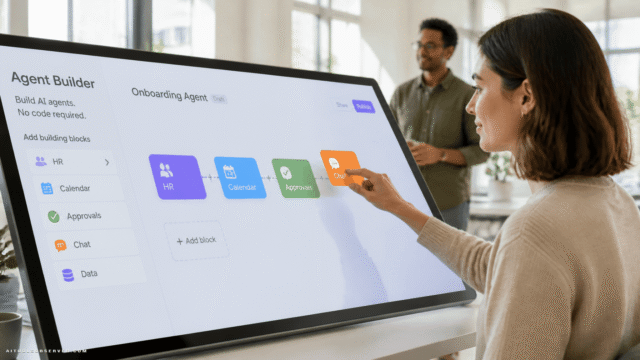
Orchestration is the missing layer. It connects brand intelligence, compliance rules, approval logic, and enterprise systems into a unified workflow rather than a sequence of manual handoffs between disconnected tools.
When governance is embedded directly into the workflow—rather than bolted on at the end—review cycles shorten. Compliance doesn’t compete with speed. It becomes part of the process.
The Operating Model Is the Real Variable
The organizations moving fastest on AI aren’t necessarily using the most advanced models. They’re making faster organizational decisions. Marketing, IT, legal, procurement, and executive leadership are aligned around a shared operating model—one that defines how work flows, who approves what, and where AI fits into each stage.
This distinction matters. The question enterprises are increasingly asking isn’t “Can we build AI?” It’s “How do we operationalize AI across the enterprise?” Those are fundamentally different problems, and only the second one addresses the bottleneck.
Automating a broken workflow doesn’t fix it. It accelerates the dysfunction.
What Workflow Redesign Actually Requires
Sustainable gains require reengineering workflows before automating them. That means:
- Mapping the full workflow end to end, not just the creation stage
- Identifying where decisions happen and who owns them
- Embedding governance earlier so compliance review doesn’t become a late-stage blocker
- Reducing stakeholder sprawl by clarifying which approvals are genuinely necessary
This is harder than deploying another AI tool. It requires organizational alignment, executive sponsorship, and a willingness to redesign processes that have accumulated years of informal workarounds.
Measuring the Right Things
One reason the bottleneck persists is that organizations are measuring the wrong outcomes. Content volume and generation speed are easy to track. Organizational velocity is harder to quantify but far more meaningful.
The more useful metrics are:
- Time from brief to launch, end to end
- Number of approval cycles per campaign
- Rework rate due to late-stage compliance or brand issues
- Stakeholder count per deliverable
If AI investments aren’t moving these numbers, the workflow architecture hasn’t changed—only the speed of one stage within it.
The Practical Takeaway
More AI tools won’t solve a workflow problem. The organizations that pull ahead will be the ones that treat AI deployment as an operating model challenge, not a technology procurement decision.
That means aligning leadership early, redesigning workflows before automating them, embedding governance into the process rather than appending it, and measuring outcomes that reflect actual business speed—not content throughput.
The bottleneck isn’t the AI. It’s everything the AI feeds into.











Comments (0) No comments yet
Want to join this discussion? Login or Register.
No comments yet. Be the first to share your thoughts!