


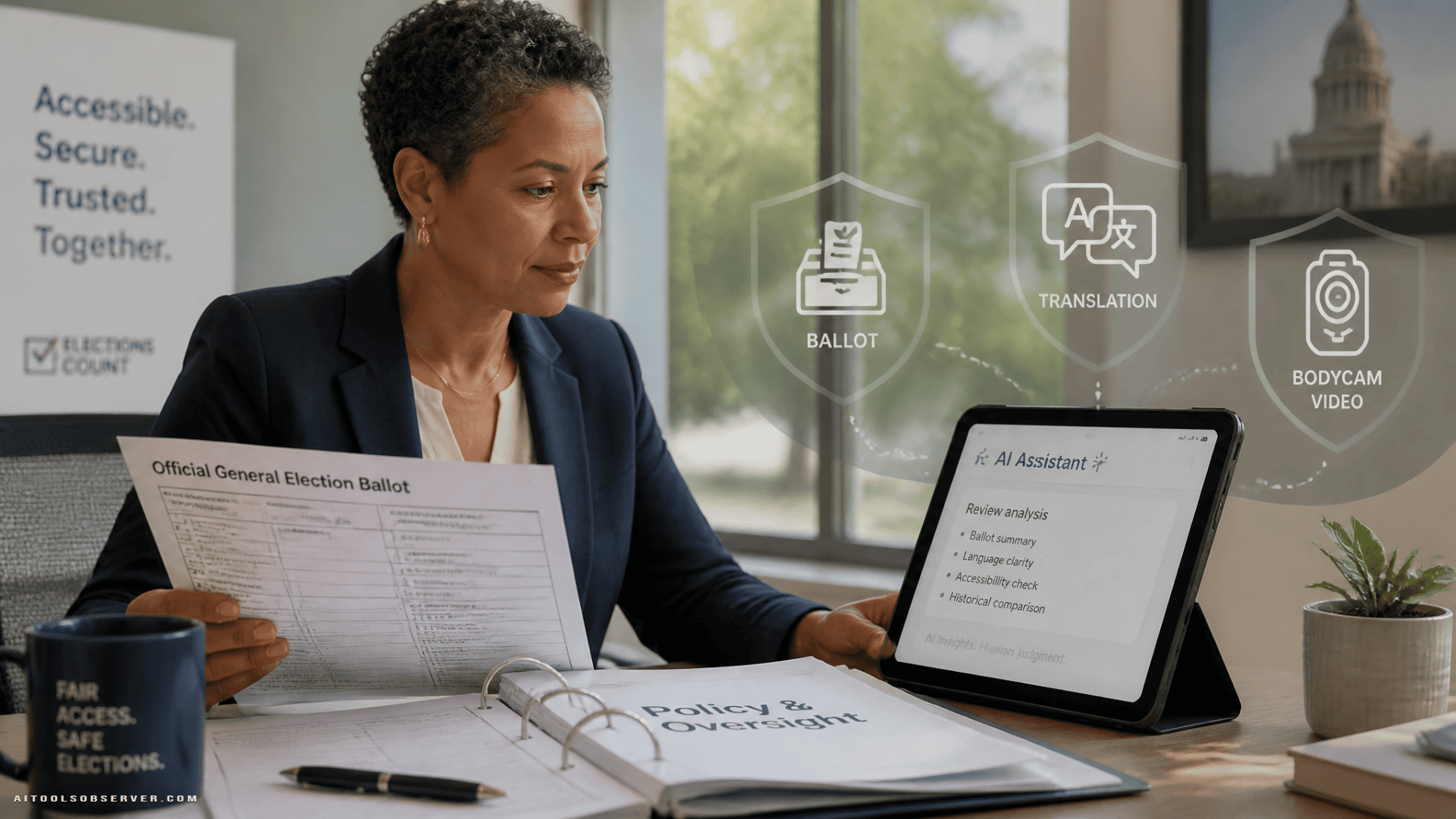
The responsible AI playbook public institutions are following
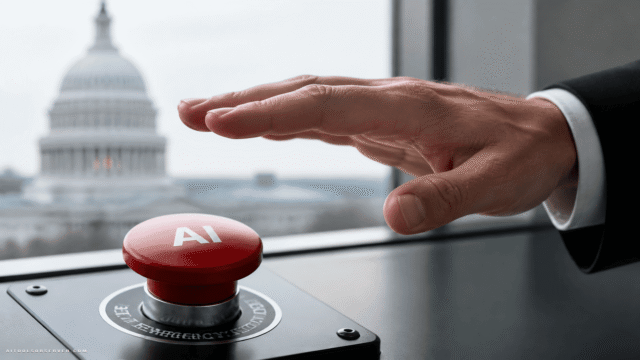
The strongest examples in government do not treat AI as a replacement for public judgment. They treat it as a support layer.
In practice, that usually means three rules:
- Keep AI away from final legal or democratic decisions
- Use it for time-consuming administrative work first
- Build training, policy, and review processes before broad rollout
That approach matters because public agencies operate under stricter expectations than private teams. If an AI system creates confusion in marketing copy, that is one problem. If it creates confusion in ballot language, eligibility guidance, or police review, the consequences are much bigger. This is also why AI Governance for Agencies matters before tools outpace controls.
How AI is being used in election administration
Election offices are a clear example of responsible scoping. The available context suggests that officials are not using AI to tabulate ballots or certify outcomes. Those functions are treated as off limits.
Instead, the practical use cases sit in what many teams would call back-office workflows.
Low-risk election AI tasks that make sense
Election administrators are exploring AI for tasks such as:
- Proofing ballot language and election materials
- Drafting or refining public communication
- Translating content into multiple languages
- Creating training modules for poll workers
- Supporting staff education around phishing, misinformation, and deepfakes
These are useful because they solve real bottlenecks. Election offices often work under tight deadlines, limited staffing, and intense scrutiny. Even small reductions in manual work can help teams communicate more clearly and catch errors earlier.
That said, the line matters. Using AI to help draft a voter information post is very different from using AI in counting, adjudication, or certification. Responsible election AI depends on keeping those boundaries explicit.
Why AI in elections needs guardrails from day one
Elections are one of the easiest places for public trust to break down. That is why AI adoption here is less about capability and more about governance.
The tension is obvious. AI can help officials communicate accurate information faster, but the same broader technology landscape also makes it easier to generate misleading content, impersonations, and deepfake-style election misinformation.
A responsible elections workflow usually includes:
- Human review of all public-facing materials
- Strict limits on where AI can and cannot be used
- Staff training on phishing, manipulated media, and fraud risks
- Documentation of process changes
- Public communication that explains how the office is using technology
This last point is easy to overlook. In a politically sensitive environment, people do not just want good outcomes. They want to understand the process behind them.
AI literacy is becoming core public-service training
One of the clearest signals from the education side of public service is that AI literacy is no longer optional. Not because every public servant needs to become technical, but because they need enough understanding to use these tools well and reject them when necessary.
That means teaching more than prompting.
What public servants actually need to learn
A useful AI training model for government appears to have three layers:
- Foundational public-service principles
Staff need grounding in administration, ethics, public accountability, and decision-making. - AI guardrails
They need to understand bias, privacy, governance, security, transparency, and error risk. - Applied use
Only after that should teams use AI to support practical workflows and complex public-sector challenges.
This is a better model than the common split between blind enthusiasm and blanket fear. It gives staff a framework for deciding where AI fits, where it does not, and how to evaluate output critically.
That is especially important in public institutions, where using AI “thoughtfully” often matters more than using it widely.
AI in police body-camera review: expanding oversight capacity
Another practical government use case is body-camera footage review. The operational problem is simple: agencies can collect huge volumes of video and audio, but reviewing it manually at scale is difficult.
Without assistance, only a small portion of footage may ever get reviewed. That creates an oversight gap. Important interactions may never be examined unless they are tied to force incidents, arrests, complaints, or public records requests.
AI can help by identifying patterns, surfacing specific interactions, and expanding how much footage departments are able to review. In other words, it can increase visibility where raw volume previously made visibility unrealistic.
The tradeoff in body-camera AI
This is not a zero-risk use case.
The potential upside is stronger review capacity, more consistent auditing, and better insight into officer-public interactions. The risk is overreliance on automated interpretation, poor contextual understanding, or staff mistrust if deployment is rushed.
That is why rollout matters as much as the software itself. Agencies need:
- Clear communication before deployment
- Defined review goals
- Human oversight of flagged content
- Policies on retention, privacy, and access
- Internal trust-building around how the system will be used
When public institutions introduce AI into oversight functions, process design is part of the use case.
What “responsible AI” looks like in government operations
Responsible AI in government is less about one perfect tool and more about workflow design.
A healthy public-sector AI program usually has these characteristics:
1. Narrow scope
Start with a specific task, not a vague mandate to “use AI.” Translation, drafting, proofing, search, summarization, and training support are easier to govern than broad decision automation.
2. Human accountability
AI can assist, but a person remains responsible for output, review, approval, and consequences.
3. Policy before scale
Agencies need basic rules around approved use, restricted use, privacy, records, and auditing before staff adoption spreads informally.
4. Training for real risks
Staff need to know not just how to use AI, but how it fails. Hallucinations, bias, prompt leakage, misinformation, and overconfidence are operational issues, not abstract ones.
These points connect directly to governance and decision quality.
5. Public-interest framing
The strongest use cases tie directly to public values: efficiency, effectiveness, and equity. If a proposed AI workflow does not improve one of those in a clear way, it may not be worth deploying.
Government AI tools are most valuable when they stay boring
There is a useful lesson here for any team evaluating civic technology.
The best public-sector AI implementations often sound ordinary:
- clearer election materials
- better staff training
- easier service discovery
- broader footage review
- stronger internal policy and literacy
That is a feature, not a weakness. In government, “boring” usually means lower risk, easier oversight, and more defensible public value.
This is also where many AI tool buyers get distracted. They search for highly advanced systems when what actually works is often a structured combination of language tools, search layers, workflow assistants, translation support, and governance practices.
How public institutions can evaluate an AI use case before adoption
If you are comparing AI tools or assessing an internal government workflow, these questions are a smart starting point:
- Does this use case support staff, or replace a sensitive judgment call?
- Can the output be reviewed by a human before action is taken?
- Would a mistake here create confusion, inequity, or legal risk?
- Is the task administrative, informational, or decisional?
- Do staff understand both the value and the failure modes?
- Can the institution explain this use to the public in plain language?
If the answers are unclear, the use case probably needs tighter scope.
The real opportunity: better public service, not more automation
Public institutions are not adopting AI responsibly by trying to automate democracy or hand off complex human decisions. They are doing it by targeting practical bottlenecks, teaching staff how to use the tools well, and setting limits where trust is non-negotiable.
That is the useful takeaway for founders, public-sector teams, and anyone comparing government AI tools: the strongest implementations are not the ones that promise the most. They are the ones that make public service more accurate, accessible, and accountable without losing human judgment.









Comments (0) No comments yet
Want to join this discussion? Login or Register.
No comments yet. Be the first to share your thoughts!