



The Problem: Blood Sugar Management Gets Complicated in Hospitals

Diabetes management at home relies on routine. Consistent diet, activity, and medication schedules give patients and their care teams a stable baseline to work from.
In the hospital, that baseline disappears. Patients may eat little or nothing. Illness changes how the body processes glucose. Standard insulin protocols, built around population averages, can’t always keep up with individual variation.
The result? Dangerous swings in blood sugar — both hyperglycemia (too high) and hypoglycemia (too low). Either condition can cause seizures, kidney failure, or death if left untreated.
This isn’t just a clinical problem. It’s now a regulatory one too.
Why CMS Is Raising the Stakes
As of 2025, U.S. hospitals must report more detailed data to the Centers for Medicare and Medicaid Services (CMS) on how well they manage diabetic patients’ blood sugar. Poor performance doesn’t just reflect badly — it can trigger financial penalties.
That regulatory pressure is pushing health systems to move beyond reactive, standardized care and toward smarter, more proactive monitoring tools.
Temple Health saw this coming and started preparing early.
The Tool: EndoTool Sub-Q

Temple began piloting EndoTool Sub-Q in 2022 and completed its full rollout across all hospitals in 2025. The tool represents a meaningful shift in how insulin dosing decisions get made.
From Sliding Scales to Predictive Modeling

Traditional insulin dosing uses a sliding scale — a standardized chart that maps current blood sugar levels to a recommended insulin dose. It’s simple, but it’s also blunt. It treats every patient the same.
EndoTool takes a different approach. It analyzes individual patient characteristics — height, weight, metabolism, kidney function — to generate customized insulin dosing recommendations. The more data it collects on a specific patient, the more accurate its predictions become.
As Samantha Messick, a neuroscience ICU nurse at Temple, put it: “It takes insulin dosing from reactive to proactive.”
That’s not a small distinction. Reactive care waits for a problem to appear. Proactive care anticipates it before it becomes dangerous.
The Outcome: More Than Twofold Reduction in Hypoglycemia

Temple administrators report a more than twofold reduction in the number of patients developing hypoglycemia since implementing the tool. That’s a significant safety improvement — and a meaningful signal for other health systems watching closely.
How the Workflow Actually Works

Understanding the practical workflow matters here, especially for teams evaluating similar tools.
- Patient data is collected — height, weight, metabolic markers, kidney function, and current blood sugar levels feed into the system.
- EndoTool generates a dosing recommendation — tailored to that specific patient’s profile, not a population average.
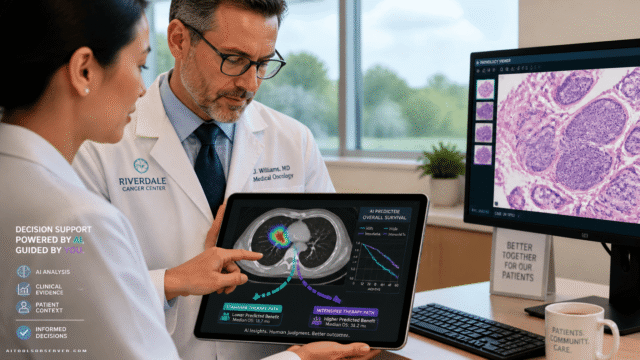
- A doctor or nurse reviews and approves the dose — the AI doesn’t act autonomously. Human sign-off is required before any insulin is administered.
- The system learns over time — the longer it monitors a patient, the more responsive its recommendations become.
That human approval step is deliberate. Temple’s Chief Medical Information Officer Ben Slovis has been clear that the goal is augmentation, not replacement. “Our goal is not to chase shiny objects, but to approach these tools with thoughtful evaluation,” he said.
The Human Element: A Real Tension Worth Acknowledging

Not everyone in the building is fully at ease with AI-assisted care — and that’s a legitimate conversation to have.
Maureen May, a Temple nurse and president of PASNAP (the region’s leading nurses union), voiced a concern that resonates across the healthcare industry: “You cannot take away the human aspect of care. AI can provide algorithms and tools that help, but the human eye is the most important.”
The worry isn’t unfounded. Over-reliance on algorithmic recommendations can erode the intuitive, rapid-response thinking that experienced nurses develop over years. If clinicians start deferring to the tool rather than engaging critically with it, the quality of care could actually decline — even as the metrics improve.
Temple’s design choice to require human approval on every dose is a direct response to this concern. It keeps nurses in the loop, not just as administrators of a machine’s output, but as active clinical decision-makers.
Temple’s Broader AI Strategy: Measured, Not Impulsive

What makes Temple’s approach worth studying isn’t just the tool itself — it’s the governance model around it.
The health system reviews its overall AI strategy every three months. New tools go through small-scale pilot programs before any system-wide rollout. That cadence of evaluation keeps the organization from locking into solutions that look promising on paper but underperform in practice.
This is the kind of disciplined adoption framework that separates organizations getting real value from AI from those chasing headlines.
Temple isn’t alone in this space. St. Luke’s Health Network uses AI to predict cardiac arrest and reduce ICU transfers. Jefferson Health and Penn Medicine use ambient listening tools to generate structured clinical notes from doctor-patient conversations. The pattern is consistent: targeted AI applications solving specific, high-stakes workflow problems.
What This Means for Healthcare AI Adoption
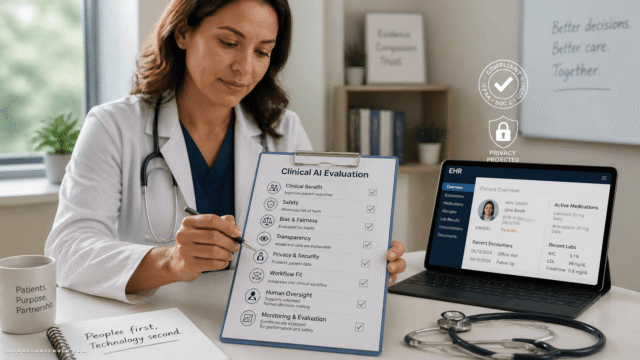
Temple’s use of EndoTool Sub-Q is a useful case study for any health system evaluating clinical AI tools. A few key takeaways stand out.
Specificity beats generality. The tool works because it solves one well-defined problem — insulin dosing — rather than trying to manage all of diabetes care at once.
Regulatory alignment accelerates adoption. CMS reporting requirements gave Temple a concrete business case for investing in better glucose management. When AI solves a compliance problem and a clinical problem simultaneously, adoption decisions get easier.
Human oversight isn’t optional. The requirement for nurse and physician approval isn’t just a safety feature — it’s what makes the tool clinically credible and professionally acceptable.
Pilot before you scale. Temple’s 2022 pilot gave the organization three years of learning before full deployment. That runway matters when you’re dealing with patient safety.
The Bottom Line
AI in clinical settings works best when it’s precise, transparent, and designed to support human judgment rather than replace it. Temple Health’s experience with EndoTool Sub-Q demonstrates what that looks like in practice — a measurable reduction in patient harm, a clearer path to CMS compliance, and a workflow that keeps nurses and doctors firmly in control.
The technology didn’t solve the problem. The people using it thoughtfully did.
That distinction is worth holding onto as AI continues to move deeper into healthcare.



Comment (1)
Want to join this discussion? Login or Register.
nice