


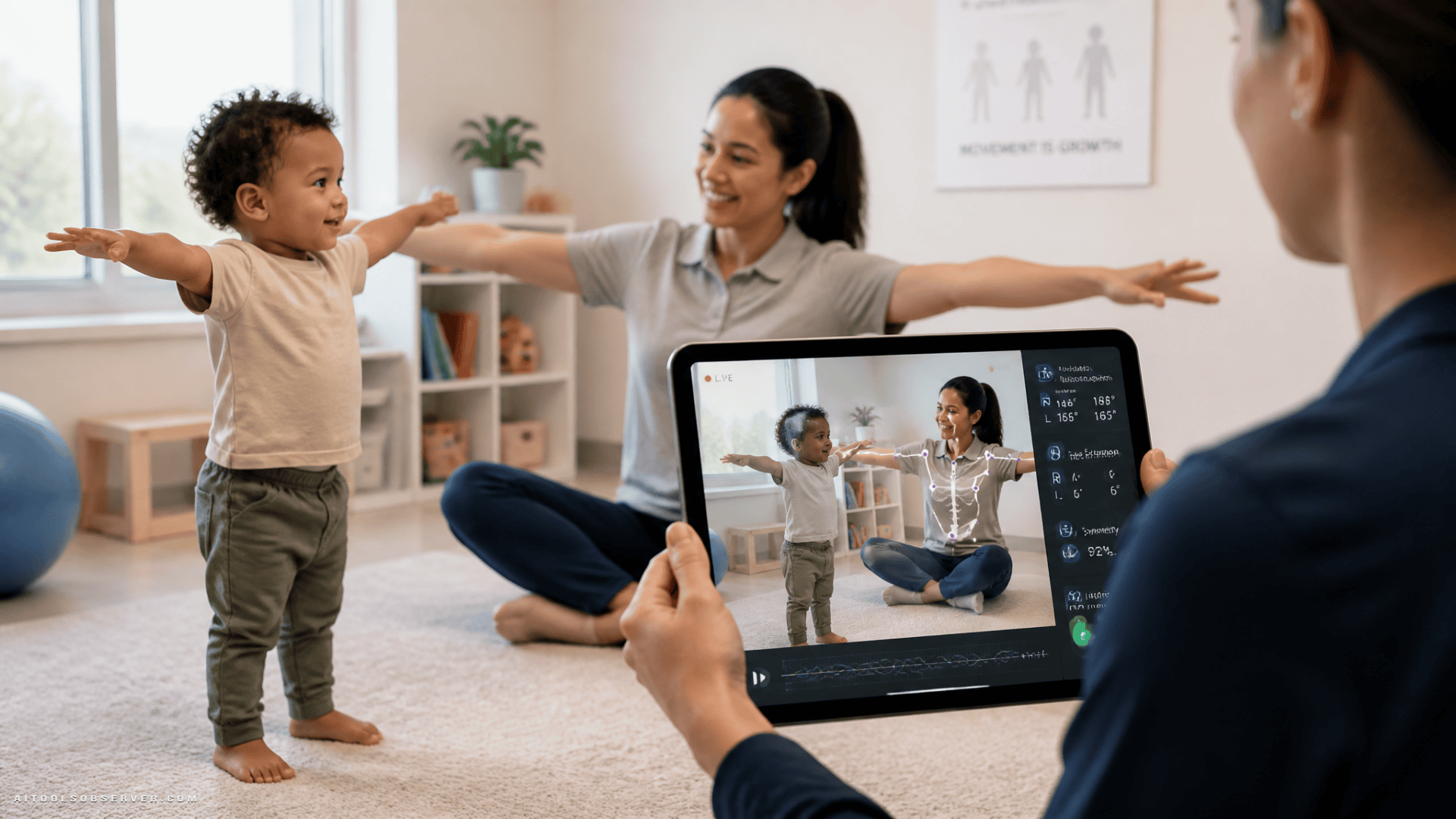
Why motor imitation matters in autism screening
Motor imitation is a basic part of early development. Children learn by copying gestures, actions, and simple movements from the people around them.
Researchers have long treated imitation differences as a meaningful behavioral signal in autism evaluations. That does not mean imitation alone can diagnose autism. It does mean it can offer a useful, observable marker inside a broader screening and assessment process.
The practical challenge has always been measurement. If a marker is clinically useful but hard to capture consistently, it stays stuck in research workflows.
That is where CAMI-2DNet stands out. It is designed to turn an important but difficult-to-measure behavior into an objective signal from ordinary video.
What CAMI-2DNet actually does
The system analyzes video of a child imitating an instructor performing simple movements. It tracks body joint positions, compares the child’s motion to the demonstrated action, and produces an objective score tied to imitation performance.
In plain terms, it tries to answer a simple question: how closely and consistently does the child reproduce the movement?
That may sound straightforward, but it solves several hard problems at once:
- capturing movement without specialized equipment
- reducing dependence on subjective human observation
- avoiding hours of manual annotation
- making the assessment easier to run in more places
The research team’s goal appears to be practical deployment, not just lab performance. That distinction matters because many healthcare AI projects work well in controlled environments but struggle outside them.
Why standard video changes the conversation
The most important feature here may be the input, not the model.
Using standard video lowers the hardware barrier. A clinic, school, or research site does not need a full motion-capture setup to collect useful movement data. That alone can widen access to objective behavioral assessment.
It also opens the door to more consistent workflows across settings. If a tool can work with conventional cameras, it becomes easier to test, compare, and potentially integrate into routine screening pipelines.
For healthcare teams, this creates a very different adoption path than high-cost sensor systems. Instead of redesigning the environment around the technology, the technology starts adapting to the environment.
What the research suggests about performance
The broader CAMI research has already pointed to motor imitation as a useful marker in autism-related assessment. The description also notes that a prior clinical study found a short CAMI assessment could distinguish autistic children from neurotypical peers and also help differentiate autism from ADHD to a degree.
That second point is especially important. In practice, developmental concerns do not arrive neatly sorted into categories. Overlap between conditions can complicate early decision-making, which is why objective measurements can be valuable.
For CAMI-2DNet specifically, the key reported result is not just that it works. It is that it performed comparably to more resource-intensive 3D motion-capture approaches while relying only on conventional video. The description also suggests it matched or outperformed expert human raters in this task.
That combination matters more than raw AI novelty. If a lower-cost workflow can approach the value of a more complex one, adoption becomes much more realistic.
Where this could help in the real world
CAMI-2DNet is not positioned as a standalone diagnostic system. It is better understood as decision support for screening and evaluation workflows.
That makes it useful in a few specific contexts.
Clinics
Pediatric and developmental clinics need ways to triage, document, and monitor concerns more efficiently. A video-based motor imitation assessment could give clinicians one additional objective measure during intake or follow-up.
That does not replace expert judgment. It helps structure it.
Schools
Teachers and school support staff are often among the first to notice developmental differences. A more accessible screening support tool could eventually make it easier to gather structured behavioral data when concerns arise, especially in environments without advanced clinical equipment.
Families
Home-based use raises more implementation questions, but the appeal is obvious. If standard video can support reliable data capture, families may face fewer logistical barriers in beginning the assessment process or contributing information to clinicians.
Research networks
The lower the hardware burden, the easier it becomes to study larger and more diverse groups across multiple sites. That can improve validation and help test whether the tool holds up across different populations and environments.
The bigger healthcare AI lesson
A lot of healthcare AI focuses on prediction. CAMI-2DNet highlights a different value: measurement.
That is a useful distinction.
In many clinical areas, the bottleneck is not a lack of expert frameworks. It is the difficulty of collecting consistent, objective, scalable data. If AI can make those measurements easier to obtain, it can improve workflows even without making final decisions itself.
This is why computer vision in healthcare keeps gaining attention. When applied carefully, it can turn ordinary visual inputs into structured signals that clinicians can actually use.
For autism screening, that means moving from “someone should observe this behavior” to “this behavior can be measured more consistently and at lower cost.” This aligns with the broader challenge described in AI in Healthcare and the Discovery‑Delivery Gap.
The tradeoffs and limitations to keep in mind
The promise here is real, but so are the constraints.
First, autism is complex. No single movement test should be treated as a complete answer. Behavioral, developmental, and clinical context still matter.
Second, real-world robustness is everything. Video-based systems need to handle variation in lighting, camera placement, body size, movement style, and environment. The research description suggests this was a major design focus, which is encouraging, but broader validation remains essential.
Third, deployment is not just a technical issue. Clinical teams need workflows, training, interpretation guidance, and trust in how scores are used.
Fourth, accessibility can cut both ways. Standard video makes collection easier, but broader use also raises practical questions around privacy, consent, and data handling, especially when children are involved.
So the right framing is not “AI can diagnose autism from a video.” The better framing is “AI may help measure one important behavioral signal more objectively and more accessibly.”
Why this matters for AI tool buyers and healthcare teams
If you track AI tools across healthcare, CAMI-2DNet fits a pattern worth watching: narrow, workflow-specific AI that solves a real operational problem.
It is not trying to be a universal autism platform. It is focused on one measurable task with a clear pain point:
- specialist time is limited
- subjective observation does not always scale well
- specialized equipment restricts access
- earlier assessment needs better support tools
That is often where practical AI wins first. Not in replacing professionals, but in reducing friction around repeatable, high-value tasks.
For clinics and health researchers, this kind of tool is worth following because it could improve consistency without requiring major infrastructure changes. For schools and families, its potential value is even simpler: fewer barriers between concern and action.
At the same time, successful use depends on workflows, training, interpretation guidance, and trust in how scores are used.
What to watch next
The most important next step is broader validation.
The research team is working to expand evaluation across cohorts, sites, and movement types. That is exactly what should happen before anyone treats this as ready for widespread use. Multi-site performance is where many promising healthcare AI tools either prove their value or show their limits.
It will also be worth watching how CAMI-based assessments fit into existing developmental workflows. A strong tool does not just generate a score. It needs to produce information clinicians can interpret and act on.
If CAMI-2DNet continues to hold up across settings, its biggest contribution may be simple: making one part of autism screening more objective, more scalable, and more available outside specialized labs.
The practical takeaway
CAMI-2DNet matters because it focuses on a real bottleneck in autism screening: the difficulty of getting timely, objective assessments into everyday settings.
For anyone evaluating AI in healthcare, that is the signal to pay attention to. The strongest tools are often the ones that use familiar inputs, fit existing workflows, and help experts move faster without asking them to trust a black box with the final decision.










Comments (0) No comments yet
Want to join this discussion? Login or Register.
No comments yet. Be the first to share your thoughts!