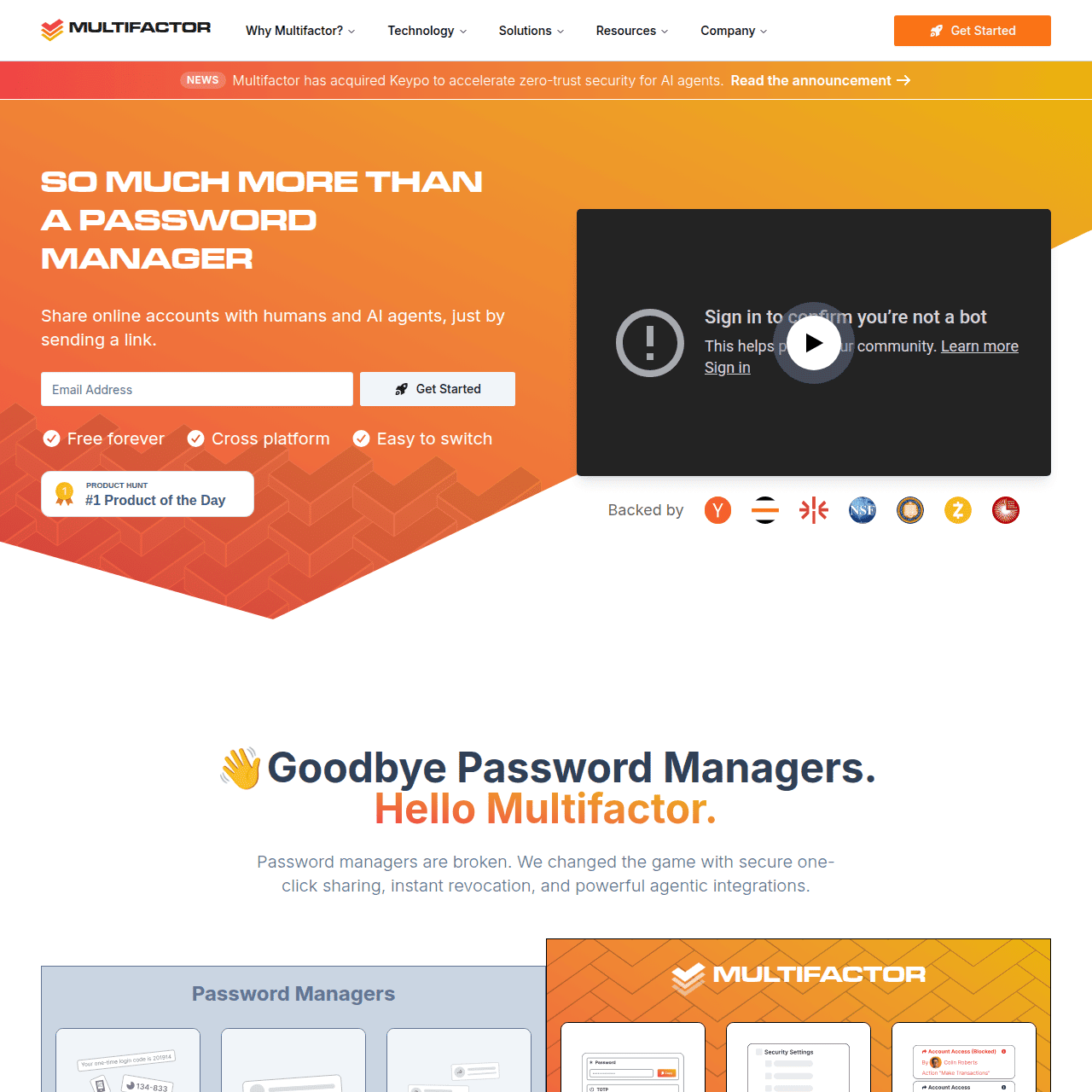

What Is Multifactor?
Multifactor is a next‑generation account manager built to replace traditional password managers by securing every factor of your online identity in one unified platform. It stores passwords, passkeys, two‑factor codes, and other credentials, then uses advanced zero‑trust cryptography to authenticate both humans and AI agents into your accounts without exposing raw secrets.
The platform offers instant access control, fine‑grained permissions, detailed event history, and multi‑factor management, giving organizations strong security and governance over critical accounts. Its AI assistant, Multi, enables natural‑language commands and secure cross‑account access so agents can perform tasks safely.
Powered by post‑quantum cryptography, Multifactor helps individuals, teams, and enterprises future‑proof account security for the emerging agentic web.
Quick Snapshot
Multifactor centralizes passwords, passkeys, and multi-factor credentials under a zero‑trust, post‑quantum security model, giving you precise, auditable control over every account. It simplifies access management for people and AI agents while sharply reducing identity and credential risk.
- Works on
-
- Web
- API
- Pricing Model
- Freemium
Starting at Custom — Consumer plans are free forever with unlimited accounts, passwords, and sharing across devices. Enterprise plans are custom and add advanced auditing, compliance, priority support, cloud RBAC, and SSO integrations. - Fits on
- Affiliate Program
- We could not identify an affiliate program.
- API Availability
- Multifactor has an API available.
- Key Features
-
- Unify passwords, passkeys, and MFA securely
- Zero‑trust, post‑quantum access control layer
- Govern human and AI account access safely
- Audience
-
- developers
- security teams
- startups
- SMBs
- enterprises
- AI and agentic app builders
- IT administrators
Screenshot

Key Features of Multifactor
Unified credential vault
Store passwords, passkeys, multi‑factor codes, and other credentials in one secure, centrally managed platform.
Zero‑trust access control
Apply a zero‑trust security model to govern who or what can access each account, with strict policy enforcement.
Post‑quantum cryptography
Protect authentication and credential data using post‑quantum‑ready cryptographic techniques for long‑term security.
Fine‑grained permissions
Define detailed, per‑account permissions so individuals, teams, and AI agents only get the exact access they need.
Detailed event history
Track and review access events across accounts for better visibility, auditing, and incident response.
AI assistant Multi
Use a built‑in AI assistant to issue natural‑language commands and enable secure cross‑account access for agents.
Multi‑factor management
Manage multiple factors of authentication in one place, from passwords and passkeys to two‑factor codes.
Secure sharing
Share account access safely with people and AI agents without revealing underlying passwords or secrets.
Use Cases for Multifactor
Centralized account security
Consolidate passwords, passkeys, and multi‑factor credentials into a single, secure platform, reducing the risk of scattered secrets and unmanaged accounts.
AI agent access control
Allow AI agents to log into services and perform tasks without ever exposing raw passwords, using natural‑language commands and strict access policies.
Team and enterprise governance
Manage account access across teams with fine‑grained permissions, instant access control, and detailed event history for audits and compliance.
Future‑proofing against quantum threats
Leverage post‑quantum cryptography to protect credentials and access flows from emerging quantum computing risks.
Multi‑factor authentication management
Store and manage two‑factor codes and other MFA credentials centrally so security teams can enforce stronger authentication without adding friction.
Frequently Asked Questions
What is Multifactor and how is it different from a traditional password manager?
Multifactor is a secure account manager that unifies passwords, passkeys, and multi‑factor credentials under a zero‑trust, post‑quantum security model. Unlike traditional password managers, it is designed to govern access for both humans and AI agents with fine‑grained permissions and detailed audit trails.
Can Multifactor manage access for AI agents without exposing passwords?
Yes, Multifactor is built to authenticate AI agents into accounts without revealing raw passwords or secrets. Its AI assistant and policy controls let agents perform specific tasks while access remains tightly governed and auditable.
Who is Multifactor best suited for?
Multifactor is ideal for developers, security teams, IT administrators, startups, SMBs, enterprises, and AI or agentic app builders who need secure, centralized, and auditable control over online account access.
Does Multifactor support multi-factor authentication credentials?
Yes, Multifactor is designed to secure every factor of your online identity, including passwords, passkeys, two‑factor codes, and other multi‑factor credentials in a unified platform.
Is there a free version of Multifactor?
Yes, consumer plans are free forever and include unlimited accounts, passwords, and sharing across devices. Enterprise plans are offered on a custom pricing basis.
How does Multifactor use post-quantum security?
Multifactor is built on innovative post‑quantum cryptography to secure credentials and authentication flows against emerging quantum computing threats, helping organizations future‑proof their account security.
Multifactor · Our Verdict
Multifactor stands out by treating passwords, passkeys, and multi‑factor credentials as a single, governed security layer rather than scattered secrets. Its zero‑trust, post‑quantum approach and AI‑aware design make it well‑suited for teams preparing for both today’s threats and the agentic workflows that are rapidly emerging.
Multifactor ·
-
 Freemium
 Papermark AI
AI data room copilot for secure dealmaking
Business & Finance AI -
MODV – My Own Document Vault
Secure, AI-powered document vault with intelligent search
Privacy & Data Protection -
FurtherAI
AI workspace to automate modern insurance operations
Industry-Specific Advisors - Freemium
TwelveLabs
AI that understands video like humans do
Video & Animation AI - Credit-Based
Mighty
AI document fraud detection for financial teams
Fraud Detection & Risk Analysis - Your Ad Here
- Freemium
GoWhisper
Private local AI transcription that stays offline
Speech-to-Text Transcription -
Adobe Photoshop AI
AI-powered image editing for fast, stunning visuals
AI Photo Editors