



What HungerMap Live Actually Does
HungerMap Live is a publicly accessible platform developed by the UN World Food Programme. First launched in January 2020, it aggregates data across more than 90 countries—covering food insecurity levels, climate conditions, agricultural output, market prices, inflation, and conflict dynamics—and displays which areas are currently food insecure or trending in that direction.
The original version used AI primarily to estimate food insecurity in countries where direct survey data was sparse. Its predictive capability was limited, and it did not track diet quality or nutritional adequacy.
HungerMap Live 2.0, released in April, changes that. The update introduced a redesigned interface and new predictive AI features that allow WFP field offices and partner governments to act before conditions deteriorate rather than after.
The Burhakaba Case: From Signal to Action
The district of Burhakaba, roughly 180 kilometres northwest of Mogadishu, illustrates the operational value of the platform. Local medical centres were filling with severely malnourished children. WFP’s team identified the district’s deteriorating conditions through HungerMap Live before the situation became irreversible.
The result was targeted intervention: food assistance reached 48,000 people, and nutrition support was delivered to 3,000 women and children.
“Instead of waiting for that malnutrition of children to deteriorate and lead to displacement or even death, we knew it prior.”
That is the core value proposition—not eliminating the crisis, but compressing the time between early warning and field action.
What the Predictive Layer Analyses
HungerMap Live 2.0 draws on several data streams to generate forward-looking assessments:
- Rainfall deficits and flood risk — Somalia faces both drought and flash flooding driven by climate variability
- Market price data — the country imports most of its food, making it acutely sensitive to global price shocks
- Conflict dynamics — an active conflict now in its fourth decade shapes access and displacement patterns
- Nutrition indicators — a new capability in version 2.0, tracking diet quality alongside food availability
By combining these inputs, the platform moves from describing current hunger to explaining why conditions are worsening and forecasting where they will worsen next.
The Honest Limits of the Tool
Renk is careful about what the platform can and cannot do. HungerMap Live data does not replace on-the-ground assessment. It helps determine which communities to prioritise and what type of aid is most appropriate—whether cash assistance or specialised nutrition support—but field verification remains essential.
More pointedly, he notes that AI-assisted prioritisation does not make the underlying resource shortage acceptable. WFP’s Somalia office requires an additional $192 million through January 2027 to reach everyone who needs food. Better targeting helps allocate what exists. It does not substitute for what is missing.
“It helps us to prioritise with stronger evidence,” Renk said. “But in itself, it doesn’t make the shortage of support acceptable.”
Why This Use Case Matters Beyond Somalia
Somalia is an extreme case—compounded by climate shocks, a 35-year conflict, import dependency, and chronic underfunding. But the architecture of HungerMap Live 2.0 is designed to operate across more than 90 countries, and the underlying logic applies broadly to any resource-constrained humanitarian operation.
The platform demonstrates a specific and replicable AI application pattern:
- Aggregate heterogeneous data from climate, economic, conflict, and nutrition sources
- Generate predictive signals about where conditions are likely to worsen
- Surface those signals in a format that field teams and governments can act on
- Shorten the decision cycle between early warning and resource deployment
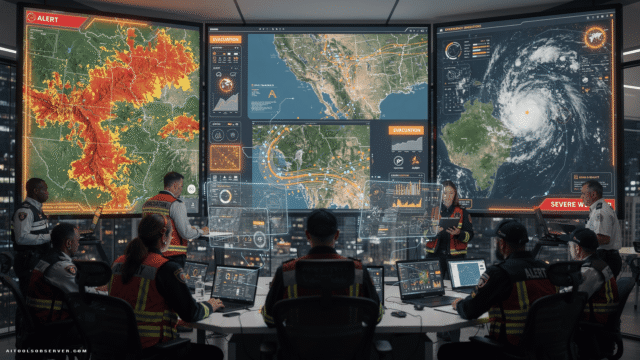
This is not AI replacing human judgment. It is AI structuring the evidence base so that human judgment can be applied faster and with greater precision. A related example appears in AI Mapping Disasters in Real Time.
The Practical Takeaway
For anyone evaluating AI tools in high-stakes, resource-constrained environments, HungerMap Live 2.0 offers a useful reference point. The value is not in automation—no algorithm decides who receives food. The value is in reducing the time and uncertainty between a deteriorating signal and a defensible operational decision.
That gap—between knowing something is getting worse and acting on it—is where preventable harm accumulates. Compressing it is a concrete, measurable outcome. It is also a design goal that translates directly to other domains: supply chain disruption, public health surveillance, climate-related displacement.
The tool is publicly accessible. The methodology is documented. For teams working on early warning systems or crisis response workflows, it is worth examining not just as a humanitarian application, but as a model for what grounded, operationally useful predictive AI actually looks like.








Comments (0) No comments yet
Want to join this discussion? Login or Register.
No comments yet. Be the first to share your thoughts!