


The Adoption-Value Disconnect
The numbers are striking. Industry research suggests that while the vast majority of large enterprises now use AI in at least one business function, only a small fraction report meaningful earnings impact at the enterprise level. The rest are somewhere in between: AI is present, people are using it, but the organization as a whole is not measurably better off.
This is not a paradox. It is a predictable outcome when AI is deployed to optimize individual performance without accounting for how that performance interacts with the broader system.
A useful analogy: a rowing coach assigns his strongest rowers to the top team and his weakest to the junior team. The junior team wins consistently—because they row in synchrony. The top team, each member maximizing individual output, disrupts the shared rhythm and creates drag. Enterprises face the same dynamic when AI tools make individuals faster without improving how work, knowledge, and decisions flow across the organization.
Intensity Without Absorption
AI tools often do not reduce workload—they accelerate it. Tasks that once took days can now be initiated in minutes. People start more projects, produce more analysis, generate more output. But the organizational capacity to absorb, evaluate, and act on that output has not scaled at the same rate.
The bottleneck shifts from creation to consumption. And at the organizational level, this compounds: every employee producing more means every team receiving more, without a corresponding increase in bandwidth to process it.
The implication is that AI should not primarily be a content-generation tool. It should reduce the need to generate and consume static assets in the first place—surfacing the right answer for the right person at the right moment, rather than producing more material to be reviewed.
Context Without Institutional Memory
Most AI systems are trained on general knowledge. They understand the world reasonably well. They do not understand your organization—its supplier relationships, its exception policies, its unwritten rules about how decisions actually get made.
This creates a specific failure mode: answers that are technically correct but contextually wrong. An AI that recommends a supplier without knowing your organization’s sourcing restrictions is not helpful. It is a liability dressed as a recommendation.
Enterprise processes run on two parallel tracks: the formal system of record (transactions, master data, process logic) and tacit institutional knowledge (policies, precedents, informal agreements). When AI only sees the first, its outputs reflect a partial picture.
Prediction Without the Right Tool
Business decisions are fundamentally prediction problems. Will this shipment arrive on time? Which stores will run out of stock? What is the credit risk on this account? These questions depend on structured, tabular data—not unstructured text.
Large language models are well-suited to language tasks. They are architecturally less suited to generating reliable forecasts from numerical tables. Traditional machine learning approaches can handle structured data well, but they typically require specialist involvement and multi-week cycles—by which time the question has often changed.
The result: predictive capability is either restricted to data science teams or approximated poorly by general-purpose models. Neither serves the organization well.
Joule Work: A Unified Engagement Layer
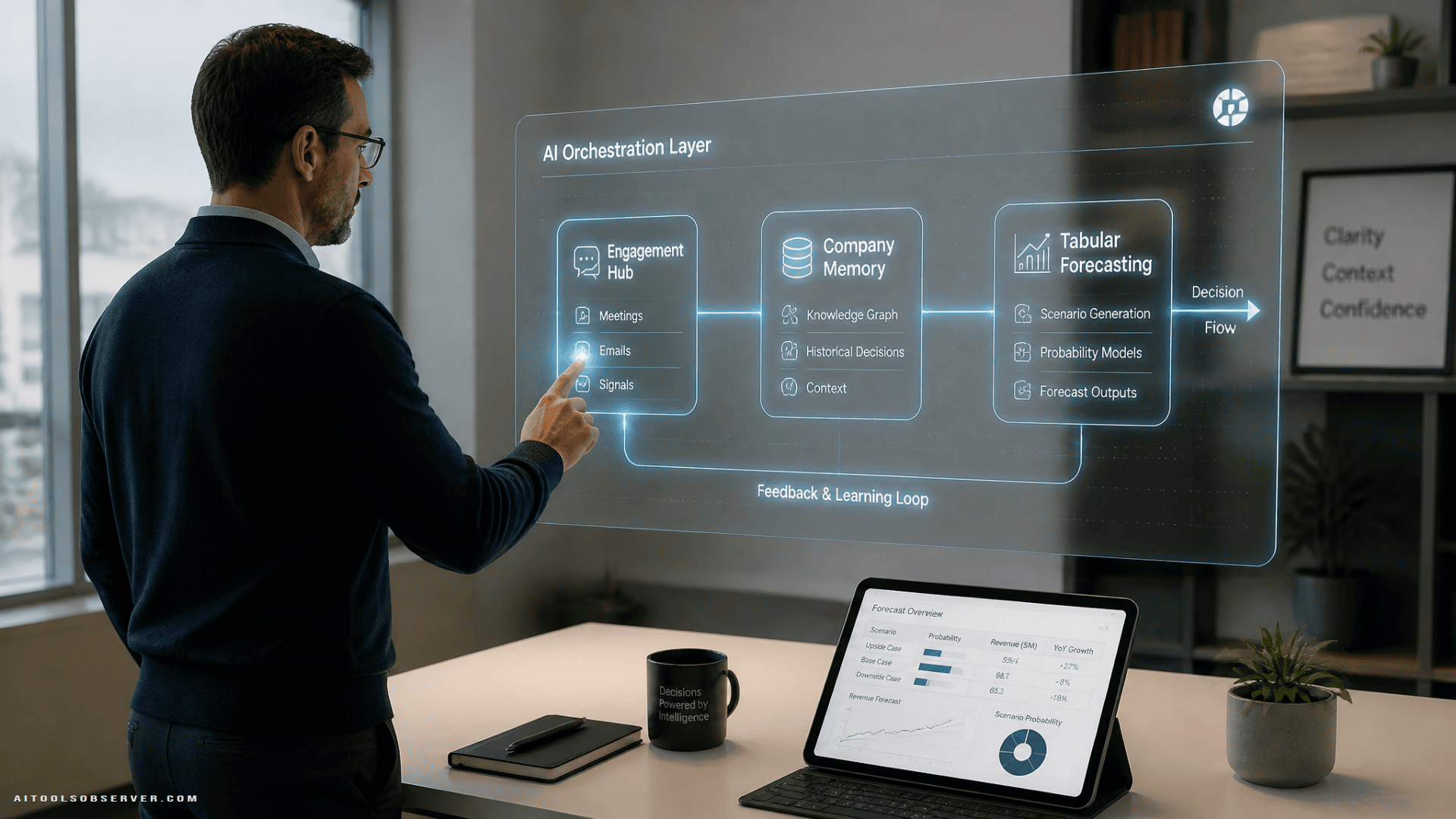
Joule Work is positioned as a central workspace that spans SAP and non-SAP systems, using AI agents to act on behalf of users rather than generating assets for them to process. The framing is deliberate: instead of producing a report about which stores are running low on inventory, it pulls data across systems and orchestrates the actions needed to address the situation.
This is a meaningful architectural choice. If the goal is to reduce intensity—not just accelerate output—then the engagement model has to shift from “generate and review” to “ask and act.” Joule Work appears to be SAP’s attempt to make that shift concrete.
SAP Company Memory: Institutional Knowledge as Infrastructure
SAP Company Memory is described as a continuously updated layer that captures institutional knowledge—process models, policies, chat inputs, application logic—and makes it available to both people and AI agents as reusable building blocks.
The key word is continuously. A one-time knowledge base becomes stale quickly. Treating company knowledge as infrastructure—something that is maintained, governed, and updated as the organization evolves—is a different commitment. It means agents can act not just correctly, but contextually: reflecting the actual rules and decisions that process owners have agreed upon, not a generic approximation of what those rules might be.
When someone asks about sourcing options, the answer can reflect the organization’s actual policy—including exceptions, approvals, and constraints—rather than a generic response based on publicly available information.
SAP-RPT-1.5 and TabPFN 3: Prediction Engines for Structured Data
SAP-RPT-1.5 and TabPFN 3 are specialized models designed for tabular data. They are intended to integrate with Joule Work and SAP Business Data Cloud, enabling forward-looking questions to be answered directly on live enterprise tables.
The practical implication is that decision-makers working in core systems—procurement, supply chain, finance—can ask probabilistic questions and receive answers grounded in real data, without routing requests through specialist teams. What is the probability of on-time delivery? What is the cost delta across rerouting scenarios? What is the risk profile of this counterparty?
Making this capability broadly available across the organization removes a structural bottleneck. Prediction becomes a system property rather than a specialist service.
What This Architecture Is Actually Arguing
Taken together, these three components represent a coherent position: that enterprise AI value is not the sum of individual productivity gains. It is a function of how well AI integrates into the flow of work, knowledge, and decisions across the organization.
Joule Work addresses the intensity problem by shifting from asset generation to autonomous action. SAP Company Memory addresses the context problem by treating institutional knowledge as living infrastructure. The tabular prediction models address the forecasting problem by putting structured-data reasoning where decisions are actually made.
Each component solves a distinct failure mode. The combination is designed to close the gap between AI adoption and organizational value capture.
The Practical Takeaway
If your organization is using AI extensively but struggling to point to enterprise-level impact, the question worth asking is not “are we using enough AI?” It is “where is AI creating drag rather than flow?”
The sub-optimization pattern—strong individuals, weak system—is a known failure mode in organizational design. It applies directly to AI deployment. The organizations that move from adoption to value capture will likely be those that treat AI as a system-level capability, not a collection of individual productivity tools.
SAP’s direction with these three components is worth watching precisely because it is trying to answer that harder question. Whether the execution matches the architecture is something that will become clearer as these capabilities reach production use at scale.














Comments (0) No comments yet
Want to join this discussion? Login or Register.
No comments yet. Be the first to share your thoughts!