


What the Study Actually Did
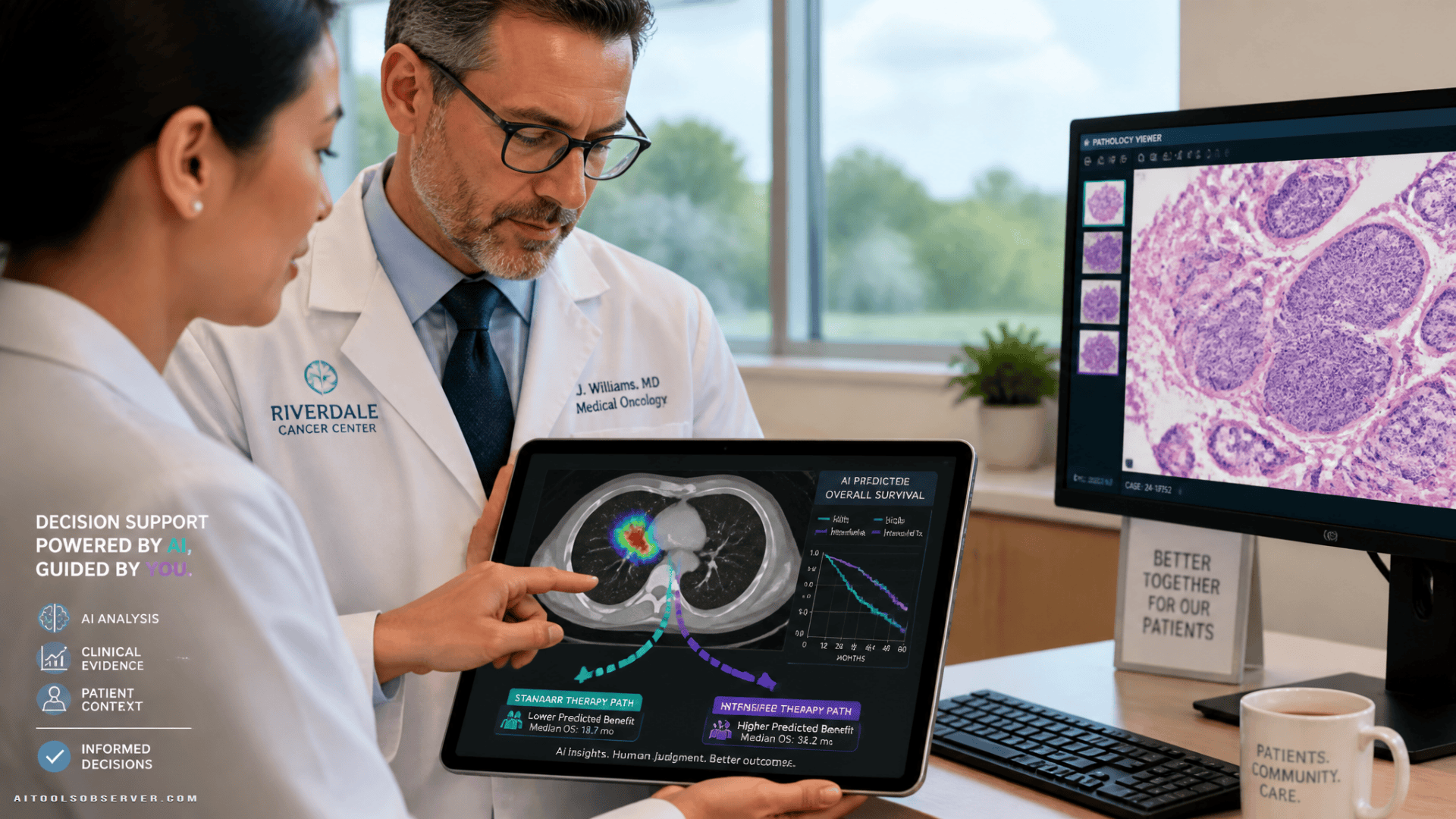
The research comes from the 13LUNG project, a large international trial spanning six centers across Italy, Germany, Greece, Israel, Spain, and the United States. The team enrolled 2,396 patients with advanced non-small cell lung cancer (NSCLC) treated with immunotherapy.
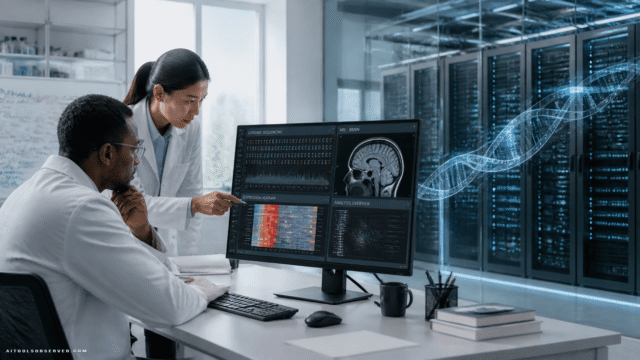
Rather than relying on a single data type, the researchers built two families of AI models trained on combinations of:
- Clinical and blood data
- Imaging and digital pathology
- Genomic data
The goal was straightforward: predict treatment response and survival better than existing biomarkers.
The Numbers That Matter
The study used AUC (Area Under the Curve) as its performance metric. Scores between 0.8 and 0.9 are considered excellent.
- The model using clinical and blood data alone scored 0.77
- The model adding imaging and digital pathology scored 0.88
Both outperformed standard clinical biomarkers. The richer the data input, the better the prediction — which is intuitive, but now it’s validated at scale across diverse healthcare systems.
The Human-AI Collaboration Finding
This is where it gets practically interesting. Twenty physicians — ten lung cancer specialists and ten from other specialties — reviewed 100 real patient cases, first without AI support, then with it.
AI assistance improved sensitivity for identifying responders from an AUC of 0.72 to 0.87. Physicians outside thoracic oncology showed the largest gains. Inter-physician agreement also improved, rising from slight to moderate.
That last detail matters. It’s not just that the AI was more accurate — it made clinicians more consistent with each other, which is a different and arguably more durable kind of value.
Why Community Oncology Is the Real Story
Most lung cancer patients aren’t treated at major academic centers. They’re seen by generalists and community oncologists who may not have deep immunotherapy expertise.
The 13LUNG findings suggest this tool could deliver something close to expert-level guidance at the point of care — without requiring a thoracic specialist in the room. That’s a meaningful equity argument, not just a performance benchmark.
What’s Still Ahead
The current results cover the retrospective phase of 13LUNG. The project is now prospectively enrolling more than 2,000 additional patients across the same six centers, shifting focus toward treatment optimization and real-world clinical usability.
Performance in a controlled study and performance in a busy oncology clinic are two different things. The prospective phase will be the harder, more important test.
The Practical Takeaway
If you’re tracking AI in healthcare, this study is worth bookmarking — not because it solves immunotherapy prediction, but because it demonstrates a credible, peer-reviewed path toward multimodal clinical decision support that actually outperforms what clinicians use today.
The benchmark has moved. The question now is whether the prospective data holds up — and whether health systems can integrate tools like this without turning them into shelfware.





Comments (0) No comments yet
Want to join this discussion? Login or Register.
No comments yet. Be the first to share your thoughts!