


From Programmed to Trained: A Fundamental Shift
The distinction matters more than it might initially appear.
A programmed robot executes a fixed sequence of instructions. Given a specific input, it produces a specific output. Change the conditions, and the behavior breaks. This is how factory robot arms have operated for decades — reliable within tight tolerances, brittle outside them.
Atlas operates differently. According to Alberto Rodriguez, Boston Dynamics’ director of robot behavior, Atlas is no longer programmed. It is trained. The robot develops behaviors by learning to adapt to variables, much as a large language model learns patterns from data rather than following hand-coded rules.
This architectural choice is not incidental. It is what made a World Cup appearance possible.
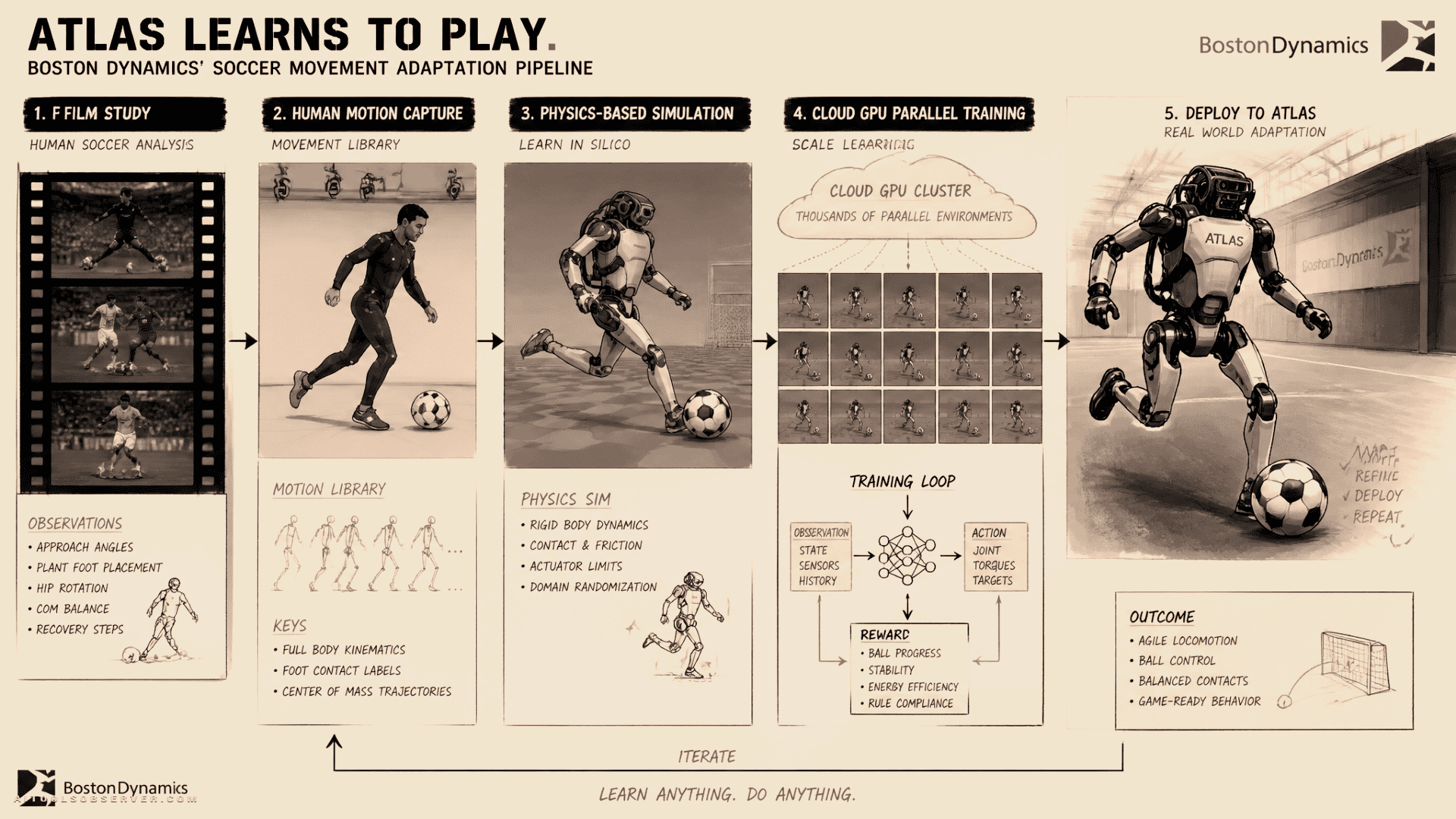
Film Study, Motion Capture, and Simulation
Before Atlas touched a ball, it watched footage of professional footballers performing drills and movements. That film served as a behavioral reference — the equivalent of a player reviewing game tape to understand mechanics before attempting them physically.
Human motion-capture data was then recorded, including Boston Dynamics’ own engineers suited up and running through the target movements themselves. This data was fed into a physics-based simulation environment, where Atlas could execute the same actions millions of times in parallel across cloud GPUs.
The scale of that simulation is what compresses the timeline. What a human athlete might require roughly a year of physical trial and error to develop, Atlas worked through in approximately 24 hours.
Deliberate Adversarial Conditions
The simulation does not run under ideal conditions. That is by design.
Engineers introduce systematic disruptions throughout training: ground friction changes without warning, the ball appears in the wrong position, Atlas is told its own feet are a different size than they actually are. The system must learn to execute the task correctly regardless.
“We keep pushing it around, or lying to it about where the ball is, or putting obstacles on the ground, or changing the friction with the ground,” Rodriguez said. “It kind of has to not just learn to do something, but learn to adapt to whatever conditions it’s actually going to encounter in the real world.”
The output of this process is what Rodriguez describes as “muscle memory” — behaviors that are too fast to reason about in real time, executed from trained instinct rather than live calculation.
The Grass Problem
Preparing Atlas for the World Cup introduced a specific locomotion challenge that factory deployments do not encounter: natural grass.
Grass is mechanically inconsistent. Foot contact can produce either slip or unexpected grip depending on surface moisture, blade density, and angle of approach. The training regime for walking and running had to be adapted to handle this variability without degrading performance on harder surfaces like concrete.
This is a precise illustration of why the trained approach matters. A programmed locomotion system would require explicit rules for every surface type. A trained system learns to generalize across surface conditions — provided the training environment includes sufficient variation.
Hardware Specifications
The behavioral sophistication runs on capable hardware. Atlas is a fifth-generation humanoid robot, fully electric, and built for demanding industrial environments.
Key specifications include:
- 56 degrees of freedom — 56 independent articulation points across the body
- 2.3-meter reach
- Lift capacity of up to 110 pounds
- Autonomous battery swapping — Atlas can replace its own batteries without halting operation
The autonomous battery swap is a detail worth noting for industrial deployment contexts. Continuous operation without human intervention for recharging is a meaningful constraint in manufacturing environments.
Hyundai’s Industrial Ambitions
The World Cup appearance was a public demonstration, but the underlying investment thesis is industrial.
Hyundai Motor Group acquired a controlling stake in Boston Dynamics from SoftBank in 2021. The company has since committed to a $26 billion investment in the United States over four years, including a dedicated robotics manufacturing facility near Savannah, Georgia, with a stated target capacity of 30,000 Atlas units annually by 2028.
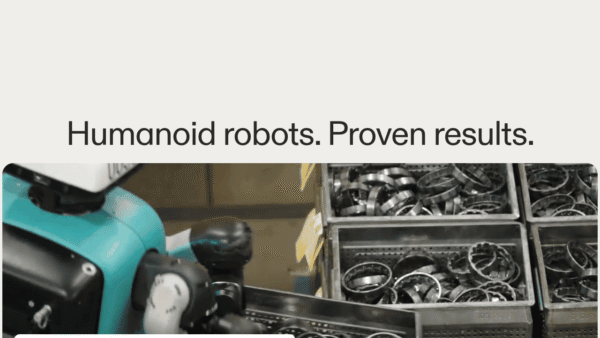
Atlas is already being tested in Hyundai factory settings, with an initial focus on part sequencing in automotive manufacturing. The use case is deliberate: automotive assembly involves structured but variable environments, making it a reasonable proving ground for adaptive robotic behavior before broader deployment in manufacturing environments.
“We see robotics not as a side venture, but as a strategic capability that will shape how we compete,” said Sungwon Jee, Hyundai’s executive vice president and global chief marketing officer. “Mobility isn’t just about cars anymore. It’s about autonomous systems, robotics, and smart infrastructure.”
What the World Cup Appearance Actually Demonstrated
The pitch performance was not a proof of concept for soccer. It was a proof of concept for environmental adaptability under public scrutiny.
Operating reliably in record high temperatures, executing precise physical movements on an unpredictable natural surface, in front of 80,000 people — these are conditions that stress-test both hardware and trained behavior simultaneously. The fact that the demonstration held up is the relevant data point.
“We’ve shown that this brand-new humanoid hardware can perform in the most extreme environments,” Rodriguez said, “operating reliably in record high temperatures, performing exciting and engaging athletic feats.”
The Practical Takeaway
For anyone tracking the AI tools and autonomous systems landscape, Atlas represents a concrete case study in what the shift from programmed to trained robotics actually looks like in production.
The training pipeline — film study, motion capture, physics simulation, adversarial conditioning, cloud-scale parallel execution — is not conceptually distant from how modern AI models are built. The difference is that the output is physical behavior rather than text or image generation.
The industrial deployment timeline is specific: 30,000 units annually by 2028, starting in automotive part sequencing. That is a measurable commitment, not a roadmap slide. Whether the timeline holds is a separate question, but the direction of travel is clear.
Humanoid robotics is moving from laboratory demonstration to factory floor. The training infrastructure that makes that possible is already running.









Comments (0) No comments yet
Want to join this discussion? Login or Register.
No comments yet. Be the first to share your thoughts!