


A 10-Kilowatt Machine With an Outsized Job
PUR-1—Purdue University Reactor Number One—has operated beneath the West Lafayette campus since 1962. It is a pool-type research reactor, the only operating reactor in Indiana, and it produces a maximum of 10 kilowatts of thermal power. Purdue’s own comparison is instructive: roughly enough to run ten microwaves simultaneously.
Power output is not the point. Data is the entire product.
In 2019, with backing from the Department of Energy’s Office of Nuclear Energy, Purdue stripped out the reactor’s analog instrumentation and controls and replaced them with a fully digital system. The result is the only reactor the US Nuclear Regulatory Commission has ever licensed with all-digital instrumentation and controls. No other facility in the American fleet holds that distinction.
The practical difference shows up immediately in measurement precision. Under analog controls, operators could pin the reactor’s power level to within roughly 5%. With digital instrumentation, the system resolves power to a fraction of a watt.
What the Digital Twin Actually Does
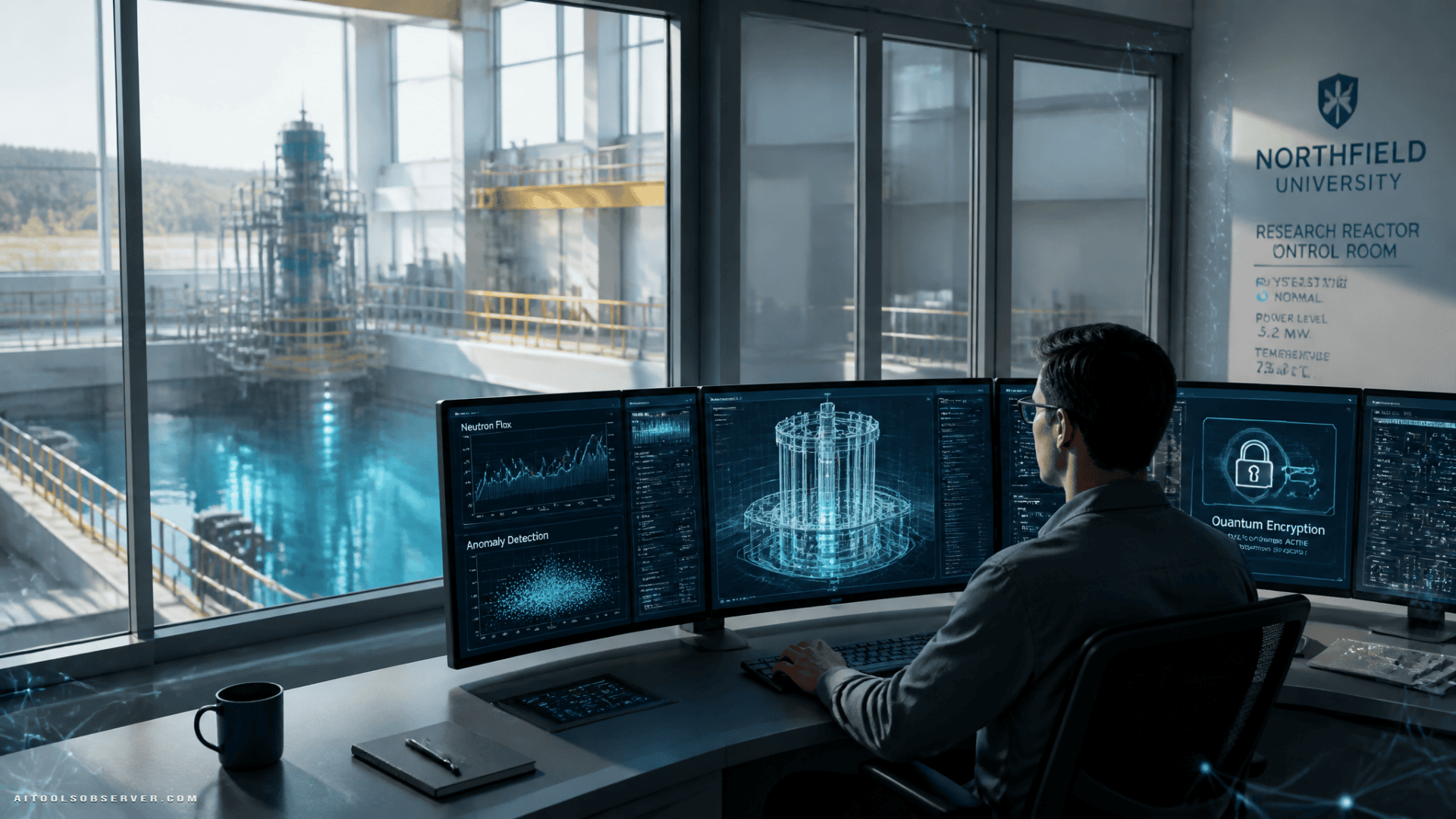
Since 2023, PUR-1 has had a computational counterpart. The lab of Stylianos Chatzidakis, assistant professor and associate director of the facility, built a digital twin—a physics-and-data simulation that ingests live sensor readings from the operating reactor and runs AI-driven predictions against them.
The twin is not a generic model. It draws on more than 2,000 monitorable parameters exposed by PUR-1’s control system. Researchers identified 67 signals that do most of the descriptive work, capturing how the system actually behaves under operating conditions.
The headline result comes from a study published in Scientific Reports, conducted by researchers from Purdue and Argonne National Laboratory. A machine-learning algorithm trained on the twin’s data learned the physics governing a key measure of how steadily the reactor produces power, then predicted changes in that measure over time with 99% accuracy.
Seungjin Kim, who heads Purdue’s School of Nuclear Engineering and directs the facility, describes this as the only university-operated digital twin anywhere that is fed by signals from a true operating nuclear reactor—not a simulation of a reactor, but an actual running core.
Why Remote Operation Makes This Urgent
The precision matters because of where the industry is heading. Small modular reactors and microreactors are designed to operate in remote locations—often with no on-site staff—monitored from a shared control center that may be hundreds or thousands of miles away.
Chatzidakis has framed the target scenario explicitly: a control room managing a fleet of reactors at distance, with the digital twin providing the situational awareness that proximity once supplied. PUR-1 can generate real numbers on how much that configuration would reduce operating and maintenance costs, because it is already doing a version of it.
The analog-era argument against this was simple: remote operation requires a network connection, and a network connection is an attack surface. That tension does not disappear because the reactors are smaller.
The Cybersecurity Question Has No Easy Answer
Purdue’s response to the attack-surface problem is methodologically sound: study it on a 10-kilowatt teaching reactor before it becomes a problem on a full-scale power plant.
In a technical letter report published by the NRC, Chatzidakis and colleagues used real-time PUR-1 data to test whether AI and machine-learning models could distinguish normal cybersecurity states from anomalous ones inside a nuclear system. The models identified the abnormal events. The significance is not just the result—it is the provenance. The document carries the regulator’s name, giving the broader industry a reference point built on live reactor data rather than laboratory simulation.
This does not produce a certificate of unhackability. What it produces is something the field has not previously had: empirical data from an operating core, rather than answers derived entirely from computer models and controlled demonstrations.
Quantum Encryption: The Next Experiment
The lab’s forward-looking work moves into territory that sounds speculative until you examine the threat model. Chatzidakis’s group has been studying whether quantum encryption could secure the communications channels flowing in and out of a reactor. The argument is direct: encryption built on quantum principles cannot be broken by classical computers, supercomputers, or quantum computers.
Work published in Nuclear Technology, along with a paper posted to arXiv, has tested quantum-secured channel behavior using real PUR-1 data feeding into simulations. The next phase involves actual quantum hardware encrypting live signals from the reactor, accessed through the digital twin.
The logic is the same as the cybersecurity work: if quantum-secured remote operation has failure modes, a 10-kilowatt research reactor is the right place to find them.
What Comes Next at Purdue
The facility is expanding its infrastructure. Purdue’s School of Nuclear Engineering is constructing a second digital twin of PUR-1 inside a new full-scale reactor control room. The same space will house a digital twin of PUMA—the Purdue University Multidimensional Integral Test Assembly—a scaled-down model of an advanced light-water reactor slated for its own digital instrumentation upgrade to support small modular reactor research.
A $6 million award from the DOE’s Office of Nuclear Energy, granted to a Purdue-led consortium, is funding the work.
PUR-1 also keeps its educational function. Students can sit an NRC licensing exam and walk away qualified to operate the reactor. The facility draws approximately 1,500 visitors annually, including industry representatives and policymakers.
The Realistic Scope of What This Changes
None of this converts the existing US commercial fleet. No gigawatt-scale plant is trading its analog panels for keyboards in the near term, and licensing digital controls at that scale is a substantially heavier regulatory undertaking than doing it on a 10-kilowatt research reactor.
What PUR-1 represents is a proving ground for the features that the next generation of American reactors is already being designed around: digital controls, remote monitoring links, and software systems watching the core in real time. The questions being answered in that Indiana basement—can AI reliably predict reactor behavior, can anomaly detection work on live nuclear data, can quantum encryption protect remote control channels—are the same questions that advanced reactor developers will eventually have to answer for the NRC.
The value of answering them first on 10 kilowatts, with a regulator already in the room, is not difficult to calculate.



















Comments (0) No comments yet
Want to join this discussion? Login or Register.
No comments yet. Be the first to share your thoughts!