


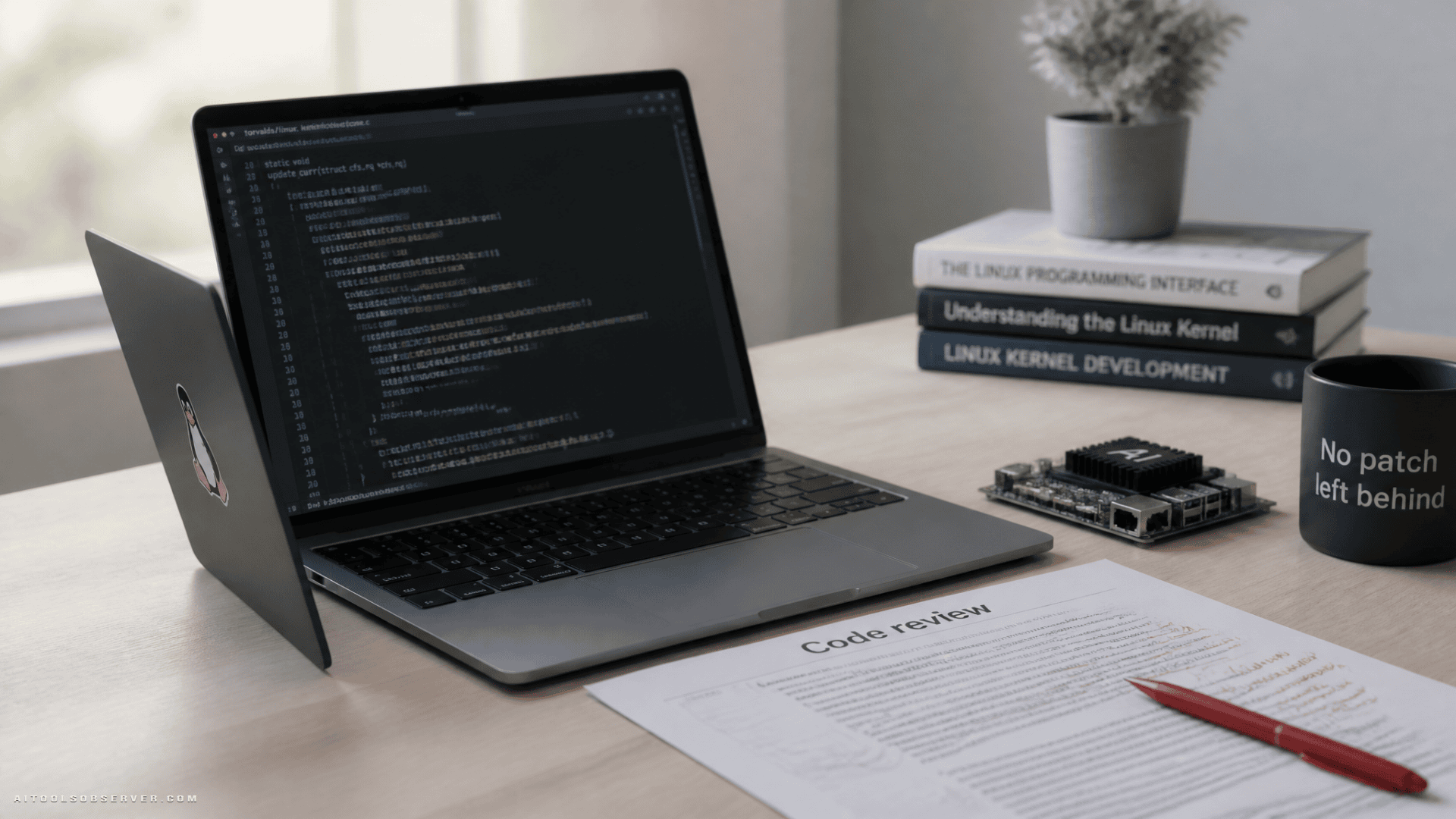
The Trigger: Sashiko and the False Positive Problem
The debate wasn’t really about Sashiko specifically. It was about whether maintainers should be subjected to automated, AI-powered bug reports at all—true or false.
One commenter cited the Software Freedom Conservancy’s position that the open source community should “support, not just tolerate” those who outright reject LLM tools, and that every FOSS contributor deserves “self-determination” on the matter.
Torvalds pushed back hard. He said he won’t force anyone to use AI tools, but he’ll “very loudly ignore” anyone trying to stop others from using them.
Torvalds’ Case: Technical Merit, Not Fear
His position is framed as pragmatic rather than ideological. “AI is a tool, just like other tools we use,” he wrote. “And it’s clearly a useful one.”
He also turned the criticism around: anyone pointing to AI’s flaws should be equally willing to point at human code maintainers. Natural intelligence, he noted, isn’t always all that great either.
This isn’t Torvalds’ first brush with AI tooling. Earlier this year, he described experimenting with vibe coding to build a Python audio visualizer for a guitar pedal project—cutting out “the middle-man-me” by going straight to an AI assistant.
The Productivity Question Is Still Open
The utility argument is murkier than Torvalds suggests. A study by METR found that open source developers using AI coding tools were actually 19% less productive than those who didn’t—even while feeling 20% more productive.
That said, the same researchers followed up in early 2026 suggesting the gap may be closing, citing early results and participant conversations. The honest read: AI coding tools are getting more useful, but the evidence isn’t settled.
The Legal Angle Nobody’s Fully Resolved
There’s a quieter issue lurking beneath the governance debate. LLM-generated code may not be copyrightable—which raises real questions about whether it can be licensed under the GPLv2 or any other copyright-enforced license without substantial human input.
For now, public domain code can coexist with GPL code without obvious conflict. But as AI-generated contributions scale up in open source projects, the licensing question could become harder to sidestep.
Meanwhile, Not Everyone Is Rolling Out the Welcome Mat
The open source community isn’t uniformly warming to AI tools. The developer behind the jqwik Java testing library took a more adversarial stance in May, embedding a hidden prompt-injection instruction designed to make vibe coding bots delete all jqwik tests and code.
That’s a pointed signal: some maintainers aren’t waiting for governance debates to resolve. They’re building defenses into the codebase itself.
What This Means for AI Tool Adopters
The Linux kernel debate is a useful bellwether for anyone building with or around AI coding tools. A few things worth tracking:
- False positive rates matter at scale. A 20% noise rate is manageable in a small repo. In a project with Linux’s volume, it’s a maintainer tax.
- Governance is catching up slowly. Open source communities are still figuring out norms, and Torvalds’ position—permissive but not prescriptive—is likely to influence how other major projects respond.
- The legal layer is unresolved. Copyright status of LLM output is a real open question, not a fringe concern.
Torvalds’ stance won’t end the debate. But it does set a tone: judge the code, not the tool that helped write it.











Comments (0) No comments yet
Want to join this discussion? Login or Register.
No comments yet. Be the first to share your thoughts!