


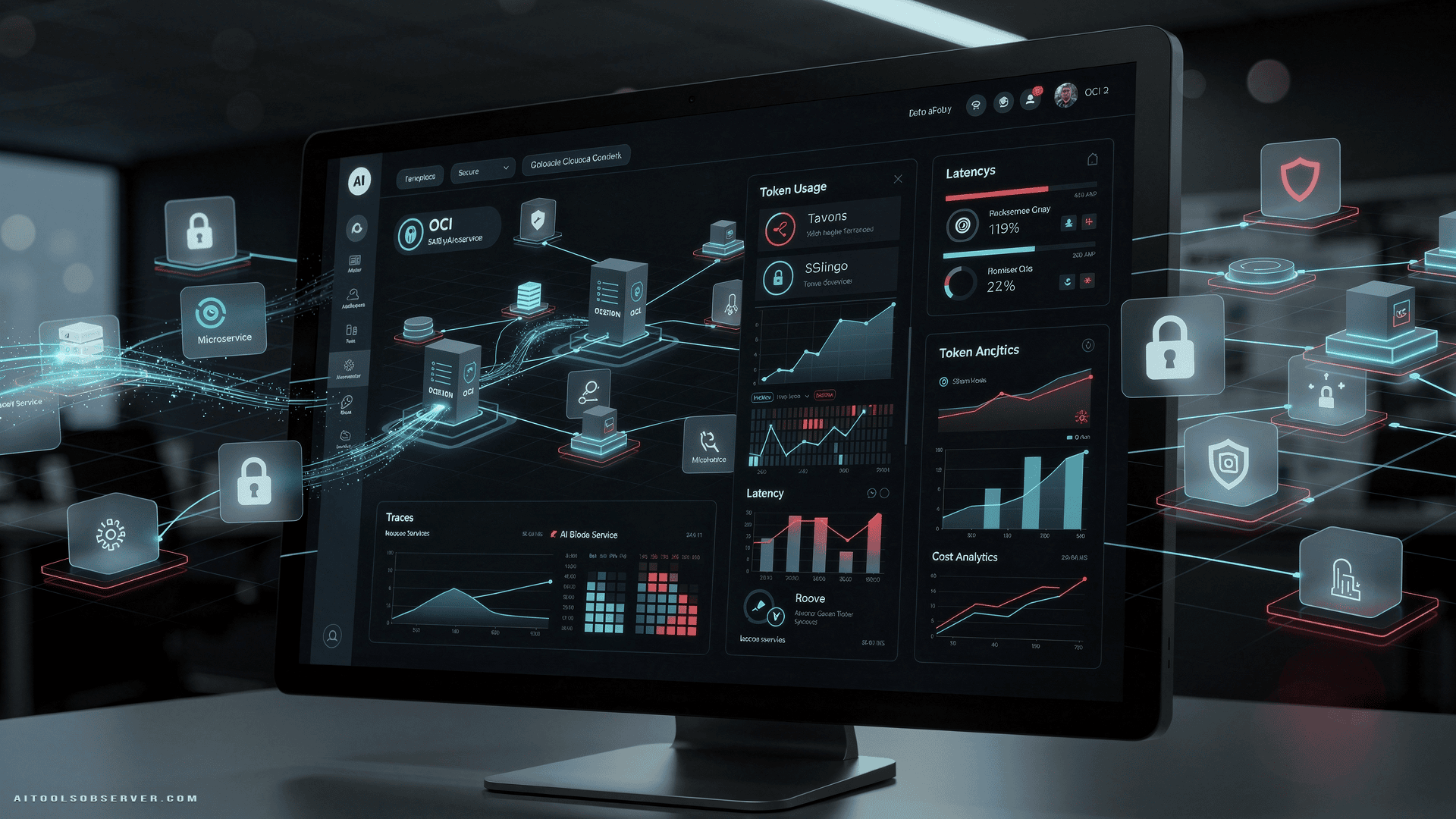
The Problem with Traditional Logs in AI Systems

Standard application logs capture service activity and errors. They do not capture the AI decision path. When a model chooses a tool, a prompt influences routing, or a retry inflates latency and cost, none of that appears in a conventional log entry.
Without structured AI observability, enterprise teams face a specific set of blind spots: limited traceability across model calls and tools, hidden token consumption and cost growth, difficulty isolating which prompt or step produced a poor answer, and governance gaps around metadata and output lineage.
These are not edge cases. In production AI workflows, they are the norm.
Langfuse addresses this by converting AI execution into a structured operational record. It captures traces, observations, metadata, latency, token usage, cost, evaluation scores, and datasets — all inspectable and improvable over time.
One Request, One Trace

The foundational design principle for AI observability is straightforward: one user request maps to one Langfuse trace.
A trace represents the full lifecycle of that request. Observations within it capture individual model calls, tool calls, retrieval steps, routing decisions, and downstream actions. In a flat workflow, this is simple. In a nested or multi-agent workflow, it becomes the difference between a coherent execution tree and a scattered collection of disconnected log lines.
In the OCI-aligned implementation described here, Langfuse tracing uses a consistent root trace identity propagated through the entire AI workflow — including trace URLs, metadata, environment tags, callback handlers, and parent span propagation. A useful trace surfaces which model was called, which prompt or workflow version was active, which tools were invoked, where latency accumulated, how many tokens were consumed, and what the estimated cost was.
This level of visibility is not a debugging convenience. It is an operational requirement for any AI system running in production.
Cost Control and Token Visibility

Cost is one of the most underestimated challenges in enterprise AI. A single user-facing answer can involve hidden planning calls, routing decisions, tool executions, summarization steps, retries, and evaluation passes. Without observation-level usage tracking, teams see only the surface cost — not the real one.
Langfuse supports two approaches to cost and usage data. Teams can ingest usage details explicitly via API, SDKs, or integrations, or allow Langfuse to infer cost based on the model parameter of each generation. Both approaches feed into a consistent metrics layer.
Practical monitoring presets include request count, average latency, total generation cost, token usage, daily request trends, observation breakdowns, environment-specific request counts, and cost or latency trends segmented by workflow version or execution category. This gives engineering and product teams the data they need to understand cost drivers before they become budget problems.
Evaluation as a Feedback Loop

Observability without evaluation is incomplete. Knowing what happened is useful. Knowing whether it was good is what drives improvement.
Langfuse supports structured evaluation by allowing teams to attach scores to traces, review execution paths, build labeled datasets, and compare the effects of prompt or model changes over time. Teams can assess whether an answer was useful, grounded, policy-aligned, and produced through the correct workflow path.
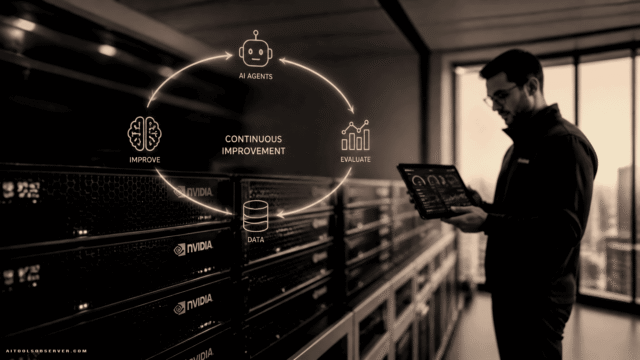
This turns quality improvement from a manual guessing exercise into a repeatable feedback loop — one that accumulates evidence rather than relying on intuition.
Self-Hosting on OCI: Architecture That Holds at Scale

For enterprise deployments, self-hosting is not optional — it is a data governance requirement. Tracing data contains prompts, context, tool inputs, outputs, and user-linked metadata. That data should not leave the enterprise boundary without deliberate policy.
Langfuse supports two practical deployment patterns on OCI: a VM-based setup using Docker Compose for simpler environments, and an OKE (Oracle Kubernetes Engine) deployment for teams that need Kubernetes-native scaling and operational control. Credentials and secrets are resolved through OCI Vault, keeping sensitive configuration out of application code and container images.
Architecture Components

The production architecture separates concerns cleanly across several layers:
- Postgres handles transactional state — system configuration, user data, and operational records.
- ClickHouse stores high-volume observability data — traces, observations, and scores — at analytics scale.
- Redis absorbs cache and queue traffic, decoupling the web layer from background processing.
- Async worker processes events in the background, offloading the web server from heavy computation.
- S3 or Blob Storage holds raw events, exports, and multimodal attachments.
- Langfuse web server handles all UI, API, and SDK traffic.
- An optional LLM API or gateway supports playground and evaluation-related flows, deployable within the same VPC or via VPC peering.
This separation is what makes Langfuse viable at enterprise scale. Each component handles a distinct workload class. Together, they prevent the observability layer from becoming a bottleneck in the systems it is meant to monitor.
Multi-Agent Systems: Tracing Across Agents and Tools

Multi-agent architectures introduce a specific tracing challenge. When an orchestrator delegates to specialized agents, and those agents invoke tools, the execution path fans out across multiple components. Without a shared trace context, the result is a collection of disconnected logs that no one can reconstruct into a coherent picture.
Langfuse solves this with a clear structural rule: the orchestrator creates the root trace and root span. Downstream agents continue that same trace with child spans. Tool calls appear as nested spans under the agent that invoked them.
The result is a single execution tree that shows which agent handled each part of the request, what tools were called and in what sequence, where latency increased, and which steps consumed the most tokens and cost. This structure also preserves decision lineage — valuable for audits, incident reviews, and understanding how one user request expanded into multiple agent and tool actions.
Custom Dashboards for Ongoing Monitoring

Langfuse supports custom dashboards that track system behavior over time. Useful examples include token consumption per agent, cost attributed to specific agents over a rolling window, and average response latency per workflow stage. These dashboards move observability from reactive debugging to proactive operational awareness.
What Comes Next: From Observability to Active Control

The current implementation establishes the observability foundation. The logical next step is to move from passive observation into active control.
Langfuse provides an evaluation framework, prompt management, and LLM-as-a-judge capabilities that become increasingly valuable as agentic systems grow in complexity. These features allow teams to test prompt changes systematically, score outputs automatically, and close the loop between what the system does and what the organization expects it to do.
Observability is the prerequisite. Evaluation and prompt management are what make continuous improvement operational.
Closing Reflection
Enterprise AI raises a question that goes beyond model capability: can the organization understand, trust, operate, and improve how its AI systems produce answers?
Langfuse makes that question answerable. It provides the tracing, cost visibility, evaluation infrastructure, and self-hosted deployment patterns that enterprise teams need to run AI workflows with the same operational discipline they apply to any other production system.
In an environment where a single user question can trigger dozens of model and tool interactions, visibility is not a feature — it is the foundation.





Comments (0) No comments yet
Want to join this discussion? Login or Register.
No comments yet. Be the first to share your thoughts!