


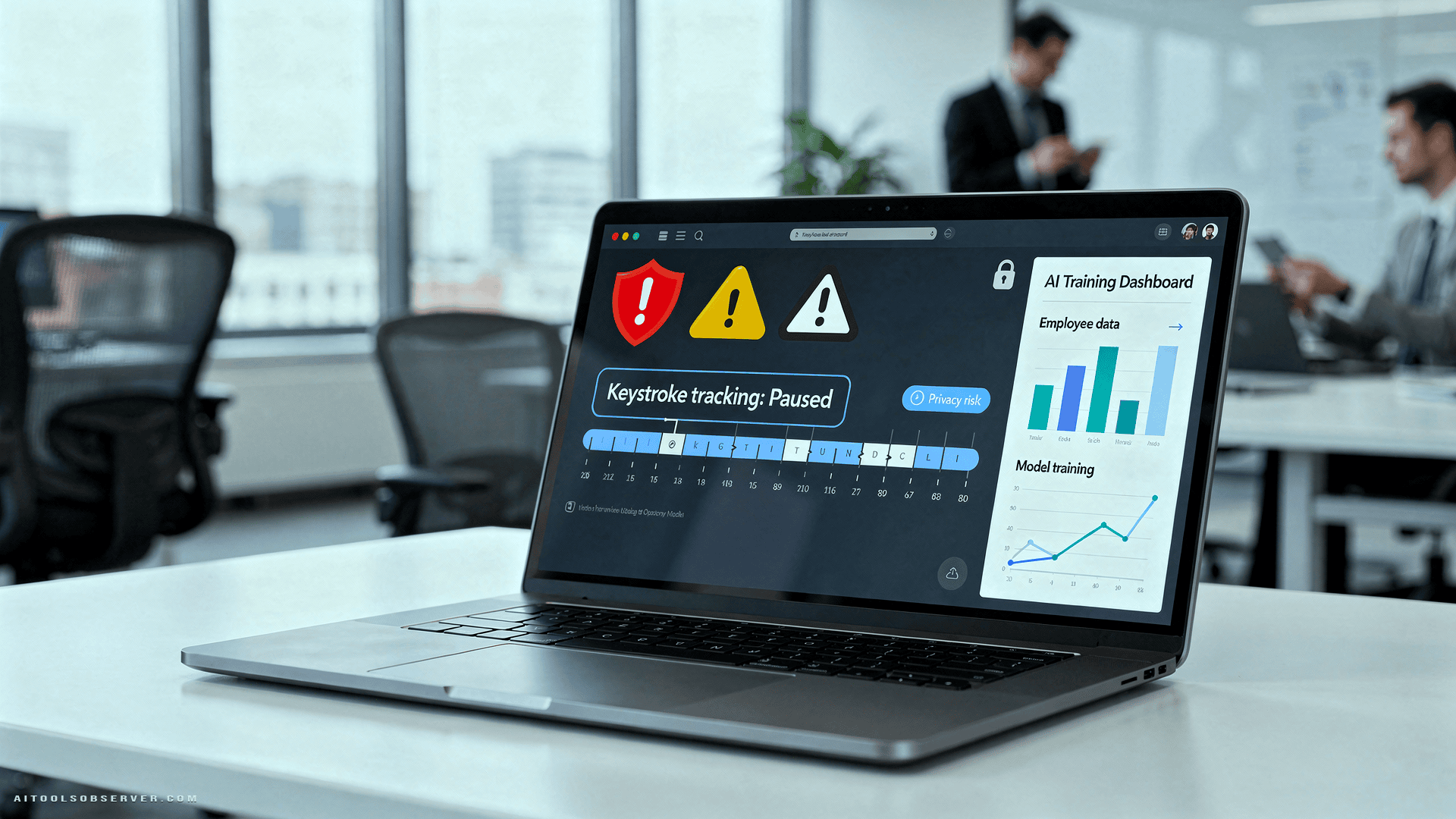
What the Model Capability Initiative Actually Was

Meta introduced the MCI with a straightforward rationale. If the company intends to build AI agents capable of completing everyday computer-based tasks, it needs real behavioral data — how people actually navigate software, type, click, and work. The logic is technically sound. Synthetic data has limits; observed human behavior provides signal that is difficult to replicate artificially.
Meta told the BBC at launch that the collected data was “not used for any other purpose” and that “safeguards in place protect sensitive content.” Multiple layers of risk review were cited as evidence of due diligence.
The problem was not the explanation. The problem was the context in which it landed.
Why Employees Pushed Back Hard

Meta has laid off approximately 2,000 employees this year. In April, the company announced plans to cut a further 10 percent of its workforce — roughly 8,000 additional roles. Against that backdrop, asking remaining staff to have their every keystroke logged to train the AI systems potentially replacing their colleagues was always going to generate friction.
One current Meta employee described the experience to the BBC as feeling “very dystopian.” A recently departed employee was more direct, calling the tracking tool “just the latest way they’re shoving AI down everyone’s throat.”
Beyond the symbolic weight, there were practical grievances. Employees working from home reported that the MCI consumed enough bandwidth to cause noticeable internet usage spikes. Battery life on laptops was also affected — a concrete, daily irritant that made the tool impossible to ignore.
What Has Actually Changed
According to an internal memo seen by Reuters, authored by Stephane Kasriel — a vice president within Meta’s Superintelligence Labs unit — the team behind the MCI has introduced several concrete adjustments.
Employees can now pause data collection for up to 30 minutes at a time. They can also request full exemptions from the initiative. The memo additionally cited “several optimizations” to reduce the tool’s impact on battery life and data consumption.
Kasriel acknowledged the concerns directly:
“While we remain confident in the privacy protections we put in place at launch, which went through several layers of risk review, we have heard your concerns about personal data on work devices, battery life, and wanting more control over when capturing happens.”
Meta declined to comment on the record.
The Broader Signal for AI Tool Governance
This episode is not simply an internal HR story. It illustrates a structural tension that will increasingly surface across the enterprise AI landscape: the gap between what is technically permissible and what is organizationally acceptable.
Data collection for AI training is legitimate. Behavioral data from real users is genuinely valuable. But deploying such tools on a workforce already anxious about automation — without meaningful opt-out mechanisms from the outset — is a governance failure, not a technical one.
The fact that pause controls and exemption requests were not part of the original design is telling. These are not complex features. Their absence suggests the initial rollout prioritized data volume over workforce trust.
What This Means for AI Adopters and Enterprise Decision-Makers
For anyone evaluating AI tools that involve employee activity monitoring, behavioral logging, or productivity tracking, the Meta situation offers a practical checklist worth internalizing.
Consent architecture matters at launch, not as a retrofit. Opt-out and pause mechanisms should be default features, not concessions extracted through internal petitions.
Context shapes perception. The same tool deployed in a stable, growing organization lands differently than one deployed during layoff cycles. Timing and organizational climate are variables in adoption success.
Performance impact is a trust issue. When a monitoring tool visibly degrades the devices people depend on daily, it stops being abstract and becomes personal. Technical performance is inseparable from employee buy-in.
Transparency has limits without agency. Meta explained what the tool did. What it failed to provide initially was meaningful control. Explanation without agency is not sufficient for workforce trust.
Closing Observation
Meta’s partial retreat from the MCI is not a defeat for AI training ambitions — the initiative continues, and the data collection rationale remains intact. What changed is the degree of control employees have over their own participation.
That shift, modest as it appears, reflects a broader reality taking shape across the AI industry: the workforce is not a passive data substrate. When the people building and using AI tools push back, even the most resource-rich organizations have to listen. The question for every enterprise deploying AI internally is whether they build that listening into the design from the start — or wait for the petition to arrive.














Comments (0) No comments yet
Want to join this discussion? Login or Register.
No comments yet. Be the first to share your thoughts!