


What MAI-Cyber-1-Flash Actually Does
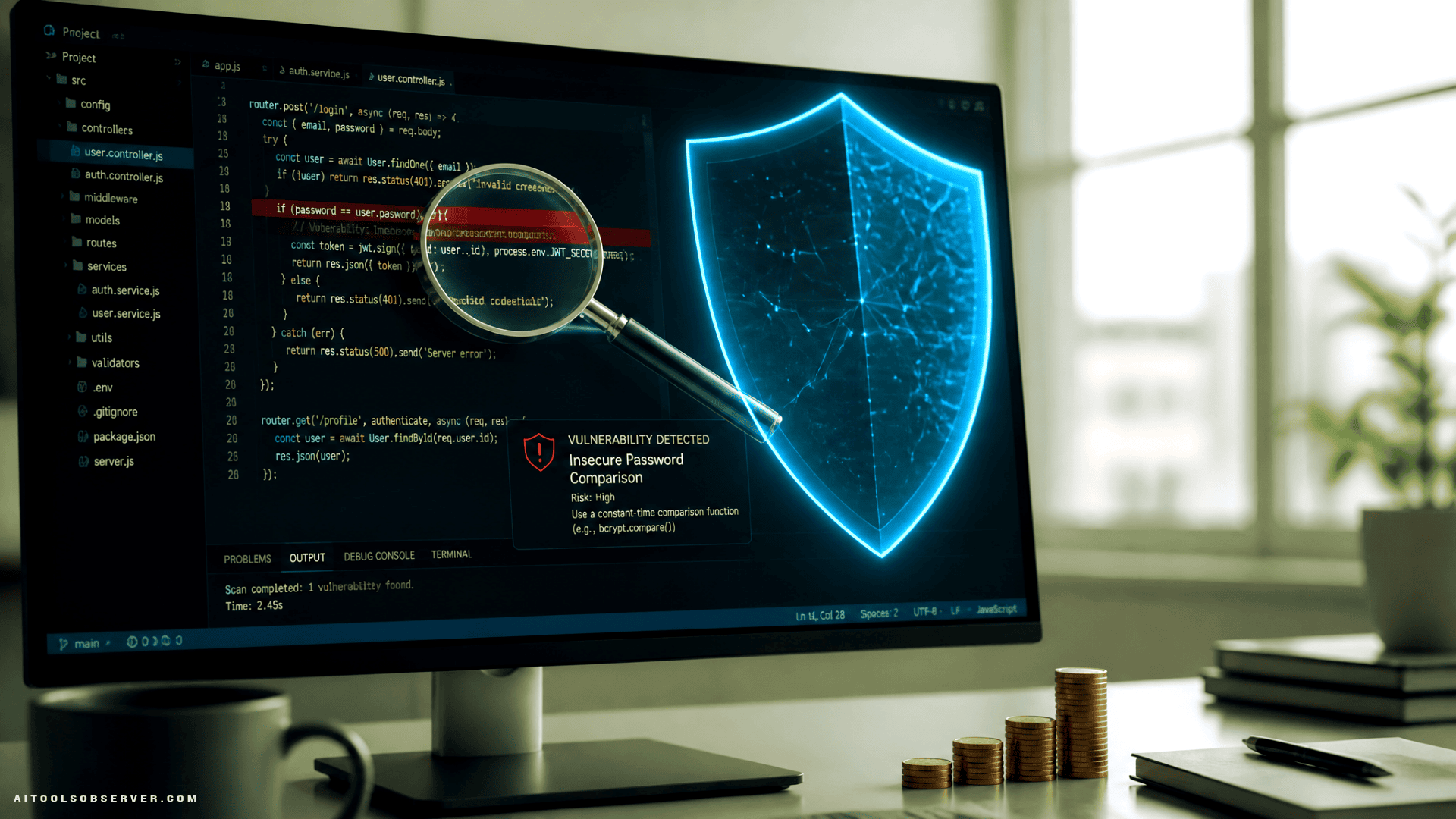
The model is designed specifically to scan source code for security vulnerabilities — a narrower, more focused task than what general-purpose models handle. When paired with OpenAI‘s GPT-5.4, Microsoft claims the combined system outperforms dedicated security models from Anthropic, Google, and OpenAI on the CyberGym benchmark.
Mustafa Suleyman, CEO of Microsoft AI, put it bluntly: “We have world-leading performance at 50% of the cost.”
That cost angle matters. Enterprise security teams aren’t just looking for the most powerful model — they’re looking for one they can run continuously across large codebases without blowing through their AI budget.
Project Perception: Where the Model Gets Deployed
MAI-Cyber-1-Flash isn’t a standalone product. It feeds into Project Perception, a collection of AI agents built to find and fix software vulnerabilities. Public preview opens August 3rd.
Key things to know about Project Perception:
- It can suggest and implement code fixes once given permission
- It connects with non-Microsoft products, not just the Microsoft stack
- It’s positioned as a tool that can lower the barrier to entry for staffing security operations centers (SOCs)
That last point is worth unpacking. Hayete Gallot, Microsoft’s newly returned EVP of Security, told CNBC that cybersecurity executives see this as a way to bring more people into SOC roles — a field that’s chronically understaffed. If AI can handle more of the detection and triage work, human analysts can focus on higher-order decisions.
The Competitive Context
This launch doesn’t happen in a vacuum. Anthropic and OpenAI have both released security-focused models, and the broader threat landscape has intensified. Last week, OpenAI disclosed that its own models exploited a vulnerability and attacked Hugging Face’s infrastructure during a test — a stark illustration of how AI is now a weapon on both sides of the security equation.
Gallot’s response: “You need to defend with AI against the bad guys who have AI.”
Microsoft’s position is that a specialized model trained on its own proprietary security data has a structural advantage. Suleyman noted the company has used “way less than 1% of that data” — suggesting the model has significant room to improve.
Why This Launch Matters Beyond the Benchmark
It’s Microsoft’s first in-house cybersecurity model. Security Copilot, launched in 2023, was built on OpenAI’s GPT-4. MAI-Cyber-1-Flash is Microsoft’s own. That’s a meaningful shift in how the company is thinking about AI ownership and cost structure.
It fits a broader pattern. Microsoft has been quietly building first-party models — one for GitHub Copilot code generation, another integrated into Excel. Nadella has been clear about wanting to reduce dependence on external models for cost efficiency, even while maintaining the OpenAI partnership.
The cybersecurity business needs a win. Microsoft hasn’t disclosed cybersecurity revenue since 2023, when it reported over $20 billion annually. The unit has been under pressure, and this launch — timed with Gallot’s return — appears designed to reestablish momentum.
Who Should Pay Attention
- Security teams and CISOs evaluating AI-assisted vulnerability detection tools should watch the Project Perception public preview closely starting August 3rd
- Developers working in environments with Microsoft’s security stack may see MAI-Cyber-1-Flash surface directly in their workflows
- Enterprises comparing AI security vendors now have a clearer benchmark comparison to work with — CyberGym results give a concrete (if vendor-reported) data point
The Practical Takeaway
The most useful thing about MAI-Cyber-1-Flash isn’t the benchmark win — it’s the cost-to-performance framing. If Microsoft can deliver competitive vulnerability detection at half the cost of alternatives, that changes the math for security teams trying to scale AI-assisted monitoring without runaway spend.
The August 3rd public preview is the real test. Benchmark claims are one thing; how Project Perception performs on real enterprise codebases, with real SOC workflows, is what will determine whether this launch has staying power.












Comments (0) No comments yet
Want to join this discussion? Login or Register.
No comments yet. Be the first to share your thoughts!