


The Inbox Problem Nobody Talks About
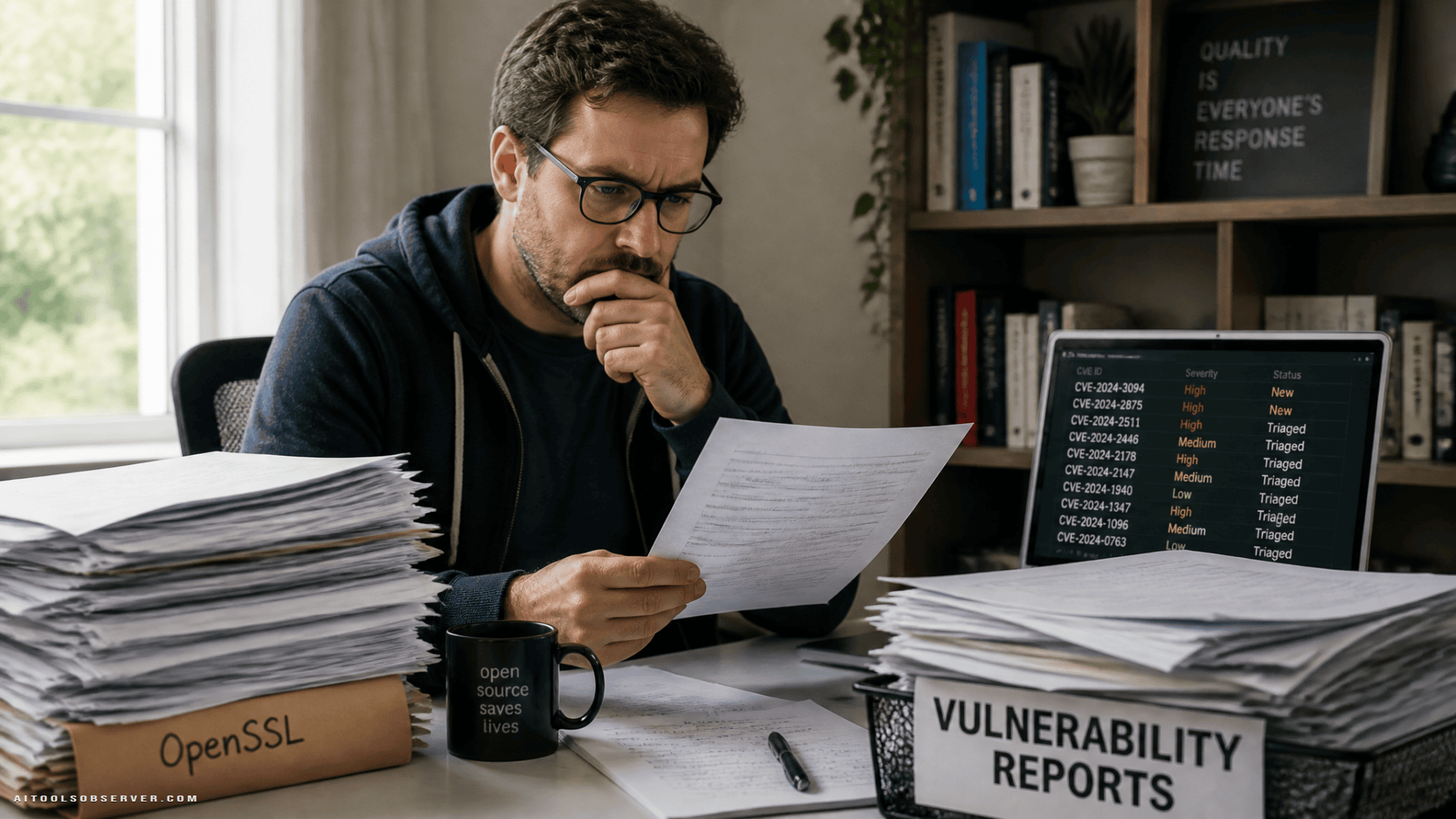
OpenSSL’s security address went from roughly nine reports a month to around seventy. That’s not a success metric—it’s a queue. Every one of those reports needs a human expert to read it, reproduce it, assess its severity, and either fix it or explain why it isn’t actually a problem.
AI lowered the cost of finding potential vulnerabilities. It did not conjure additional senior engineers to deal with them.
One in Ten
Of the 400-plus vulnerability reports OpenSSL received over the past year, around 43 resulted in a published CVE. That’s roughly one in ten.
The other nine out of ten still consumed expert time. In fact, proving something can’t be exploited is often harder than confirming it can. So the “false positive” isn’t free—it’s just unpublished.
For a well-resourced commercial security team, a 7x spike in reports is a staffing challenge. For a lean open-source project, it can be a genuine crisis.
The Asymmetry at the Heart of This
Here’s the structural problem:
- Vulnerability discovery: Getting cheaper, faster, and more automated every month.
- Vulnerability triage and remediation: Still stubbornly human, expertise-intensive, and slow to scale.
AI shifts the economics on one side of the equation without touching the other. The result is a widening gap between what gets flagged and what gets fixed.
The right question for any organisation using AI security tooling isn’t just “what can it find?” It’s “who is going to deal with everything it finds?”
Open Source as Invisible Infrastructure
Most organisations know they use open-source software. Far fewer know which projects sit three layers deep in their stack—quietly doing critical work, maintained by small teams with limited funding.
Heartbleed was a wake-up call. The industry responded, investment increased, and people started paying attention to open-source sustainability. Based on the current trajectory, some of those lessons appear to be fading.
AI could make the consequences of that much more visible, much faster.
What Organisations Can Actually Do
You don’t need to write code to support the infrastructure you depend on. But you do need to know it exists.
A useful starting point:
- Map your dependencies. If a critical CVE dropped tomorrow in a project you rely on, could you identify where it lives in your stack?
- Know who maintains it. A project with two part-time maintainers and no funding is a resilience risk, not just a technical one.
- Consider direct support. Funding, engineering resources, and community participation are all legitimate ways to reduce that risk.
Germany’s Sovereign Tech Agency has modelled one approach—treating critical open digital infrastructure as something worth investing in directly, not just regulating from a distance.
The Takeaway
More AI-powered vulnerability discovery is, on balance, a good thing. But the benefit only materialises when there are enough skilled people to act on what those tools surface.
Right now, the tools are scaling. The teams aren’t. That gap is the actual security problem—and it lives upstream of any CVE score.














Comments (0) No comments yet
Want to join this discussion? Login or Register.
No comments yet. Be the first to share your thoughts!