



What Mistral Large 4 is
Based on the available description, Mistral Large 4 is a 1-trillion-parameter open-weight model launched in preview. Mistral says it is designed to compete with leading Chinese open systems, especially across cyber, coding, finance, manufacturing, and multimodal work.
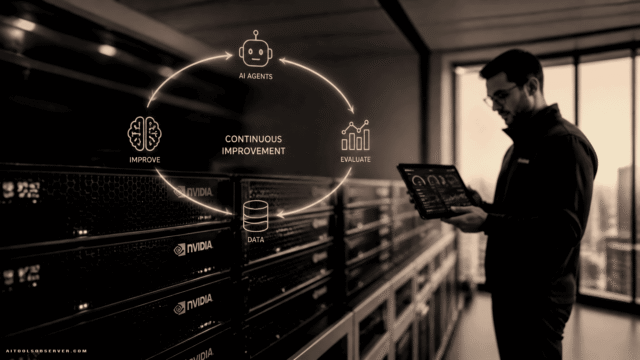
The company also says the model was trained on 4,000 Nvidia Grace Blackwell GPUs over roughly two months in Mistral-operated data centers in Europe. That matters less as a headline number than as a signal: Mistral is showing it can train at serious scale on its own infrastructure footprint.
For readers tracking launches, the key point is simple: this is Mistral moving from “important European startup” to “direct participant in the global open-model race.”
Why this launch matters now
The most useful way to read this launch is through access, not just capability.
Closed models still dominate many high-end production workflows, but open-weight models solve a different problem. They give organizations more control over deployment, tuning, compliance boundaries, and security posture. That is especially relevant in regulated sectors and for teams that cannot or do not want to depend fully on external APIs.
At the same time, the strongest open models have increasingly been associated with Chinese labs. That has made open-weight AI part of a broader geopolitical and commercial competition, not just a technical one. Mistral’s framing suggests it sees a gap in the market for a non-Chinese, high-capability open-weight alternative.
The practical positioning: cyber, coding, finance, manufacturing, multimodal
Mistral is not presenting Large 4 as a general-purpose chatbot first. The emphasis is more operational.
The stated workload focus areas are revealing:
- Cybersecurity
- Coding
- Finance
- Manufacturing
- Multimodal tasks
That mix points toward enterprise and state use cases where open deployment options matter. A model aimed at cyber workflows, for example, can be more valuable when it is controllable, auditable, and deployable in restricted environments.
The coding claim is also important, although the available context suggests the model may still trail the frontier in some coding performance. That does not make it irrelevant. For many teams, “strong enough and self-hostable” can beat “best available but closed.”
Why cybersecurity stands out
Cyber may be the most interesting angle in this launch.
The description suggests Mistral is initially opening preview access to developers, cybersecurity leaders, and state authorities before wider release. That is a notable rollout choice. It implies the company sees immediate demand in defensive security settings, where organizations want capable models without relying entirely on closed systems with strict guardrails.
This is not a trivial distinction. In security work, a model may need to analyze attack paths, simulate adversarial reasoning, inspect malicious patterns, or support incident response. Closed systems can be powerful here, but they can also refuse or limit outputs when they interpret activity as unsafe.
An open-weight model changes that operating model. It gives defenders more room to shape policies, control inference environments, and fine-tune for domain-specific use. That flexibility is useful, but it also increases responsibility. The same openness that helps defenders can raise misuse concerns if safeguards are weak.
The China benchmark angle
The title tension around this launch is straightforward: Mistral is trying to narrow or challenge a benchmark leadership gap associated with Chinese open models.
That matters for two reasons.
First, benchmark competitiveness still influences attention, adoption, and ecosystem momentum. Developers follow quality signals, even when benchmarks do not map perfectly to production reality.
Second, open-weight leadership has broader consequences. The more a model is downloaded, adapted, and embedded into downstream products, the more it shapes tooling standards and developer habits. Winning that layer can matter as much as winning the consumer chatbot layer.
Mistral’s claim, based on the available context, is that Large 4 ranks among the top global open-weight models and is the strongest such model developed outside China by a meaningful margin. Even if readers take company-framed benchmark claims cautiously, the intent is clear: Mistral wants to be the default Western reference point in open high-end models.
What enterprises should actually watch
For most buyers and technical teams, the size headline is less useful than the deployment implications.
Questions worth asking now include:
- How easy is self-hosting in practice?
- What hardware footprint will serious inference require?
- How does the model perform on long, multi-step enterprise tasks rather than narrow benchmarks?
- What governance controls exist for sensitive deployments?
- How well does it handle multilingual and multimodal workflows in production?
If Mistral Large 4 is genuinely strong in manufacturing, finance, and cyber use cases, then the real test will be workflow reliability, not launch-day positioning. Enterprises care about repeatability, security, cost control, and integration friction more than parameter counts.
The tradeoff behind a 1T-parameter open model
A 1T-parameter model sounds straightforwardly impressive, but it comes with tradeoffs.
Larger models can offer stronger capabilities across complex tasks, especially when trained and tuned well. But they can also raise compute demands, hosting complexity, and latency concerns depending on how they are deployed.
For organizations considering open-weight options, that creates a practical split:
- Teams with infrastructure and compliance needs may see a large open model as worth the complexity.
- Smaller teams may prefer lighter, cheaper models unless Large 4 delivers a clear quality jump in their domain.
So the launch is significant, but not universally decisive. It strengthens Mistral’s position at the top end of the market rather than making model selection simpler for everyone.
Where this puts Mistral
Mistral has long been treated as Europe’s most credible independent AI model builder. Large 4 appears designed to reinforce that identity with a more assertive global posture.
This release does three things at once:
- It signals training scale.
- It reinforces Mistral’s open-weight strategy.
- It places the company directly into the Western response to Chinese momentum in open AI.
That combination is strategically stronger than a generic “new flagship model” story. Mistral is not only shipping a model. It is trying to define where Western open AI can still compete on capability while keeping deployment flexibility.
Who should pay attention
This launch is most relevant for:
- Enterprises with self-hosting or sovereignty requirements
- Security teams evaluating controllable AI for defensive workflows
- Developers comparing open-weight alternatives to Chinese and closed U.S. systems
- Public sector buyers watching non-U.S., non-Chinese model options
- AI product teams that want open customization without dropping too far in performance
If your main priority is the absolute top closed-model capability, this launch may be more strategically interesting than immediately actionable. But if control, inspectability, and deployment flexibility matter, Mistral Large 4 deserves close attention.
The useful takeaway
Mistral Large 4 matters because it sharpens a choice the market increasingly has to make: closed convenience versus open control.
If Mistral can translate its preview positioning into reliable enterprise performance, especially in cyber and other regulated workflows, Large 4 could become one of the few open-weight models that serious organizations evaluate not as an experiment, but as core infrastructure.















Comments (0) No comments yet
Want to join this discussion? Login or Register.
No comments yet. Be the first to share your thoughts!