


What the study suggests
The model, described as rank-raceSurvival and published in Lancet Digital Health, was trained to predict mortality risk in cancer patients using only a facial photograph.
Based on the reported findings, patients in the highest-risk group had much worse short-term outcomes than those in the lowest-risk group. That separation is what makes the research notable. It suggests that the face may carry more health information than clinicians can easily quantify by eye.
This work appears to build on an earlier system called FaceAge, which estimates biological age from facial appearance. The underlying idea is simple: the face may reflect systemic health, frailty, inflammation, treatment burden, and other signals that are hard to summarize quickly in a clinic.
Why this matters beyond the headline
Most cancer prognosis tools rely on structured clinical data such as lab values, scans, staging, performance status, and treatment history. Those are useful, but they can also be slow, expensive, or inconsistently available.
A facial-photo model points to a very different workflow:
- fast input
- low cost
- noninvasive data capture
- potential use in triage or remote assessment
That does not mean a selfie can replace oncology workups. It means a face-based model could eventually serve as an extra layer of signal, especially when clinicians need a quick read on risk.
For AI adopters, this is the larger pattern to watch. Some of the most interesting healthcare models are not replacing doctors. They are turning overlooked signals into structured decision support.
What the model may actually be seeing
One of the more interesting details is that attention maps reportedly point to regions below the eyes and along the nose.
That tells us where the model may be focusing, but not what features it is using. It could be picking up cues related to muscle tone, skin texture, swelling, weight loss, fatigue, or other visible markers associated with illness. It may also be detecting patterns that humans do not consciously notice.
This uncertainty is important. If clinicians cannot interpret what the model is seeing, trust becomes harder to earn. In medicine, a strong result is not enough on its own. Doctors also want to know whether the signal is meaningful, stable, and clinically sensible.
The practical opportunity
If this type of model holds up in further testing, the most likely role is clinical decision support.
Possible use cases could include:
- flagging patients who may need closer review
- supplementing traditional prognosis tools
- helping standardize risk assessment across settings
- supporting remote or resource-constrained screening workflows
The value is speed and accessibility. A photo is easier to capture than many clinical variables. That matters in busy hospitals and in situations where structured records are incomplete.
For teams evaluating AI in healthcare, this is a useful example of a broader trend: models built on simple inputs can sometimes produce surprisingly strong predictions. The tradeoff is that simple input does not guarantee simple deployment.
The biggest concerns: bias and reliability
This is where the excitement meets the hard part.
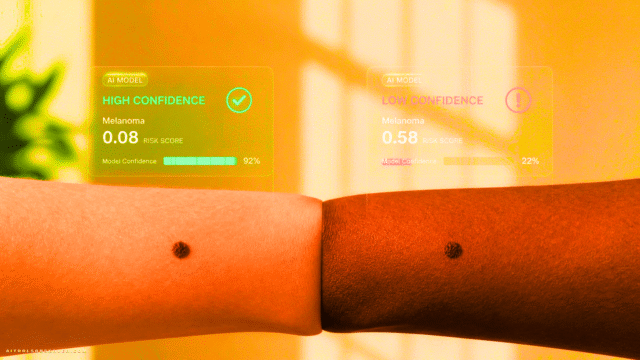
Facial-analysis systems have a long history of bias concerns. If a model performs differently across race, age, sex, lighting conditions, camera quality, or treatment-related appearance changes, the risk is not just technical. It becomes a care equity problem.
Outside experts are right to focus on two questions:
- Does the model add information beyond what doctors already know?
- Does it work fairly across diverse patient populations?
Those are the tests that matter. A model can be statistically interesting and still fail to be clinically useful.
Real-world reliability is another issue. Hospitals do not operate under clean lab conditions. Images vary. Patients present differently. Treatments can alter facial appearance in ways unrelated to long-term survival. Any production-ready system would need to handle that messiness without creating false confidence.
Why this research fits a bigger AI pattern
This study sits at the intersection of two active AI themes in healthcare.
The first is multimodal risk prediction: using images, text, and other inputs to estimate outcomes more accurately. The second is biological age modeling: using visible or measurable traits to infer underlying health rather than just chronological age.
That is why this research is worth watching even if the current model never becomes a standard tool. It shows how AI keeps pushing into areas where human judgment is intuitive but hard to measure.
For founders and product teams, the lesson is clear. New AI value often comes from converting subtle, messy signals into something structured enough to compare, rank, and act on.
What healthcare buyers should watch next
If you are evaluating medical AI tools, this kind of headline should trigger a checklist, not instant enthusiasm.
Look for answers to questions like:
- Was the model validated on diverse patient groups?
- How does it perform compared with standard clinical assessment?
- Does it improve decisions or only correlate with outcomes?
- Can clinicians understand when to trust it and when not to?
- What safeguards exist around consent, privacy, and image handling?
These are the filters that separate an interesting paper from a workable product.
The takeaway
A single face photo predicting cancer survival risk is not a clinical shortcut yet. It is a signal that AI may be able to extract useful prognosis clues from ordinary images, but only if that signal proves accurate, additive, and fair in real care settings.
For anyone tracking healthcare AI, the smart move is to treat this as promising research with a high bar for adoption. The useful question is not whether the model looks impressive in a study. It is whether it can improve decisions without introducing new risk.






Comments (0) No comments yet
Want to join this discussion? Login or Register.
No comments yet. Be the first to share your thoughts!