


What Nvidia Is Actually Claiming
Huang’s framing was characteristically bold. He compared the RTX Spark’s potential impact to the transformation of the mobile phone into the smartphone — a reinvention of the personal computer as a category, not merely an upgrade of its internals.
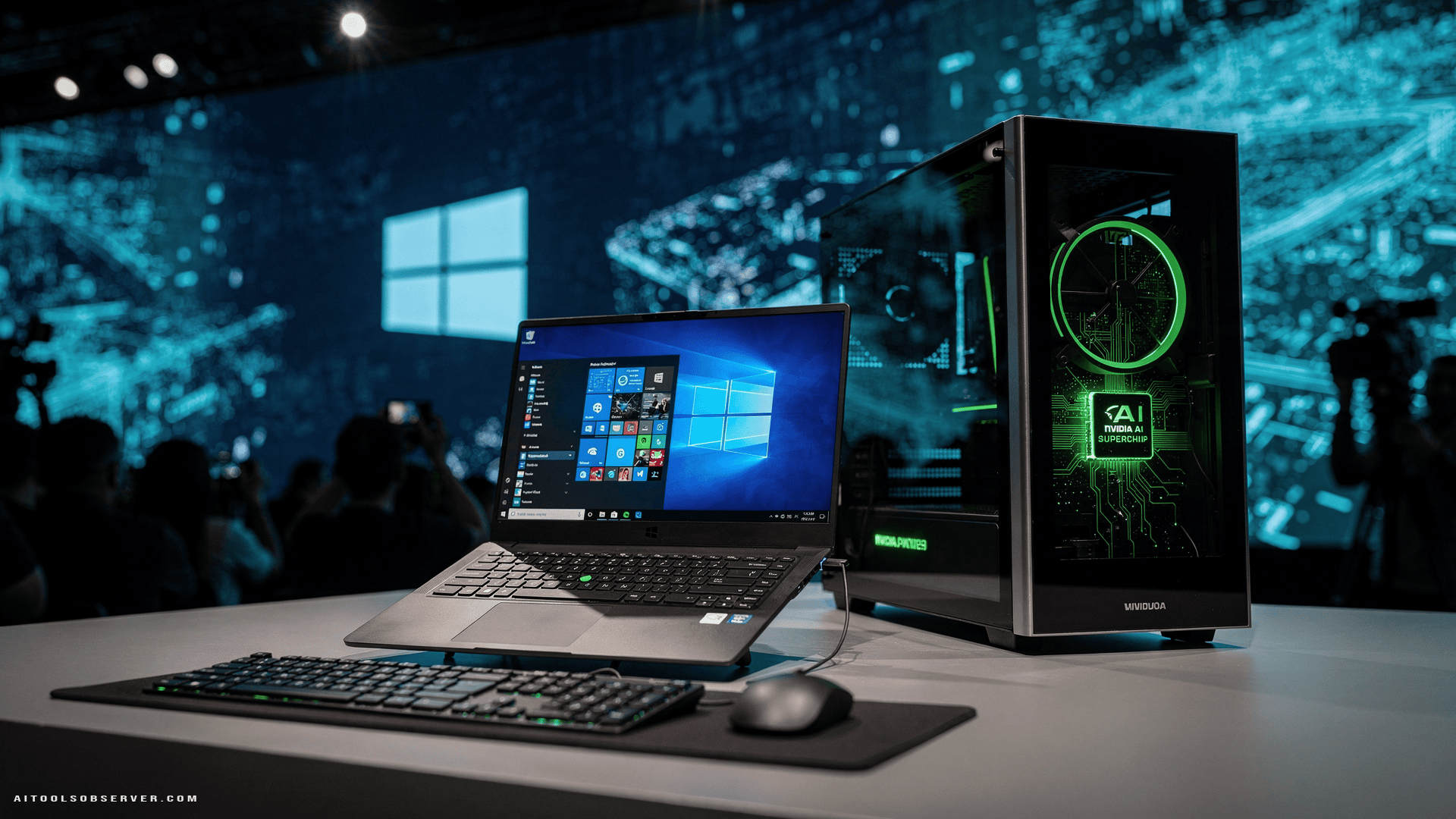
Nvidia’s official positioning describes the chip as built “for the era of personal AI agents,” enabling a new class of device that moves from being a passive tool to an active teammate. That language is precise in its intent: it positions the RTX Spark not as a faster GPU, but as the foundation for ambient, always-available AI assistance running entirely on local hardware.
Whether the software ecosystem catches up to that ambition is a separate question. The hardware architecture, however, appears engineered with that goal in mind.
A Superchip, Not Just a GPU

The RTX Spark is described as a superchip, implying a tightly integrated design that combines GPU compute, AI acceleration cores, and likely memory bandwidth optimised for inference workloads. Nvidia has not published full technical specifications at the time of writing, but the product positioning aligns closely with the company’s broader Blackwell architecture family — adapted for thermal and power constraints appropriate to consumer PCs.
Who Is Building With It

The initial wave of RTX Spark-powered Windows PCs will come from Lenovo, HP, Dell, Microsoft Surface, Asus, and MSI, with Acer and Gigabyte following in subsequent releases. Availability is targeted for autumn 2025.
That roster covers the full spectrum of the Windows PC market — from enterprise-grade business machines to consumer and gaming-oriented devices. The breadth of the partner list is itself a signal: Nvidia is not positioning this as a niche enthusiast product.
Challenging Apple and Intel on Their Own Ground

The PC market is not a greenfield opportunity. Lenovo, HP, Dell, and Apple collectively held nearly 75% of global PC market share in Q1 2025, according to Gartner. Apple’s M-series silicon has set a high benchmark for integrated AI and CPU performance in consumer hardware. Intel, meanwhile, has been pushing its own AI PC narrative through the Core Ultra processor line.
Nvidia’s entry changes the competitive calculus. The company brings unmatched credibility in AI acceleration — its GPUs are the de facto standard for training and inference at scale. Translating that authority into the consumer PC segment gives OEM partners a compelling differentiator and gives buyers a clear performance signal.
The Geopolitical Backdrop

The announcement arrived alongside a separate development: the US Department of Commerce tightened export rules on Sunday to close a potential loophole that could have allowed Nvidia’s most advanced chips — including Blackwell processors — to reach Chinese firms through subsidiaries based outside China. Washington’s ongoing effort to restrict Chinese access to frontier AI hardware continues to shape Nvidia’s global market strategy.
For the RTX Spark’s consumer rollout, the immediate impact is limited. But the regulatory environment underscores how strategically significant Nvidia’s chip architecture has become — and why controlling the consumer endpoint matters as much as the data centre.
Who This Is For

The RTX Spark-powered PC line is aimed squarely at professionals, developers, and AI-forward knowledge workers who want to run capable AI models locally — without latency, without subscription costs, and without sending sensitive data to external servers. It will also appeal to the growing segment of technically informed consumers who understand that on-device inference is both faster and more private than cloud-dependent alternatives.
For enterprise buyers, the proposition is straightforward: a Windows PC that can run AI agents, local LLMs, and inference workloads without requiring a cloud connection or a separate AI appliance.
For developers building AI-native applications, the RTX Spark ecosystem represents a standardised, widely distributed hardware target — something that has been notably absent from the Windows AI PC story until now.
Pricing and Availability
Specific pricing has not been announced at the device level. Given the partner lineup — which spans budget-conscious OEMs like Acer alongside premium brands like Microsoft Surface — a wide price range is expected. Autumn 2025 is the confirmed availability window for the first wave of devices.
The Broader Signal

Nvidia’s move into consumer AI hardware is not a pivot — it is an extension. The company has built its $5 trillion valuation on the infrastructure layer of the AI boom. The RTX Spark is the logical downstream step: bringing that infrastructure capability to the edge, to the individual, to the everyday machine.
Jensen Huang’s smartphone analogy deserves to be taken seriously, not as marketing hyperbole, but as a structural observation. The smartphone redefined what a phone was for. If on-device AI agents become genuinely useful — and the hardware is finally capable enough to run them — the PC may be undergoing a similar identity shift.
The RTX Spark is Nvidia’s bet that it will be the chip at the centre of that shift. The autumn release window will tell us whether the market agrees.


















Comments (0) No comments yet
Want to join this discussion? Login or Register.
No comments yet. Be the first to share your thoughts!