



$605 Billion in Two Moves
The scale of Nvidia’s recent financial commitments is worth pausing on. In the span of roughly one week, the company announced two major capital deployments totaling approximately $605 billion.
The first was a memorandum of understanding with a group of major Wall Street firms—including Goldman Sachs, Apollo Global Management, Blackstone, and BlackRock—to pursue $500 billion in GPU financing. The framing was deliberate: Nvidia CEO Jensen Huang positioned GPUs as a new asset class, comparable to real estate, with Nvidia retaining the option to backstop 25% of every loan made under the arrangement.
The second was a commitment of up to $105 billion to support a large OpenAI data center in Ohio, including a $1.5 billion investment in SB Energy, the SoftBank affiliate managing the site, and financial backing for roughly 4 gigawatts of development capacity opening between 2028 and 2030.
These are not marketing announcements. They are structural interventions in how AI infrastructure gets financed.
The Problem Nvidia Is Solving—For Itself
Huang’s explanation for the Ohio deal was candid. Frontier AI labs, he wrote,
“are growing faster than their balance sheets and long-term credit profiles can support.”
They have strong revenue growth but lack the decades-long infrastructure contracts and investment-grade financing capacity needed to secure large-scale compute independently.
That is a real constraint. Anthropic recently reported an annualized revenue run rate of $65 billion, up sevenfold in a year. OpenAI‘s run rate has reached $40 billion. These are fast-growing businesses, but fast growth does not automatically translate into the kind of credit profile required to sign 20-year data center leases.
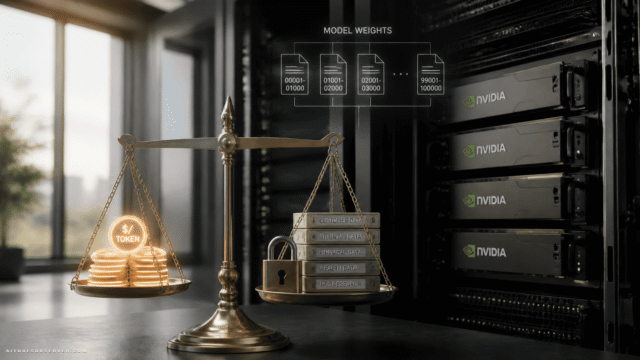
Nvidia is stepping in to bridge that gap—and in doing so, it is ensuring that the infrastructure being built runs on its hardware. The financing is not neutral. It is tied to Nvidia’s systems, which means every loan backstopped and every data center funded is another lock-in point in the ecosystem.
Capital as a Competitive Moat
This shift in strategy reflects a broader reality: when your technology lead narrows, your balance sheet can compensate.
Nvidia’s cash generation has grown 18-fold over three years. The company holds over $30 billion in marketable equity securities, up from roughly $13 billion a year earlier, with investments spread across model developers, neoclouds, and infrastructure companies—many of which are also heavy Nvidia chip buyers. It recently increased its quarterly dividend from one cent to 25 cents per share and announced an $80 billion buyback program.
The pattern is consistent: Nvidia is recycling its profits into the AI ecosystem in ways that reinforce demand for its own products. Equity investments, financing backstops, and infrastructure commitments all serve the same function—they keep the build-out moving and keep Nvidia at the center of it.
Some analysts have raised the question of circularity: is Nvidia effectively buying its own revenue? Analysts at Cantor addressed this directly, arguing the strategy is better understood as facilitating the broader AI infrastructure build-out while creating additional competitive moats. Whether that framing holds over time depends on whether the underlying demand for AI compute remains as strong as current run rates suggest.
What This Means for the Competitive Landscape
For AMD and Google, the challenge is no longer just matching Nvidia’s chip performance. They now face a competitor that is also a financing partner, an infrastructure backer, and an equity investor across the AI stack.
That is a harder position to replicate quickly. AMD can build better chips. Google can sell TPUs. Neither has Nvidia’s current cash generation or the established relationships with Wall Street that make large-scale financing arrangements possible at this speed.
The risk for Nvidia is that this strategy works only as long as AI infrastructure demand remains supply-constrained. If the market tips toward overcapacity—a scenario that analysts acknowledge is possible, if not imminent—the financing commitments and equity positions become liabilities rather than assets.
For now, the capacity shortage is real. The question is how long it stays that way.
What to Watch
For anyone tracking the AI tools and AI infrastructure ecosystem, a few implications are worth keeping in mind:
- Financing terms will shape which AI labs scale fastest. Labs that can access Nvidia-backed financing will be able to build infrastructure they could not otherwise afford. That affects which models get trained, at what scale, and on whose hardware.
- GPU-as-asset-class is a new market structure. If institutional capital starts flowing into GPU financing the way it flows into real estate, the economics of AI infrastructure change significantly—and so does the risk profile of the companies building on top of it.
- Nvidia’s equity portfolio is a signal. The companies Nvidia invests in tend to be the ones building on Nvidia hardware. Tracking that portfolio gives a reasonable proxy for where the next wave of AI infrastructure spending is likely to land.
The GPU business made Nvidia dominant. The capital strategy is what Nvidia is betting will keep it there.
















Comments (0) No comments yet
Want to join this discussion? Login or Register.
No comments yet. Be the first to share your thoughts!