
What Is mia?
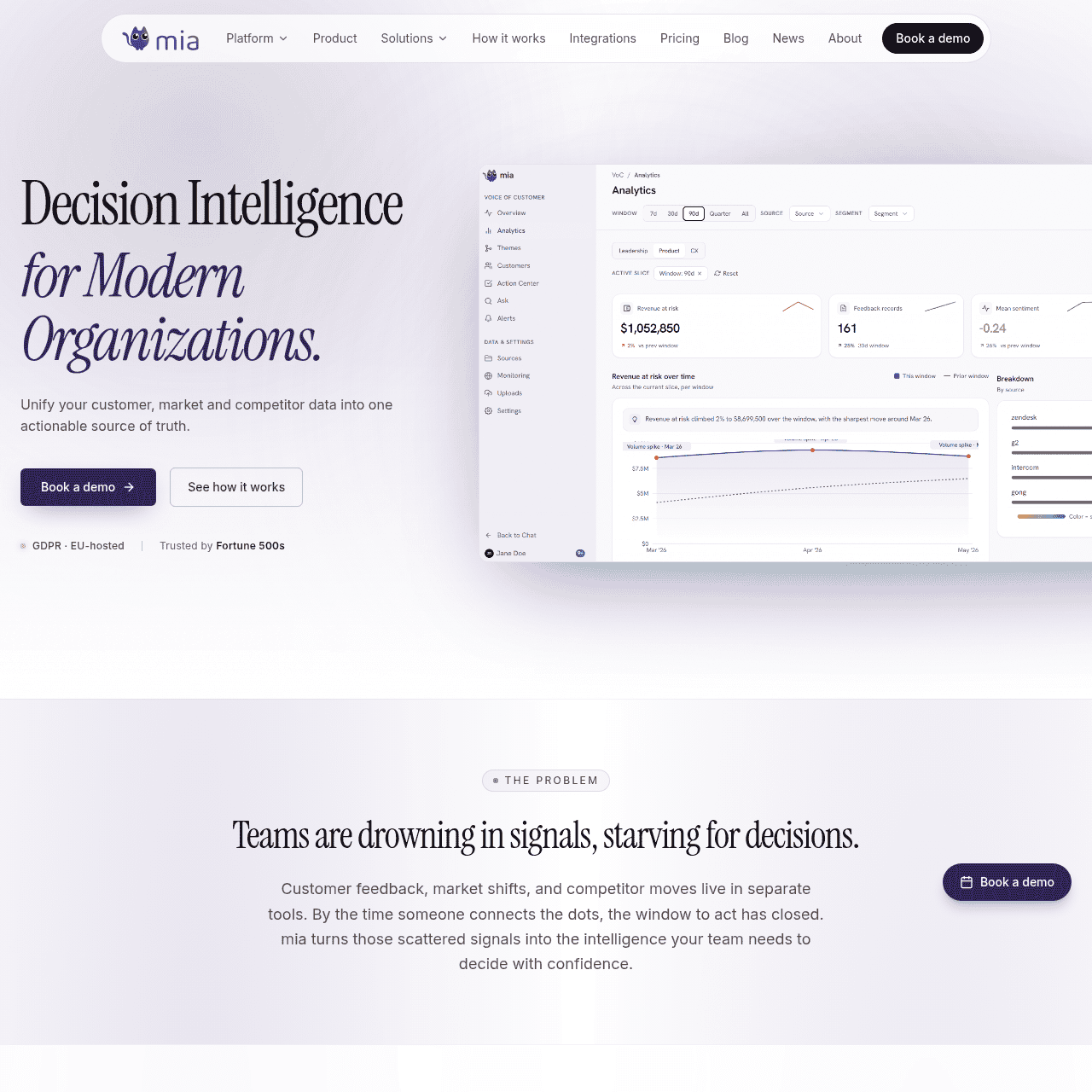
mia is a decision intelligence platform built for organizations that need to turn scattered customer, market, competitor, and product signals into decisions that reliably drive revenue. It connects to your CRM, support systems, collaboration tools, knowledge bases, and analytics platforms to continuously collect and organize signals where decisions actually happen.
Instead of chasing ad hoc reports or generic chat responses, teams get source-cited insights, opportunity intelligence, and a real-time market radar in one place. With 50+ native connectors plus webhook and REST options, mia consolidates data to inform pricing, positioning, roadmap, and go-to-market moves.
The platform emphasizes governance, transparency, and trust, so leaders can act quickly without sacrificing rigor or defensibility.
Quick Snapshot
mia unifies customer, market, competitor, and internal signals into a single decision layer so revenue and strategy teams can move from opinions to evidence-backed decisions. It compresses weeks of research into minutes while keeping every recommendation transparent, sourced, and defensible.
- Works on
-
- Web
- API
- Pricing Model
- Custom — mia offers a single custom plan with pricing tailored to team size, connected systems, and desired outcomes. Quotes are provided after a conversation with sales and a short ROI model.
- Fits on
- Affiliate Program
- We could not identify an affiliate program.
- API Availability
- mia has an API available.
- Key Features
-
- Unify scattered signals into one decision layer
- Get source-cited, defensible recommendations fast
- Power pricing, GTM, and roadmap with evidence
- Audience
-
- revenue leaders
- product managers
- go-to-market teams
- customer intelligence teams
- competitive intelligence teams
- B2B SaaS companies
- SMEs and mid-market organizations
- enterprise strategy teams
- URL
- https://gomia.ai
Screenshot

Key Features of mia
Unified intelligence layer
Consolidates customer, market, competitor, and internal signals into a single, always-on decision layer for revenue and strategy teams.
Source-cited insights
Delivers recommendations and findings backed by clearly cited sources, improving transparency, governance, and trust in every decision.
Opportunity intelligence
Surfaces insights directly tied to opportunities and accounts so teams can prioritize actions that grow pipeline and revenue.
Market radar
Continuously monitors market and competitor signals to highlight trends, risks, and opportunities relevant to GTM and product strategy.
Extensive integrations
Offers 50+ native connectors plus webhook and REST options to connect CRM, support, collaboration, knowledge, and analytics tools.
Enterprise-grade security
Implements enterprise-grade security and governance so organizations can centralize sensitive decision data with confidence.
Use Cases for mia
Pipeline strategy
Unify customer and opportunity signals from CRM, support, and market data to prioritize deals, refine pipeline forecasts, and focus revenue teams on the most impactful opportunities.
Go-to-market planning
Combine market, competitor, and product signals into a single view to inform positioning, messaging, and launch strategies with evidence-backed insights.
Product and roadmap decisions
Aggregate customer feedback, usage data, and competitive moves so product teams can prioritize features and roadmap bets with clear, defensible reasoning.
Competitive intelligence
Continuously track competitor and market signals to build a living market radar that supports sales narratives, pricing decisions, and executive strategy.
Executive strategic planning
Provide leadership with a consolidated intelligence layer that surfaces source-cited insights, enabling faster, more confident strategic decisions across the business.
Frequently Asked Questions
What is mia and who is it for?
mia is a decision intelligence platform for revenue leaders, product managers, go-to-market, customer intelligence, and competitive intelligence teams that need evidence-backed decisions based on unified customer, market, and internal signals.
How does mia connect to my existing tools?
mia provides 50+ native connectors along with webhook and REST options to integrate with your CRM, support platforms, collaboration tools, knowledge bases, and analytics systems.
How is mia different from traditional business intelligence tools?
Unlike traditional BI, mia focuses on always-on decision intelligence, combining fragmented signals into source-cited insights and recommendations that directly support revenue, GTM, and product decisions.
Is mia suitable for enterprise organizations?
Yes, mia is designed for SMEs, mid-market, and enterprise strategy teams, offering enterprise-grade security, governance, and flexible integrations to fit complex environments.
Does mia offer a free version?
No, mia does not have a free version. It operates on a custom pricing model based on team size, connected systems, and desired outcomes.
How is mia priced?
mia uses a single custom plan with pricing tailored to factors like team size, systems connected, and target outcomes, with quotes provided after a discussion with sales and a short ROI model.
mia · Our Verdict
mia stands out as a focused decision intelligence layer rather than just another analytics or chat interface. By emphasizing source-cited evidence and connecting directly to core GTM and product systems, it is well positioned for teams that care about both speed and defensibility in their strategic decisions.
mia ·
-

Cohere
Enterprise AI that’s private, secure, and controllable
AI Model Hosting & Deployment -
42Signals
Illuminate every blind spot on your digital shelf
E-commerce & Retail AI -
XOR
Automated recruiting that makes hiring fast and smart
HR & Payroll Automation - Freemium
Jinna.ai
AI assistant for proposals, invoices and follow-ups
Contract & Invoice Processing - Subscription
Let Me Know When
AI-powered website monitoring that tells you when it matters.
Productivity & Automation AI - Your Ad Here
- Freemium Featured
Intervidy
AI-powered precision hiring from CV to interview
HR & Payroll Automation -
Keevo
Stop losing traffic to stale content with AI
SEO Writing & Optimization