



What AIDE Actually Is — and What It Is Not
Launched in October 2025 by the Markle Foundation in partnership with Aspen Digital and RAND, AIDE is not a technology vendor. It does not build new AI models. Instead, it functions as a structured evaluation and guidance framework — identifying which existing tools are operationally viable for state and local emergency management agencies, and establishing responsible deployment practices for the public sector.
That distinction matters enormously. The initiative’s focus on existing technologies reflects a pragmatic understanding of where most government agencies actually stand: resource-constrained, procurement-burdened, and skeptical of hype.
Since launch, AIDE has conducted approximately 35 workshops with nearly 100 state, local, nonprofit, and private-sector organizations. The output is not a product roadmap — it is a body of operational intelligence about where AI can genuinely reduce friction and where it cannot.
The Core Problem: Demand Outpaces Capacity
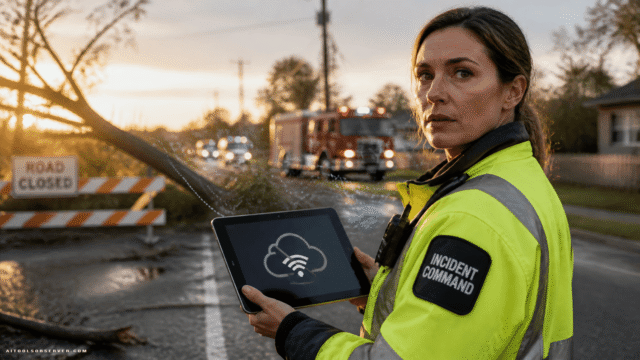
To understand why AI adoption in emergency management is both urgent and difficult, consider the baseline condition of most local emergency management offices. A single department may carry responsibility for preparedness planning, grant applications, training exercises, public outreach, and full-scale disaster response coordination — with one or two staff members.
Jeremy Greenberg, senior adviser for Aspen Digital and former director of FEMA’s Response Operations Division, describes the situation plainly: the demand of time and capability against the expectation of response borderline overwhelms emergency managers.
This is not a technology problem at its root. It is a capacity problem that technology can partially address. AI tools capable of drafting emergency plans, reviewing grant applications, and generating training exercise scenarios could return meaningful hours to staff — hours that can then be redirected toward tasks requiring direct human contact and judgment.
The AI Tool Landscape: Hazard-Specific vs. Incident-Agnostic

One of AIDE’s more useful conceptual contributions is the distinction between two categories of AI capability in emergency management.
Hazard-Specific Tools
Some applications are tightly coupled to a particular threat type. In California, AI-powered wildfire detection systems analyze infrared imagery to identify fire starts in near real time. In North Carolina, flood-monitoring technologies ingest stream gauge data and model where floodwaters are likely to travel. These tools are purpose-built, often requiring specialized data pipelines and domain-specific training.
For agencies operating in high-risk zones for a specific hazard, these tools represent a clear operational investment. The value proposition is direct: faster detection, earlier warning, better resource pre-positioning.
Incident-Agnostic Tools
The second category is broader and arguably more accessible. These are tools whose utility does not depend on the nature of the threat — they apply across all phases of emergency management regardless of whether the incident is a flood, a wildfire, or a mass casualty event.
This category includes:
- Automated administrative assistance — drafting after-action reports, reviewing emergency plans, generating training scenarios
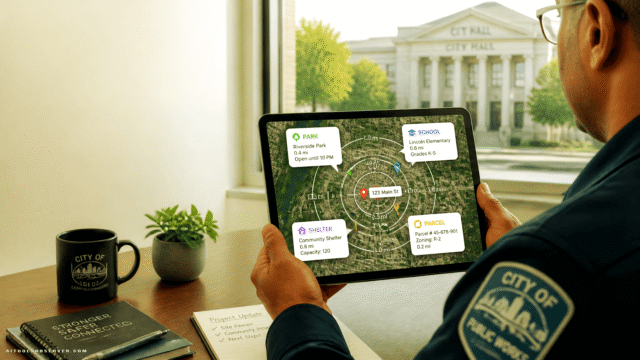
- Situational awareness platforms — aggregating and synthesizing data from multiple sources during an active incident
- Resource allocation support — modeling logistics and supply chain decisions under dynamic conditions
- Communication drafting — producing public-facing alerts and internal coordination documents at speed
The FEMA Review Council’s May 2026 report reinforced this framing, highlighting predictive analytics, computer vision, geospatial intelligence, and automated data processing as priority capability areas. These are not speculative technologies — they are deployable today.
Where Deployment Gets Complicated
Interest in AI tools among emergency managers is genuine. The barriers, however, are structural rather than attitudinal.
The Procurement Gap
Most modern AI tools — particularly large language model-based assistants — operate on subscription models. A private individual can enter a credit card and be operational within minutes. A government agency cannot. Public procurement systems involve approval cycles, contract vehicles, security reviews, and budget authorization processes that can stretch months or years.
Greenberg’s observation is direct: Government procurement systems are not the same.
AIDE is developing guidance to help agencies navigate this gap, but the friction is real and should not be minimized when evaluating AI adoption timelines in the public sector.
Training and Governance
Even when tools are procured, agencies need protocols for how staff use them, what decisions AI can inform versus make, and how outputs are audited. Without governance frameworks, even well-intentioned AI deployment creates accountability gaps — particularly dangerous in high-stakes incidents where decisions affect public safety.
AIDE’s guidance work addresses this directly, emphasizing that emergency managers must retain control of critical decisions. The technology supports; it does not command.
The Recovery Phase: An Underappreciated Use Case

Much of the public conversation about AI in emergency management focuses on the acute response phase — the hours and days when situational awareness is most critical. AIDE’s work surfaces an equally important but less discussed application: the recovery phase.
After an incident closes, emergency managers face a different kind of burden. After-action reports must be written. Lessons must be documented. Decompression — both cognitive and administrative — is necessary before the next cycle of preparedness work begins.
AI tools that can assist with note synthesis, report drafting, and structured reflection after an incident are not glamorous. But they are operationally significant. They allow the people who just managed a disaster to process what happened systematically, rather than carrying the cognitive load of documentation into the next preparedness cycle.
Greenberg frames it precisely: Taking — because this is important — a minute to decompress, write your notes, drafting after-action reports, and make sure that you’re going back through that process.
A Historical Parallel Worth Taking Seriously
AIDE’s approach draws an instructive analogy to earlier waves of technology adoption in emergency management. Geographic information systems and computer-aided dispatch platforms transformed situational awareness and resource coordination over the past few decades. Neither was adopted without friction. Both required agencies to redesign workflows, retrain staff, and develop new governance norms.
AI is not categorically different. It is the next layer of capability in a long sequence of technological integration. The agencies that will benefit most are those that treat AI adoption as a workflow redesign challenge — not merely a software procurement decision.
What This Means for AI Tool Selection in Practice
For emergency management agencies evaluating AI tools today, AIDE’s work suggests a practical prioritization framework.
Start with administrative burden. The highest-confidence, lowest-risk entry point is automating tasks that consume staff time without requiring real-time judgment — plan drafting, grant review, training scenario generation, after-action reporting. These applications are incident-agnostic, broadly applicable, and do not place AI in the decision loop during high-stakes moments.
Layer in situational awareness tools. Platforms that aggregate and synthesize data during an active incident improve the quality of human decisions without replacing them. The key evaluation criterion is whether the tool surfaces relevant information faster than existing methods — not whether it makes recommendations autonomously.
Invest in hazard-specific tools where risk profiles justify it. Wildfire detection and flood forecasting tools require more specialized procurement and integration effort. Agencies in high-exposure regions should evaluate these on a cost-benefit basis tied to their specific threat environment.
Build governance before scaling. Any AI deployment in a public-sector emergency management context requires clear protocols for human oversight, output auditing, and accountability. AIDE’s forthcoming guidance will be a useful reference — but agencies should not wait for it to begin developing their own internal frameworks.
The Accountability Principle Is Non-Negotiable
Across every phase of AIDE’s work, one principle holds constant: the decisions must remain with people. This is not a hedge or a disclaimer. It is an operational requirement.
Emergency management decisions carry direct consequences for human lives. The legitimacy of those decisions — in the eyes of survivors, communities, and oversight bodies — depends on human accountability. AI tools that improve efficiency and situational awareness are valuable precisely because they free up human capacity for the judgment calls that only humans should make.
Greenberg’s framing is worth repeating: Technology can help make emergency managers more efficient and more capable. But the decisions still need to be made by people.
Conclusion
As disaster frequency and intensity continue to rise, the pressure on emergency management agencies will only increase. AIDE’s contribution is not a silver bullet — it is a structured, evidence-based approach to identifying where AI tools can genuinely help, how to deploy them responsibly, and what governance conditions must be in place before they are trusted with anything consequential.
That kind of disciplined, operationally grounded thinking is exactly what the public sector needs — and exactly what the broader AI tools ecosystem should be held to.











Comments (0) No comments yet
Want to join this discussion? Login or Register.
No comments yet. Be the first to share your thoughts!