


The Core Research Question
The project is led by Souti (Rini) Chattopadhyay, a computer science researcher at USC who also leads the USC ACE Lab. The five-year study is backed by an approximately $600,000 NSF CAREER Award and focuses on human-AI collaboration across three fields: software engineering, journalism, and medicine.
The central goal isn’t to prove AI is good or bad for thinking. It’s to map precisely which types of human-AI interactions expand cognitive capacity and which ones narrow it — then use that map to redesign how those interactions work.
“Creativity is something that’s inherently human,” Chattopadhyay has said of the project. “This project is built on the philosophy that AI can enhance people’s ability to create and think, but it cannot replace it.”
Why EEG? What the Brain Data Actually Reveals
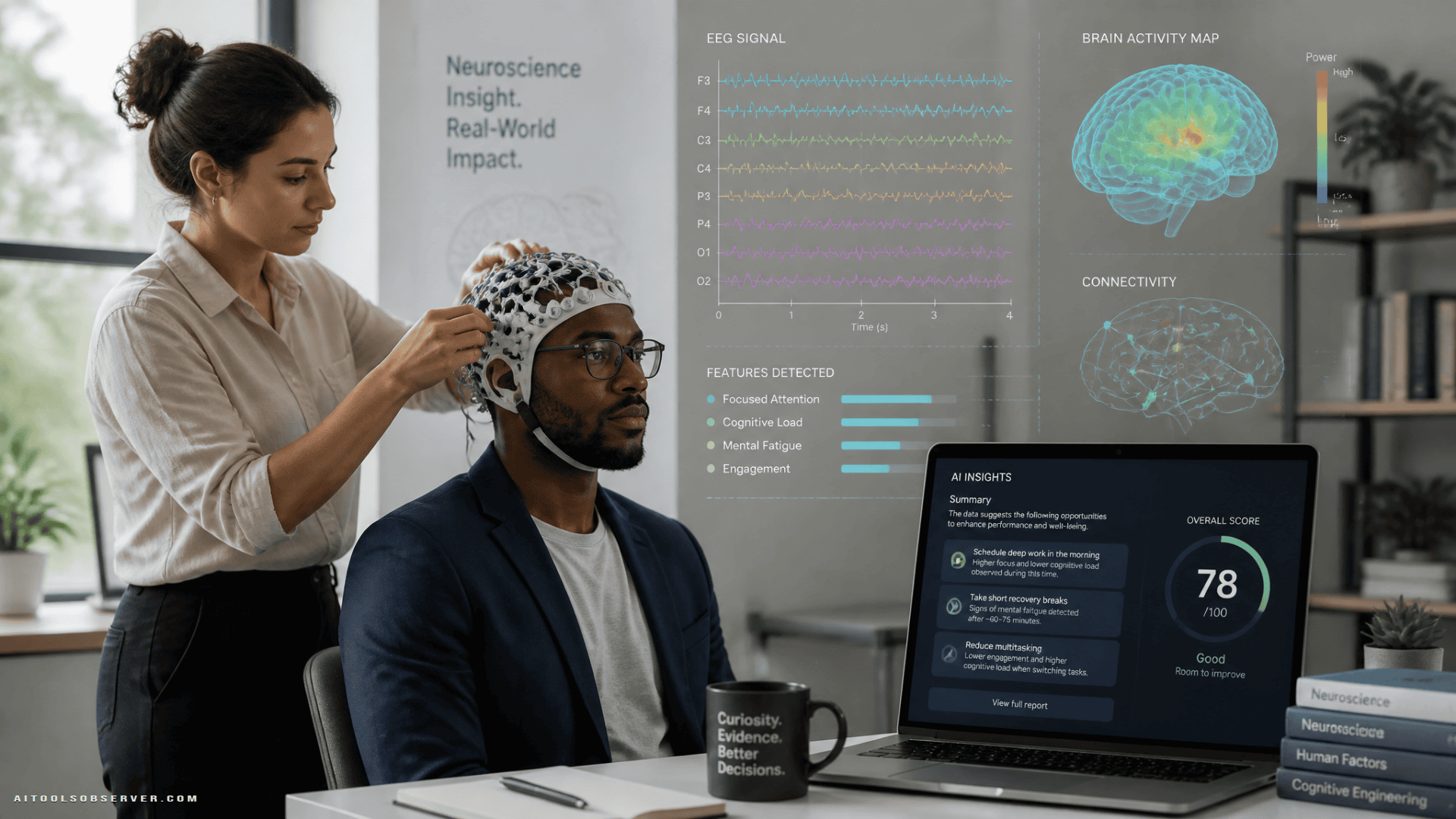
Participants across all three professions will complete job-related tasks using AI-powered agentic systems. A control group will perform the same tasks without AI. Researchers will monitor brain activity throughout using electroencephalography (EEG), which captures neural signals in real time.
Different cognitive states leave distinct patterns:
- Critical thinking tends to activate the prefrontal cortex
- Creative insight shows up as sudden bursts of neural activity
- Focused attention correlates with activity in the brain’s visual regions
By tracking which regions activate during specific workflow moments, the team can connect particular interactions with AI to measurable changes in how the brain is working. That’s a more grounded approach than self-reported surveys or behavioral observation alone.
To reduce noise in the data, the team is also collecting screen activity recordings and participants’ verbalized thought processes. The combination of neural signals, screen data, and spoken reasoning gives researchers a much richer picture of what’s actually happening during human-AI collaboration.
Two Phases: Detect, Then Redesign
The research is structured in two distinct phases.
Phase one focuses on detection and classification. Researchers will identify the specific moments when AI expands a person’s thinking versus when it starts doing the thinking for them. The output is essentially a structured map of what helps and what hinders cognitive engagement.
Phase two uses that map to build something actionable. Chattopadhyay’s team will develop four new interaction paradigms — redesigned ways for humans and AI to work together that are specifically engineered to strengthen creativity and critical thinking rather than bypass them.
This two-phase structure matters. Most AI tool design today optimizes for speed and output quality. This project is explicitly optimizing for human cognitive capacity as the primary metric.
Real-World Partners Across Journalism, Medicine, and Engineering
The study isn’t running in a lab vacuum. Industry and institutional partners are embedded across all three professional domains.
Within USC, the project partners with the USC Annenberg School for Communication and Journalism to study how journalists interact with AI in writing workflows. The Keck School of Medicine of USC is involved to examine how doctors and nurses use AI for tasks like medical summaries and clinical decision-making.
Outside USC, collaborators include Microsoft Research and teams behind Microsoft Excel on the software engineering side, and the Los Angeles Times on the journalism side. The LA Times partnership operates under a non-disclosure agreement.
The team also has plans to extend findings beyond the research setting — including “Mind the Gap” workshops with LAUSD focused on AI literacy and critical thinking for students, and conversations with local government agencies about responsible AI policy.
What This Means for AI Tool Design
The practical implications here extend well beyond academic research. If the study successfully maps which interaction patterns strengthen versus weaken human reasoning, it creates a design framework that AI tool builders could actually use.
Right now, most AI tools are evaluated on accuracy, speed, and user satisfaction. Almost none are evaluated on whether they make users better thinkers over time. This research is building the methodology to do exactly that.
For anyone selecting or building AI tools for high-stakes professional work — clinical decision support, investigative journalism, complex engineering — the question of cognitive impact is becoming harder to ignore.
The takeaway isn’t to avoid AI tools. It’s to start asking a more specific question: does this tool keep me in the loop cognitively, or does it gradually move me out of it? That distinction is worth paying attention to, and now there’s serious research infrastructure being built to answer it.









Comments (0) No comments yet
Want to join this discussion? Login or Register.
No comments yet. Be the first to share your thoughts!