


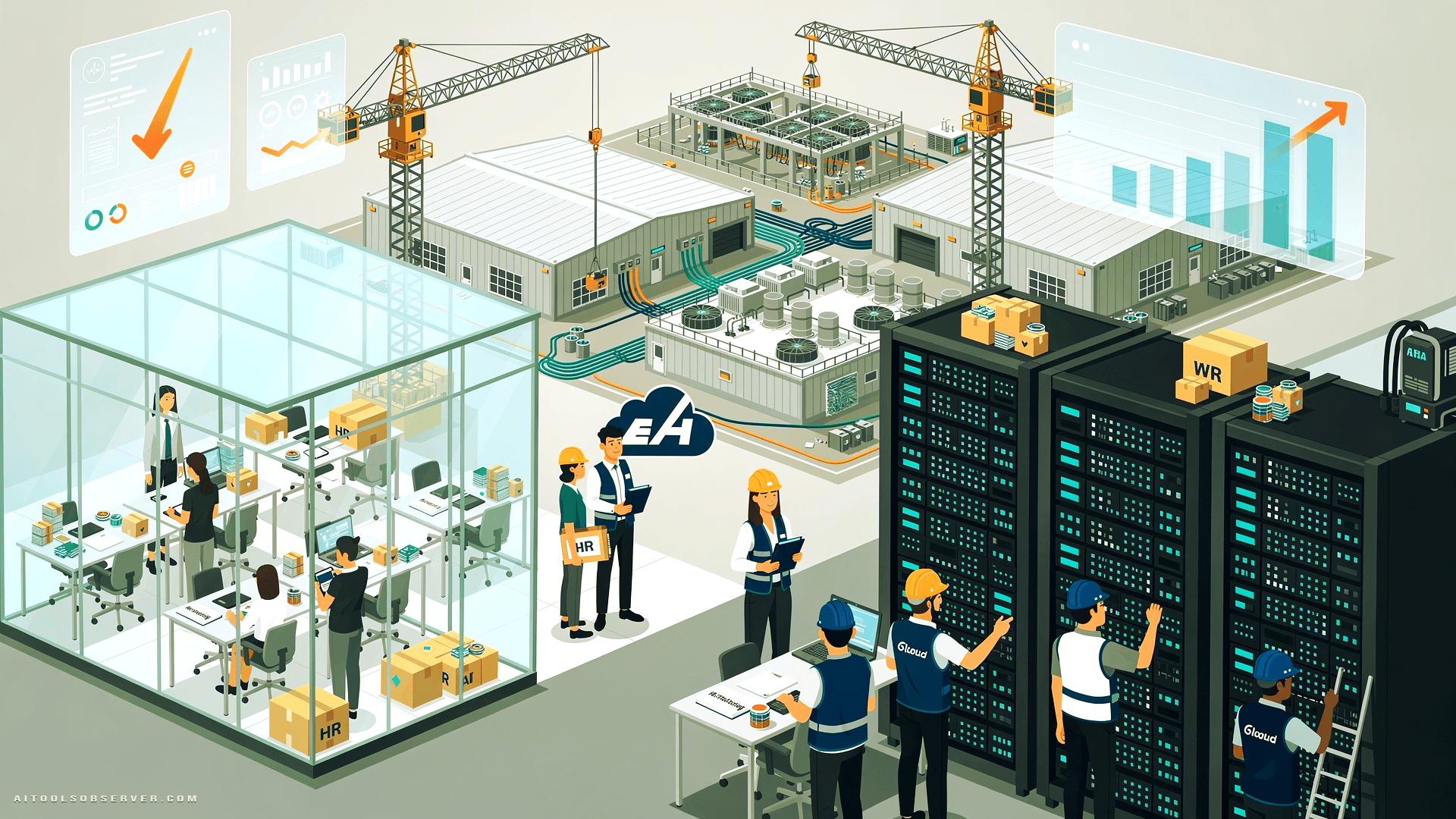
The Arithmetic of the AI Pivot
Oracle’s headcount dropped from around 162,000 to 141,000 full-time employees. The restructuring cost $1.8 billion in severance and related expenses — nearly five times the $374 million it spent on restructuring the prior year. That acceleration is significant. It signals that the workforce reduction is not a slow administrative trim but a structural reorientation executed at speed.
The company’s own annual report frames it plainly: AI deployment across operations
has resulted, and may continue to result, in reductions to our workforce.
That sentence, buried in regulatory language, is one of the more candid admissions yet from a major enterprise vendor about how AI is reshaping internal headcount decisions.
The logic is straightforward. Workforce costs are typically the largest operating expense for a technology firm. Reducing them frees capital to fund the one asset that now defines competitive positioning in enterprise cloud: compute infrastructure.
Oracle’s Strategic Position in the Compute Race

Oracle is not building data centers for its own software products alone. It is actively competing to host AI workloads for some of the most demanding customers in the world — OpenAI and Meta among them. That positions Oracle less as a traditional enterprise software vendor and more as a critical-layer infrastructure provider for the AI economy.
This is a meaningful repositioning. For decades, Oracle’s identity was anchored in databases, ERP systems, and enterprise licensing. The $50 billion infrastructure commitment represents a bet that the next decade of enterprise value will be captured at the compute layer, not the application layer.
Co-founder and CTO Larry Ellison has been the visible force behind this strategic direction. His dual role — as one of the world’s wealthiest individuals and as Oracle’s chief technologist — gives the company an unusual combination of capital access and technical conviction at the top.
A Pattern Repeating Across Big Tech
Oracle’s moves do not exist in isolation. They are part of a coordinated, industry-wide reallocation of capital and labor that is reshaping the technology sector at a pace rarely seen outside of a market crisis.
The Capital Side

Google, Amazon, and Meta collectively plan to invest approximately $650 billion in AI infrastructure this year. Amazon alone has committed $200 billion over the next twelve months — the largest single-company AI capital expenditure announced to date. These are not incremental R&D budgets. They are infrastructure bets of a scale that rivals national energy projects.
The Labor Side
More than 100,000 tech workers have been laid off across the industry in the past year. Amazon is cutting around 30,000 roles across several rounds. Meta has reduced headcount significantly. An Amazon senior executive captured the internal rationale last October, writing that the company needed to be organized
more leanly
because AI was enabling faster innovation cycles than traditional staffing models could support.
The pattern is consistent: reduce human operational overhead, redirect capital toward compute, and use AI tooling to maintain or increase output with a smaller workforce.
What This Means for the AI Tools Ecosystem
For founders, operators, and AI adopters watching this shift, the implications extend well beyond the balance sheets of large corporations.
Infrastructure scarcity will shape tool availability. As hyperscalers and infrastructure providers like Oracle race to build capacity, GPU availability, inference costs, and API pricing will fluctuate. Tools built on top of these platforms will feel the effects — in latency, pricing tiers, and feature rollout timelines.
Enterprise AI adoption is accelerating, not plateauing. The scale of capital being deployed is a leading indicator. When companies absorb billions in restructuring costs to fund AI infrastructure, they are signaling that enterprise AI workloads are growing faster than current capacity can serve. That creates demand for the tools, integrations, and workflows that sit above the infrastructure layer.
The workforce reduction narrative will intensify. Oracle’s candid disclosure that AI is directly causing headcount reductions will not be the last of its kind. Expect more annual reports, earnings calls, and internal memos to make this connection explicit. For teams evaluating AI tools, this shifts the conversation from how do we experiment with AI to how do we restructure workflows around AI.
The Risk Oracle Acknowledged
It is worth noting what Oracle itself flagged as a downside risk. The company warned that its restructuring
can be disruptive
and may create shortages of skilled workers in certain roles, potentially reducing productivity and impacting earnings. That is a precise and honest acknowledgment that aggressive workforce reduction carries execution risk — particularly when the roles being eliminated hold institutional knowledge that AI cannot yet fully replicate.
This tension — between the efficiency gains AI promises and the operational disruption of rapid restructuring — is one that every organization navigating this transition will encounter. Oracle is simply doing it at a scale that makes the trade-offs visible.
The Takeaway
Oracle’s annual report is, in effect, a case study in what the AI infrastructure race looks like from the inside: accelerated restructuring costs, explicit acknowledgment of AI-driven workforce reduction, and a capital commitment that would have seemed extraordinary three years ago but now sits within the normal range for hyperscale ambition.
The compute race is not a future event. It is the present competitive reality. For anyone tracking the AI tools ecosystem, the infrastructure decisions being made today by Oracle, Amazon, Meta, and Google will define which tools are viable, which platforms scale, and which workflows become standard — for years to come.
Observe the infrastructure layer carefully. Everything built on top of it depends on what gets built there first.









Comments (0) No comments yet
Want to join this discussion? Login or Register.
No comments yet. Be the first to share your thoughts!