


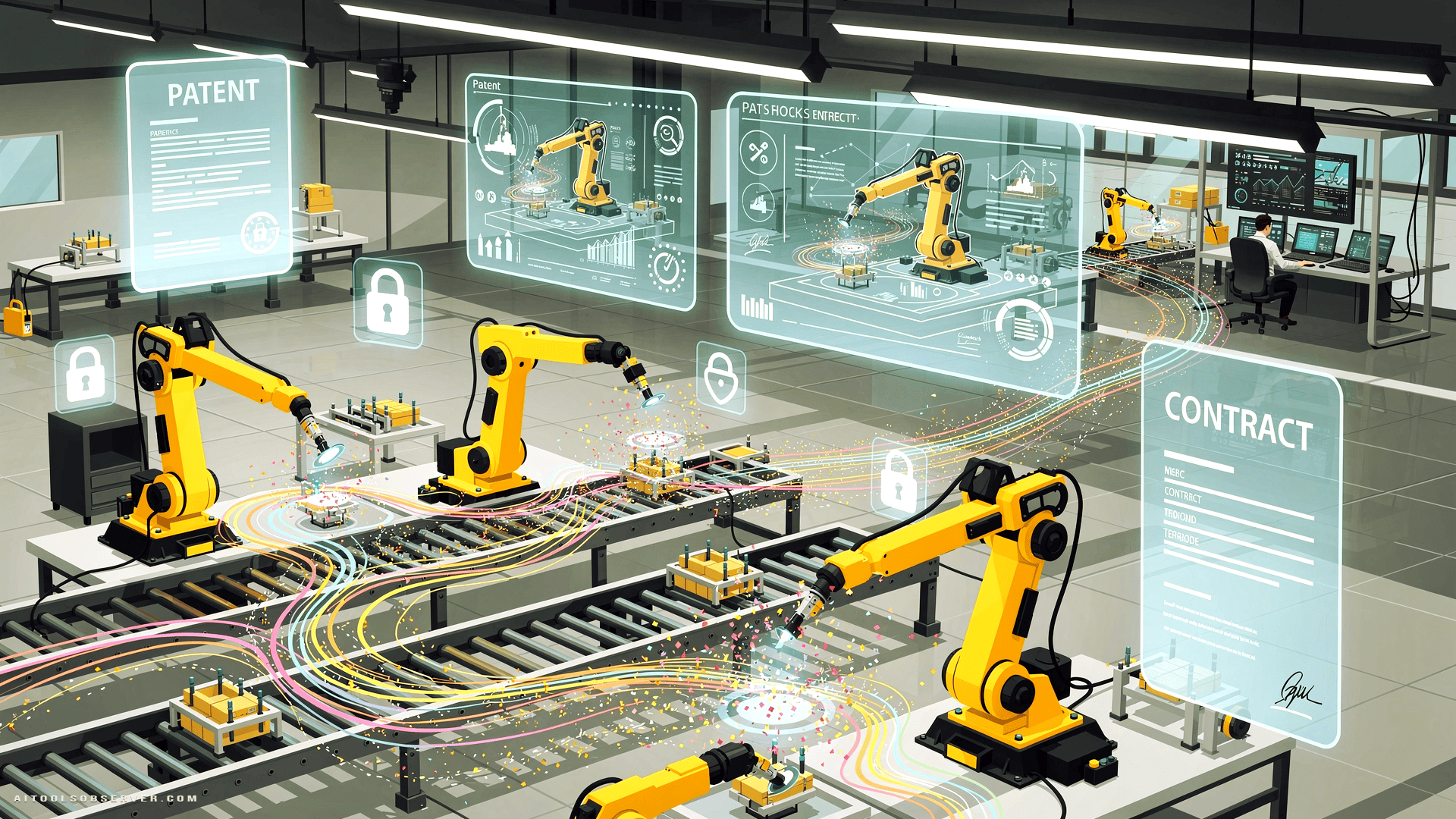
Why IP Strategy in Smart Manufacturing Is Broken for Most Companies

Most manufacturers still treat intellectual property as a legal formality — something you handle after the innovation happens. That approach worked when products changed slowly and competitive advantages were obvious.
It doesn’t work anymore.
Today’s manufacturing edge lives in AI optimization parameters, proprietary training datasets, sensor-fusion algorithms, and process know-how that evolves continuously. These assets don’t fit neatly into a single IP bucket. And if you’re not protecting them deliberately, you’re likely leaving them exposed.
Three questions should be on every manufacturing executive’s radar:
- Are your engineering teams creating AI-assisted innovations that nobody is formally protecting?
- Do you actually own the operational data your systems generate — and can you prove it?
- Is anyone tracking what employees are feeding into AI tools they downloaded without IT approval?
If the answers are unclear, you have a strategy gap.
The Hybrid IP Protection Model: Why One Approach Isn’t Enough

Smart manufacturers are moving toward a layered IP strategy that combines multiple forms of protection rather than relying on patents alone.
Patents for Core Technical Innovations
Patents remain the right tool for discrete, novel technical breakthroughs — a new AI integration with an industrial control system, a proprietary predictive maintenance architecture, or a sensor-fusion method that competitors can’t easily reverse-engineer.
With AI-for-manufacturing patent filings surging globally, freedom-to-operate analysis is no longer optional. Relying on vendor assurances without independent IP due diligence is a fast path to infringement exposure.
Trade Secrets for Evolving Know-How
Here’s the practical reality: many competitive advantages in AI-driven manufacturing aren’t static inventions. They’re continuously improving systems — training methodologies, optimization parameters, curated datasets refined over years of production.
These assets are often better protected as trade secrets than patents. Patent protection requires disclosure. Trade secret protection doesn’t — as long as you’re taking reasonable steps to maintain secrecy.
Copyright and Trademarks Fill the Gaps
Software code and user interfaces developed in-house are automatically covered by copyright. Proprietary platforms benefit from trademark protection. Neither replaces patents or trade secrets, but both add meaningful layers to a complete IP framework.
Joint Development Requires Explicit Agreements

In multi-party manufacturing relationships, IP allocation needs to be settled before work begins — not after a dispute arises. Agreements should clearly define background IP (what each party brings in), foreground IP (what gets created together), and who controls improvements, licensing rights, and sublicensing.
Ambiguity here is expensive. Precision upfront is cheap by comparison.
Trade Secret Risks: The Shadow AI Problem Is Real

The integration of AI into manufacturing has dramatically expanded the trade secret attack surface. And the most dangerous threat often isn’t a sophisticated external actor — it’s a well-meaning employee using the wrong tool.
What Shadow AI Actually Means
Shadow AI refers to employees using unvetted generative AI tools — tools that may transmit inputs to external servers, use proprietary data to train third-party models, or simply lack the confidentiality protections your legal team would require.
The uncomfortable truth is that employees will use AI tools regardless of whether you approve them. The only question is whether they’re using sanctioned tools with proper safeguards or unsanctioned alternatives that expose your most sensitive operational knowledge.
Companies that don’t provide enterprise-approved AI solutions don’t eliminate usage. They just push it underground, where the risks multiply and visibility drops to zero.
Building a Trade Secret Governance Framework

Effective trade secret protection in AI-driven environments requires more than an NDA policy. It requires a layered governance approach:
Approved Tools Only — Restrict AI usage to enterprise-approved, internally hosted, or contractually controlled systems. If a tool doesn’t have appropriate confidentiality protections, it shouldn’t be on the approved list.
Access Controls and Monitoring — Implement tiered access, data segmentation, and continuous monitoring of AI interactions. You can’t protect what you can’t see.
Contractual Protections — Every vendor, employee, and contractor should be bound by robust NDAs with clear exit protocols requiring return or destruction of proprietary information.
Regular Audits and Training — Employees need to understand what constitutes proprietary information and why feeding it into an AI tool can constitute disclosure. This isn’t intuitive — it requires deliberate training.
Need-to-Know as a Default — The most effective trade secret programs operate on deliberate restraint. If information isn’t necessary for the relationship, don’t share it. Regardless of what protections are theoretically available, the safest data is data that was never exposed.
Vendor Contracts Need Specific Protections
AI vendor agreements should go beyond standard confidentiality clauses. They should include explicit data-use restrictions, model training prohibitions (your data cannot be used to train their models), and audit rights. Where feasible, hosting models internally or in private cloud instances reduces leakage risk and strengthens your position under the Defend Trade Secrets Act by demonstrating reasonable protective measures.
Data Ownership in Smart Manufacturing: Who Actually Owns What

Sensor outputs, digital twin telemetry, AI inference logs — this data is a strategic asset. It’s also a persistent source of commercial disputes when ownership isn’t clearly defined.
In multi-party manufacturing environments, the questions get complicated fast. Who owns sensor data from a shared production line? Can a partner use your operational data to train their own AI models? What happens to shared data when the contract ends?
Without explicit contractual allocation, these questions don’t resolve themselves — they escalate into litigation.
What Data Agreements Should Actually Cover
Strong data ownership provisions address several distinct issues:
- Classification — Is the data background (pre-existing) or foreground (generated during the relationship)?
- Derivative works — Who owns AI models trained on shared data? This is frequently overlooked and frequently disputed.
- Licensing scope — What can each party do with the data, in which fields, and for how long?
- Flow-down obligations — What restrictions apply when data is shared with subcontractors or cloud providers?
- Termination rights — What happens to data when the contract ends? Deletion, anonymization, and return obligations should be explicit.
Limitation-of-liability clauses should be calibrated to data-driven dispute risks. Audit rights over data usage are worth negotiating for. These aren’t nice-to-haves — they’re the difference between owning your data and discovering someone else has been monetizing it.
USPTO Guidance on AI-Assisted Inventions: What Manufacturers Need to Know

The U.S. Patent and Trademark Office issued revised inventorship guidance for AI-assisted inventions in November 2025, and it resolved a significant amount of uncertainty for patent practitioners and innovators.
The Core Rule: Humans Must Conceive the Invention
The USPTO reaffirmed what the statute has always required — only natural persons can be named as inventors. AI systems are instruments of invention, not inventors. The determinative question is conception: a natural person must form “a definite and permanent idea of the complete and operative invention.”
This has immediate practical implications for manufacturers using AI in process innovation.
What Counts as Human Contribution
Patent claims arising from AI-assisted work must be supported by clear evidence of human intellectual contribution. That contribution can take several forms:
- Designing and refining the prompts that directed the AI
- Curating the training data that shaped the output
- Validating and testing AI-generated solutions
- Integrating AI outputs into a workable technical solution
The key is documentation. If you can’t demonstrate human intellectual contribution at each stage, you’re vulnerable to rejection during prosecution or invalidity challenges after issuance.
Build Documentation Protocols Now

Manufacturers should implement contemporaneous documentation practices for AI-assisted invention processes. This means iteration logs, decision records that show human oversight and judgment, and records of how AI outputs were modified or integrated.
This documentation serves two purposes: it supports patent prosecution and provides critical evidence if you ever need to enforce the patent.
One additional consideration — foreign patent regimes are developing divergent AI-inventorship standards. If your manufacturing operations or markets are international, filing strategy needs to account for these differences.
IP as Strategic Infrastructure, Not a Compliance Checkbox

The manufacturers who will capture the most value from AI-driven operations aren’t necessarily the ones with the most advanced technology. They’re the ones who treat intellectual property as core strategic infrastructure — built deliberately, maintained actively, and aligned with business objectives.
That means tracking innovations as they emerge, not after the fact. It means deploying layered protection strategies that match the nature of each asset. It means fortifying trade secret programs before a breach forces the issue. And it means negotiating IP ownership terms with the precision they deserve.
AI tools are accelerating the pace of manufacturing innovation. Your IP strategy needs to keep up — or the value you’re creating will end up belonging to someone else.













Comments (0) No comments yet
Want to join this discussion? Login or Register.
No comments yet. Be the first to share your thoughts!