



What the Glasses Actually Do
The Ray-Ban Meta AI glasses are, in hardware terms, a conventional-looking frame fitted with cameras, microphones, open-ear speakers, and a voice-activated AI assistant. There are no augmented-reality projections on the lenses. The interface is entirely audio-first: you speak, the glasses respond.
Core functions include voice-guided navigation, real-time translation of text and speech, photo and video capture, music and podcast playback, object and landmark recognition, currency conversion, and general Q&A. On paper, this covers a meaningful portion of what a traveller reaches for their phone to do.
The form factor matters here. Unlike earbuds or a smartphone, the glasses sit passively on your face. You can hear ambient sound while receiving audio feedback — a genuine advantage over noise-isolating headphones in an unfamiliar city.
Navigation: Useful, With Caveats

The navigation experience reveals both the potential and the limits of the device quickly.
Asking the glasses for walking directions from Gare du Nord through Le Marais produces a route — but the glasses push it to the phone’s maps application rather than delivering turn-by-turn audio guidance independently. The result is a traveller still staring at a screen, which defeats the hands-free premise.
The workaround is more effective: set a route in Google Maps separately, then use the glasses purely as a wireless headset to receive spoken directions. This works well. Ambient awareness is preserved, no earbuds are required, and the city remains audible around you. It is a capable solution, though it requires the user to configure it deliberately rather than experiencing it as seamless.
The glasses function best as a navigation layer when paired with an existing maps application — not as a standalone navigation tool.
Translation and Travel-Guide Functions: The Strongest Use Case

Translation is where the glasses earn their keep most convincingly.
Pointing at a French newspaper and requesting an English translation produces accurate, fluent results. In a café, the glasses deliver both a verbal menu summary and a line-by-line translation without requiring the phone to leave a pocket. For travellers with limited language skills, this alone has practical value.
The travel-guide function is similarly strong. Historical context for Place de la Concorde, construction timelines for the Louvre, currency conversions on the move — these are handled efficiently and without interrupting the pace of walking. The experience of receiving information through a discreet earpiece while continuing to observe the surroundings is genuinely different from consulting a phone, and in most cases, preferable.
This audio-guide mode is the device’s most coherent use case: low friction, contextually relevant, and genuinely hands-free.
Reliability: The Eiffel Tower Problem
Accuracy is where the device introduces meaningful risk.
At the Eiffel Tower, the glasses return two different heights within minutes of each other — 330 metres on the first query, 324 metres on the second. The official figure is 330 metres. Neither the discrepancy nor the error is catastrophic in isolation. What is more concerning is the confidence with which both answers are delivered, and the vagueness of the explanation when the source is questioned: “training data, internet searches and other sources.”
This is a known structural problem with large language model-based assistants. All sources are weighted and presented with similar authority, regardless of accuracy. For low-stakes travel trivia, the consequences are minor. For medical, legal, or logistical information in an unfamiliar country, the same failure mode carries greater weight.
In all other verifiable cases during the Paris test, the information provided was accurate. The glasses are useful — provided the user maintains the habit of cross-checking anything that matters.
Hardware Performance: Camera and Object Recognition
The camera produces point-of-view photos and video, but without manual zoom or focus control. If the frame sits slightly off-level on the face — which is common — images come out visibly crooked. The results are functional for casual documentation but fall well short of smartphone camera quality in terms of control and output.
Object recognition is inconsistent. Landmark identification works in some cases; in others, the glasses return observations so generic as to be unhelpful — describing a Parisian street as “a view of a street, maybe in Paris, with tall buildings.” The feature exists, but it does not yet perform reliably enough to be a primary use case.
Privacy: A Serious and Unresolved Problem
The privacy dimension of camera-equipped smart glasses is not a minor footnote. It is a central issue that any honest evaluation must address directly.
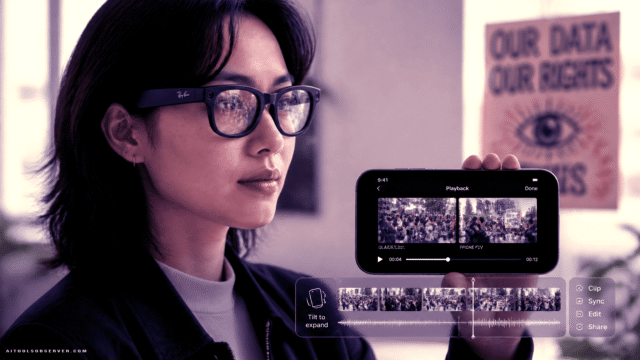
Documented cases of Ray-Ban Meta AI glasses being used to record individuals without their knowledge or consent have attracted significant press coverage. The device’s unobtrusive appearance — indistinguishable from standard eyewear — makes covert recording straightforward. Meta’s own voice privacy notice states that transcripts and stored audio recordings may be retained for up to a year unless manually deleted, and that voice interactions may be reviewed by human reviewers to improve the product.
These are not hypothetical concerns. For users who are conscious of data sovereignty, or who travel to jurisdictions with strict data protection frameworks, the implications deserve careful consideration before adoption.
Wearing the glasses also raises a social dimension: other people in public spaces cannot easily tell they are potentially being recorded. That asymmetry is ethically uncomfortable, regardless of the wearer’s intentions.
The Deeper Trade-Off: Convenience Versus Connection
Beyond the technical performance, the Paris test surfaces a question that sits outside the usual review criteria.
Travel, at its best, involves friction. Getting lost leads to unexpected discoveries. Asking a stranger for directions opens a conversation. Misreading a menu produces a story. The Ray-Ban Meta AI glasses are designed to eliminate precisely these moments of productive uncertainty. They handle directions, translation, recommendations, and information retrieval with increasing competence.
The result is a smoother journey — and a subtly thinner one. The glasses reduce the need to interact with the city or its people. They place an efficient, invisible intermediary between the traveller and the experience. Whether that trade-off is acceptable depends entirely on what the traveller is trying to get out of the trip.
Who These Glasses Are Actually For
The honest answer is that context determines value.
For travel to destinations with significant language barriers — Japan is the obvious example — the translation and travel-guide functions could provide genuine, meaningful assistance. For business travel, where time efficiency outweighs experiential depth, the convenience case is stronger. For travellers with accessibility needs who benefit from hands-free information delivery, the glasses offer real utility.
For leisure travel in familiar cultural contexts, the value proposition is weaker. The navigation workaround requires setup. The camera underperforms a smartphone. Object recognition is unreliable. And the privacy implications remain unresolved.
Verdict
Strengths: Translation, audio travel-guide function, ambient-aware navigation via paired maps app, currency conversion, low-friction information retrieval.
Weaknesses: Inconsistent factual accuracy, no standalone turn-by-turn navigation, limited camera control, unreliable object recognition, significant privacy concerns around data retention and covert recording potential.
Best suited for: Language-barrier travel, business trips, accessibility use cases, travellers who prioritise efficiency over serendipity.
Not recommended as a primary tool for: Leisure travel in familiar regions, users with strong data privacy requirements, anyone unwilling to verify AI-generated information independently.
The Ray-Ban Meta AI glasses are a technically coherent product in a category that is still finding its footing. They do several things well, and the audio-guide experience in particular hints at what wearable AI could become. But the accuracy gaps, hardware limitations, and unresolved privacy architecture mean they are not yet a tool to rely on without reservation.
The more durable question they raise has nothing to do with specifications. As wearable AI becomes ambient — woven into eyewear, clothing, and daily routine — travellers will need to decide, deliberately and in advance, what they want technology to do for them. Making travel easier is not the same as making it better. The glasses are a useful reminder that those two things are not always the same destination.
















Comments (0) No comments yet
Want to join this discussion? Login or Register.
No comments yet. Be the first to share your thoughts!