


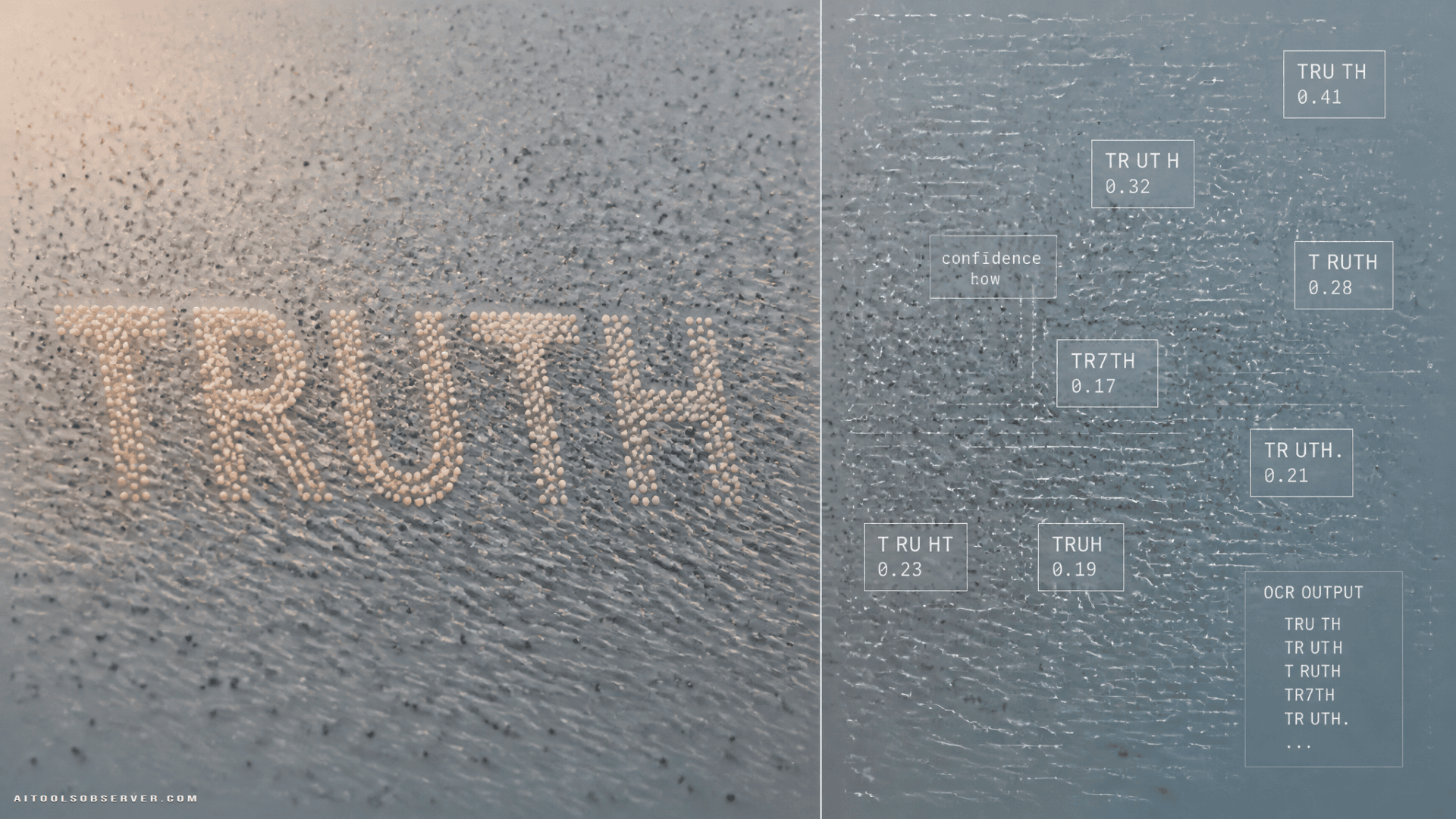
What Ghost Font actually does
Ghost Font, created by designer Eric Lu, replaces solid letter shapes with thousands of tiny animated dots. Dots inside the hidden letterforms drift in one direction, while surrounding dots move another way. The human visual system groups those motion cues almost instantly, making the word legible without any visible outlines. Pause the animation, and the text vanishes into static noise.
The technique relies on motion-based grouping—a perceptual shortcut humans perform effortlessly. For an AI model accustomed to scanning for high-contrast edges and stable character shapes, that same frame presents a near-random scatterplot.
Why most multimodal models stumble
Current multimodal vision models usually interpret video as a sequence of still frames. They excel at detecting objects, text, and patterns in individual images, but they often lack robust temporal grouping mechanisms that mirror human motion perception.
Ghost Font deliberately removes the very features OCR systems depend on: sharp boundaries, constant stroke widths, predictable alignment. The moving dots produce no single frame where letters are clearly defined. As a result, models that process the animation image-by-image frequently misread the scene or hallucinate confident but incorrect answers.
That doesn’t mean AI can’t decode Ghost Font. With optical-flow analysis, frame differencing, or explicit prompts describing the illusion, some systems can recover the hidden message. The point is that they don’t do it the way humans do, and out of the box, the failure is consistent enough to be instructive.
A modern CAPTCHA analogy, not encryption
Ghost Font is not a security tool, and its creator doesn’t position it as one. It’s more like a perceptual benchmark that revives the spirit of early CAPTCHAs, which exploited the gap between human and machine reading by distorting text. Instead of warping letterforms, Ghost Font hides them in motion.
The parallel matters because many teams now assume multimodal models can handle any document-like visual input—from handwriting to faded scans. Ghost Font demonstrates that vision-language models still interpret the world through a fundamentally different lens, especially when time becomes a variable.
Practical implications for AI tool adopters
For founders and operators picking AI tools, Ghost Font highlights a few realities:
- Motion robustness isn’t universal. Not all vision APIs or multimodal models handle video streams equally well. Behavior on static images may not translate to dynamic content like screen recordings, drone footage, or dashcam video.
- Prompts can close some gaps. Giving models a hint about motion-based encoding sometimes unlocks correct answers. This suggests that prompt engineering and preprocessing steps matter when pushing beyond standard benchmarks.
- Real-world “blind spots” remain. Ghost Font is a deliberately constructed illusion, but its mechanism resembles challenges in legitimate use cases—think reading text on a jittery conveyor belt or from a shaky smartphone video. Systems that fail cleanly in the lab may fail silently in production.
What this means for the next generation of vision models
Ghost Font will almost certainly become solvable as models incorporate better temporal reasoning, larger context windows, or dedicated motion-processing modules. The project’s value lies less in permanent superiority and more in making a learning boundary visible. It tells us that human vision still owns a few advantages in dynamic grouping and figure-ground separation that haven’t been fully ported into neural architectures.
For now, the moving dots serve as a useful probe. Any tool that claims strong visual understanding can be tested against it—and the results often separate marketing from measurable capability.
Bottom line: Ghost Font doesn’t break AI; it reveals where human vision and machine vision diverge. If you’re choosing AI tools for document or video workflows, test them on dynamic inputs, not just clean static images. The gap you find may be the one that matters most.

















Comments (0) No comments yet
Want to join this discussion? Login or Register.
No comments yet. Be the first to share your thoughts!