


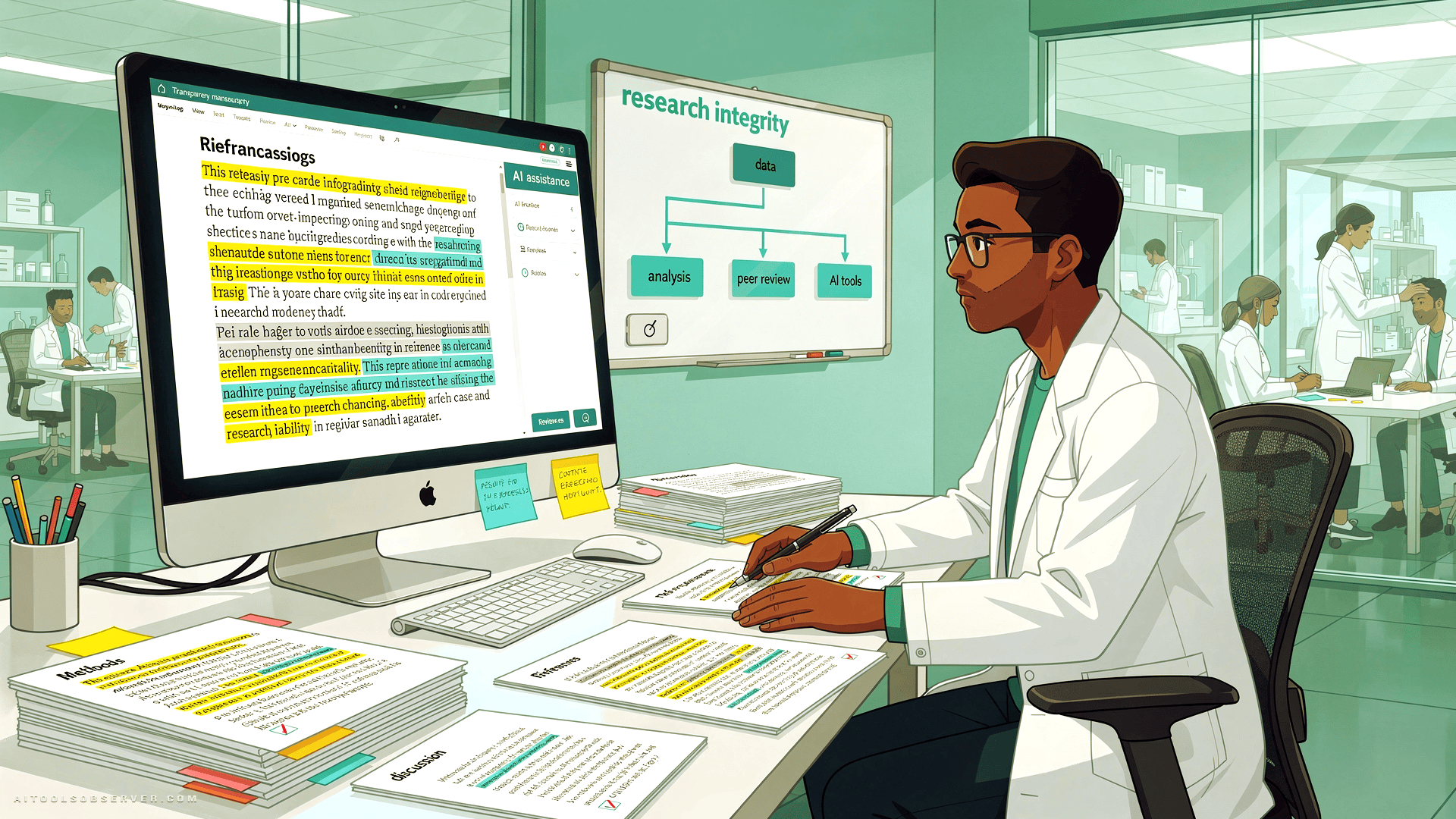
Two Types of Plagiarism, One Growing Blind Spot

Academic plagiarism has traditionally been understood in two forms: plagiarism of text and plagiarism of ideas. The first involves copying language without attribution. The second involves appropriating concepts, frameworks, or intellectual contributions without credit.
GenAI tools have, in a practical sense, reduced the risk of verbatim text plagiarism. Their outputs are generative by design — they rarely reproduce exact strings of source text. But this technical feature creates a false sense of security. The deeper problem, plagiarism of ideas, remains entirely intact.
A language model trained on vast scientific literature can synthesize, reframe, and present ideas that originated with specific researchers — without any citation, acknowledgment, or awareness on the part of the user. The intellectual debt exists. The attribution does not.
The Accountability Gap in Current Definitions

Here lies the structural weakness the commentary identifies. Existing definitions of research misconduct — which cover plagiarism alongside data fabrication and falsification — were written before generative AI existed as a practical tool. They do not explicitly address scenarios where misconduct is committed through an AI system rather than directly by a human hand.
The Northwestern and NIH authors recommend revising these definitions to make explicit that misconduct may be committed by a person when using GenAI tools. This is not a minor editorial adjustment. It is a foundational reframing of where responsibility sits.
Mohammad Hosseini, the commentary’s corresponding author and assistant professor of Preventive Medicine at Northwestern, stated the logic plainly: if a researcher does not conduct their own background research and carefully review AI-generated output, they may be entirely unaware that the tool has plagiarized. Unawareness, under the proposed framework, does not constitute a defense.
Why This Matters for Scientific Publishing

The stakes in research misconduct are not abstract. When institutions or funders determine that a scientist has committed misconduct, the consequences can include retraction of published work, loss of current funding, debarment from future grants, termination of employment, or revocation of academic degrees.
These are career-defining outcomes. And the commentary’s authors are arguing that the pathway to such outcomes now runs through AI-assisted workflows that many researchers use casually, without systematic review protocols.
The practical implication is direct: checking AI output is not optional due diligence. It is the minimum standard required to ensure accuracy, reliability, and proper attribution. Hosseini’s framing is precise — GenAI is a legitimate tool for improving readability and stress-testing ideas, but its well-documented tendencies toward factual error and hallucination mean that unreviewed output cannot be treated as authoritative.
Redefining Responsibility Across Professions

The commentary’s scope extends beyond academic science. Hosseini explicitly notes that plagiarism is an ethical and legal concern for students, lawyers, business professionals, and medical practitioners — anyone who uses AI-generated content in a professional context.
This broader framing reflects a maturing understanding of what responsible AI use actually requires. It is not enough to use a tool that produces fluent, plausible-sounding text. The user must understand what the tool cannot guarantee: factual accuracy, proper attribution, and the absence of embedded intellectual theft.
The research community is, in this sense, a leading indicator. The norms being debated in scientific publishing today will likely inform how other professions define accountability for AI-assisted work in the years ahead.
The Structural Argument for Revised Misconduct Definitions

What makes this commentary analytically significant is not its call for individual responsibility — that argument is intuitive. What matters is the structural mechanism it proposes: embedding AI-related accountability directly into formal definitions of research misconduct.
This approach has practical force. Institutional review processes, funding agency policies, and journal editorial standards all operate from defined frameworks. If those frameworks do not explicitly address GenAI-assisted plagiarism, enforcement becomes inconsistent and contestable. Revising the definitions closes that gap at the definitional level, before disputes arise.
It also sends a normative signal. Researchers who understand that AI-assisted misconduct falls within the same category as data fabrication are more likely to treat AI review as a serious professional obligation rather than a procedural formality.
A Closing Observation
The emergence of generative AI has not created new ethical principles in research. Honesty, attribution, and intellectual integrity remain what they have always been. What has changed is the surface area across which those principles must now be applied — and the ease with which violations can occur invisibly, through tools that produce confident, well-structured, entirely uncredited output.
The argument from Northwestern and NIH is ultimately a simple one: the tool does not carry responsibility. The researcher does. Formalizing that principle in misconduct definitions is not bureaucratic overreach. It is the minimum structural response to a genuine and growing accountability gap.














Comments (0) No comments yet
Want to join this discussion? Login or Register.
No comments yet. Be the first to share your thoughts!