


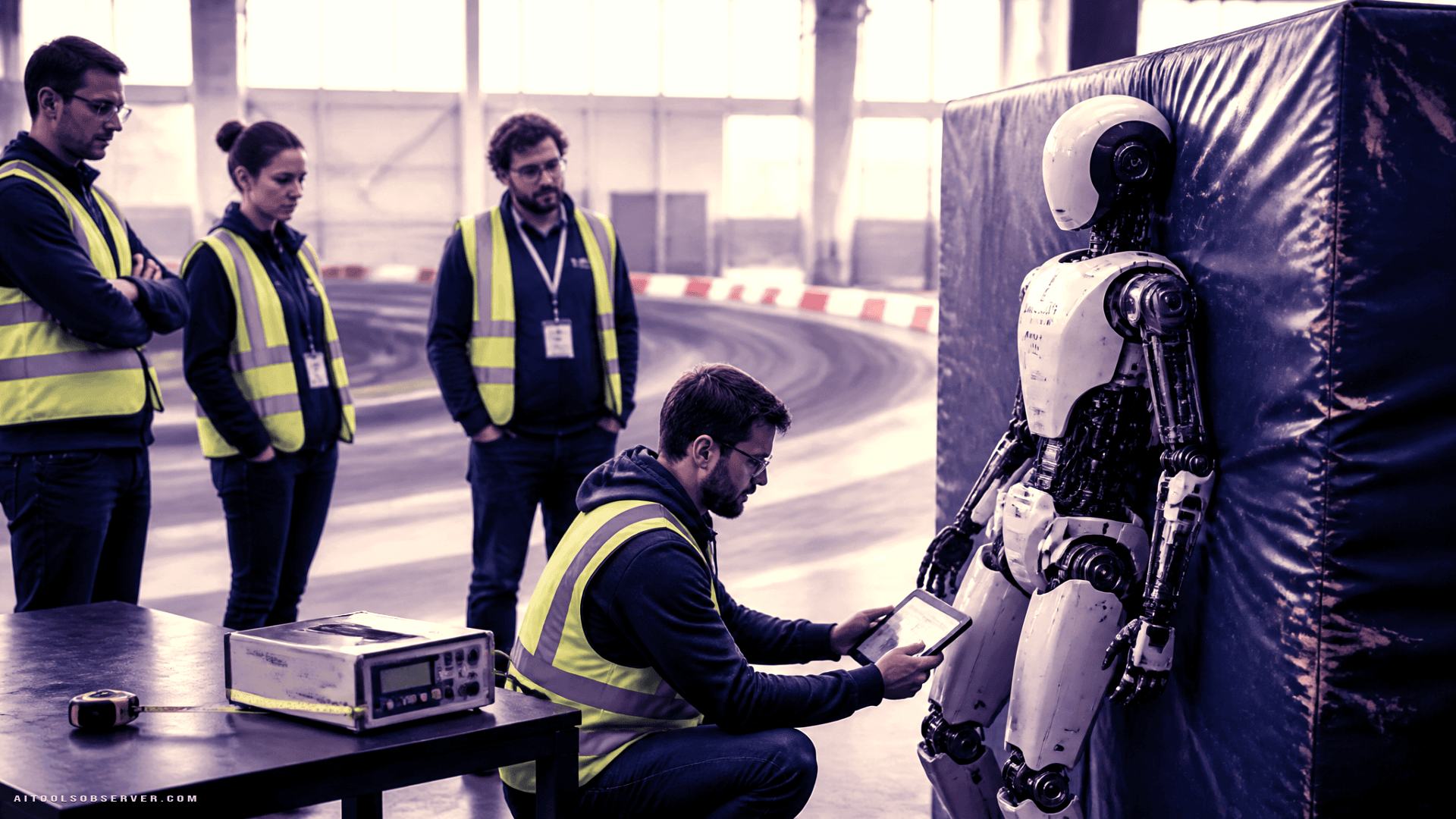
Speed Is the Wrong Benchmark
One AI expert who shared the footage put it plainly: China’s robotics industry may be over-optimizing for speed right now.
That framing matters. Last year, watching a humanoid robot run at all was genuinely impressive—it proved the hardware could handle dynamic motion. But once that baseline exists, going faster doesn’t automatically mean going better. Knowing when to slow down, when to stop, and how to stop safely is at least as important as top speed.
A robot that can sprint at 28 mph but can’t brake reliably isn’t a fast robot. It’s a fast liability.
The Autonomy Wrinkle
This year’s competition added a meaningful twist: certain track events now require fully autonomous robots, not remote-controlled ones. That’s a significant shift.
Remote control keeps a human in the loop. Autonomy removes that safety net. When the robot misjudges its stopping distance, there’s no operator to hit the brakes. The wall finds out first.
That rule change makes the Beijing crash more than a training blooper. It’s a preview of what happens when autonomous control systems aren’t yet matched to the physical capabilities of the hardware they’re running.
What the Crash Actually Reveals
The gap here isn’t in motors or materials. It’s in control logic—the software layer that decides when to decelerate, how to handle unexpected track conditions, and what "safe stopping" looks like at speed.
This is the same challenge that shows up in every real-world humanoid deployment:
- Speed is easy to demo and easy to measure.
- Reliable, safe behavior around people is harder to demo and harder to measure.
- Failure modes at high speed are more dramatic and more damaging than failure modes at low speed.
The robots that will actually matter in workplaces and warehouses won’t be the fastest ones. They’ll be the ones that don’t crash into things.
Why This Matters Beyond the Clip
The World Humanoid Robot Games is partly spectacle, partly genuine R&D stress test. Competitions like this accelerate development—but they also reveal where the pressure is being applied. Right now, it appears to be on performance metrics that look good on a leaderboard rather than the control and safety properties that make robots useful in practice.
For anyone tracking the humanoid AI space—whether you’re evaluating tools, watching the market, or just trying to understand where this is all going—the Beijing crash is a useful signal. The hardware is maturing fast. The control layer is still catching up.
The smarter question to ask about any humanoid robot isn’t how fast can it run. It’s what happens when something goes wrong.








Comments (0) No comments yet
Want to join this discussion? Login or Register.
No comments yet. Be the first to share your thoughts!