



What Is Nvidia Halos?
Halos is Nvidia’s safety system for robotics — designed to run from the silicon level all the way up through software, sensors, simulation, and certification. Think of it as a safety operating layer that travels with the robot wherever it goes.
Nvidia originally developed safety infrastructure for autonomous vehicles. Halos for Robotics extends that work into a much messier domain: warehouses, hospitals, factories, and anywhere else robots are now being deployed alongside humans.
The core challenge? Automotive safety has relatively standardized definitions across companies and countries. Robotics doesn’t. A robot vacuum and a robotic forklift have almost nothing in common from a safety standpoint, even if they’re both “autonomous mobile robots.”
The Four Layers of the Halos Stack
Halos isn’t a single product. It’s a layered system that covers hardware, software, sensors, and testing.
1. Safety-Dedicated Hardware
At the foundation is the Nvidia IGX Thor computing module — a platform built for robotics and industrial applications that includes an independent processor dedicated entirely to safety workloads. The idea is that safety-critical computing runs on the same silicon as the functional AI system, but stays isolated from it.
2. The Halos Operating System
The Halos OS monitors every hardware block and every software library in real time. If something fails, the system catches it fast. Safety-critical workloads are isolated to prevent interference from other processes running on the same device.
3. Holoscan Sensor Bridge
This component connects sensor data to safety-related processing in a way that can detect corrupted or unreliable data before it causes a problem. It can be embedded directly into hardware components like microcontrollers or FPGAs, which means safety validation happens close to the source.
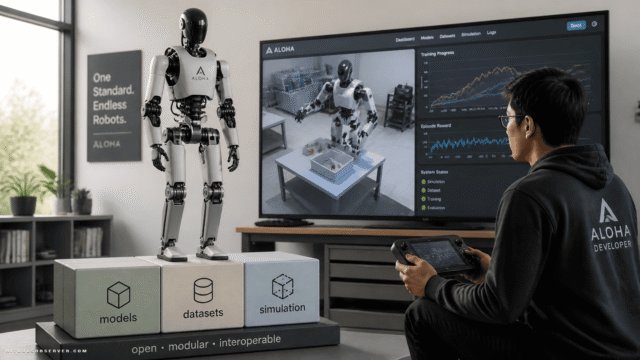
4. Simulation and Inspection Tools
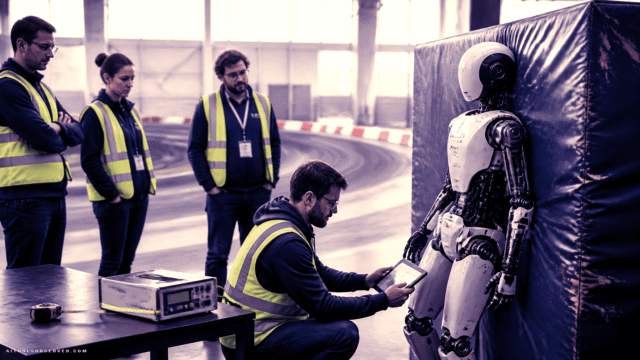
Halos includes virtual testing environments where robots can be stress-tested before they ever touch a real floor. There’s also an inspection lab program that gives robotics companies fast feedback on safety issues — called “artifacts” — that surface during development.
Why Robotics Safety Is Harder Than Automotive Safety
Autonomous vehicles operate on roads. Roads have rules, lanes, and relatively predictable environments. Robots operate in unstructured spaces where anything can happen.
Amit Goel, head of robotics ecosystem and edge computing at Nvidia, described the challenge directly: a robot moving down a warehouse aisle at six miles per hour can’t see around corners. It doesn’t know if a forklift, a person, or a pallet is about to appear. The practical response? Robots slow almost to a halt before turns, because the environment is genuinely unpredictable.
This is why Halos had to be programmable. Nvidia needed to give developers the ability to define custom safety functions for their specific use cases — without breaking the underlying safety infrastructure. That’s a real engineering tension: flexibility versus control.
Real Robots Already Using Halos
This isn’t vaporware. Several companies are already building Halos into their products.
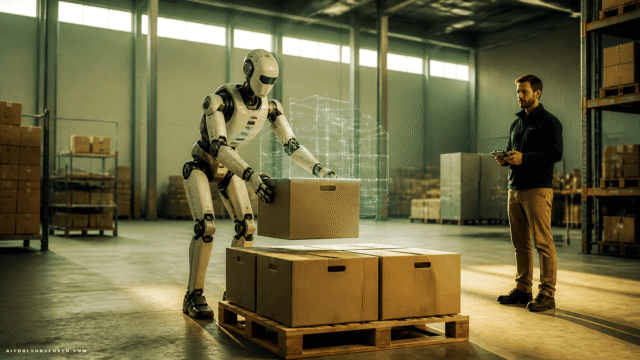
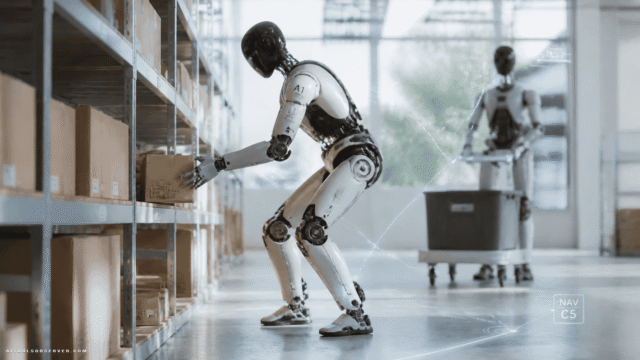
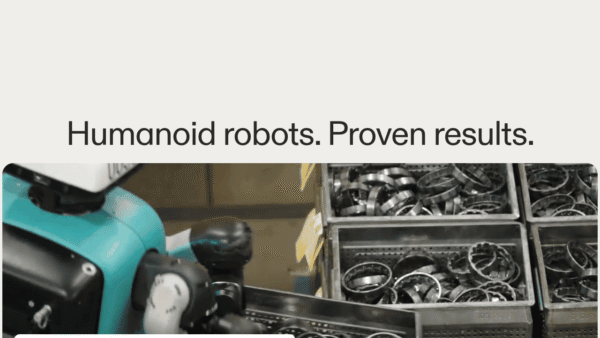
Agility Robotics was the first to integrate Halos into its Digit 5 humanoid robot. Previous versions of Digit required external sensors placed around the robot’s work cell to ensure safety. With Halos, all the relevant safety hardware and sensors are embedded inside the robot itself. It can now operate anywhere in a factory or warehouse without requiring new infrastructure to be set up for each new task.
Boston Dynamics is an early partner in Nvidia’s Halos safety accreditation program. The focus spans their Spot robot dogs, Stretch wheeled robots, and Atlas humanoid robots — with Atlas potentially deploying in Hyundai automotive factories by 2028.
KION Group, a German company deploying autonomous forklifts and mobile robots, is also working to incorporate Halos. So is LG, which is developing a humanoid robot based on Nvidia’s Isaac GROOT foundation model.
The Bigger Picture: From Caged Robots to Unchained Ones
For most of industrial history, robots were bolted to one station, doing one repetitive task, surrounded by physical barriers to keep humans away. That model is changing.
The new generation of robots is expected to handle multiple tasks across multiple environments — and to do that safely, without cages or fixed infrastructure. As Goel put it, the robot is now “literally unchained — the safety goes with the robot wherever it goes.”
That shift has real implications. It means robots can be redeployed quickly. It means they can work near people without requiring expensive facility modifications. And it means the bottleneck to broader robot adoption is no longer just capability — it’s verifiable, portable safety.
What This Means If You’re Watching the Space
Halos is positioned as the safety layer that makes general-purpose robotics deployable at scale. Whether humanoid robots ever become truly autonomous general workers is still an open question. But the near-term deployment of robots in warehouses, hospitals, and factories is already happening — and it’s accelerating.
For anyone evaluating robotics platforms, AI infrastructure tools, or industrial automation solutions, the safety stack underneath the robot is becoming just as important as the AI model on top of it. Nvidia is betting that Halos becomes the standard layer everyone builds on.
That’s worth watching closely.




Comments (0) No comments yet
Want to join this discussion? Login or Register.
No comments yet. Be the first to share your thoughts!