


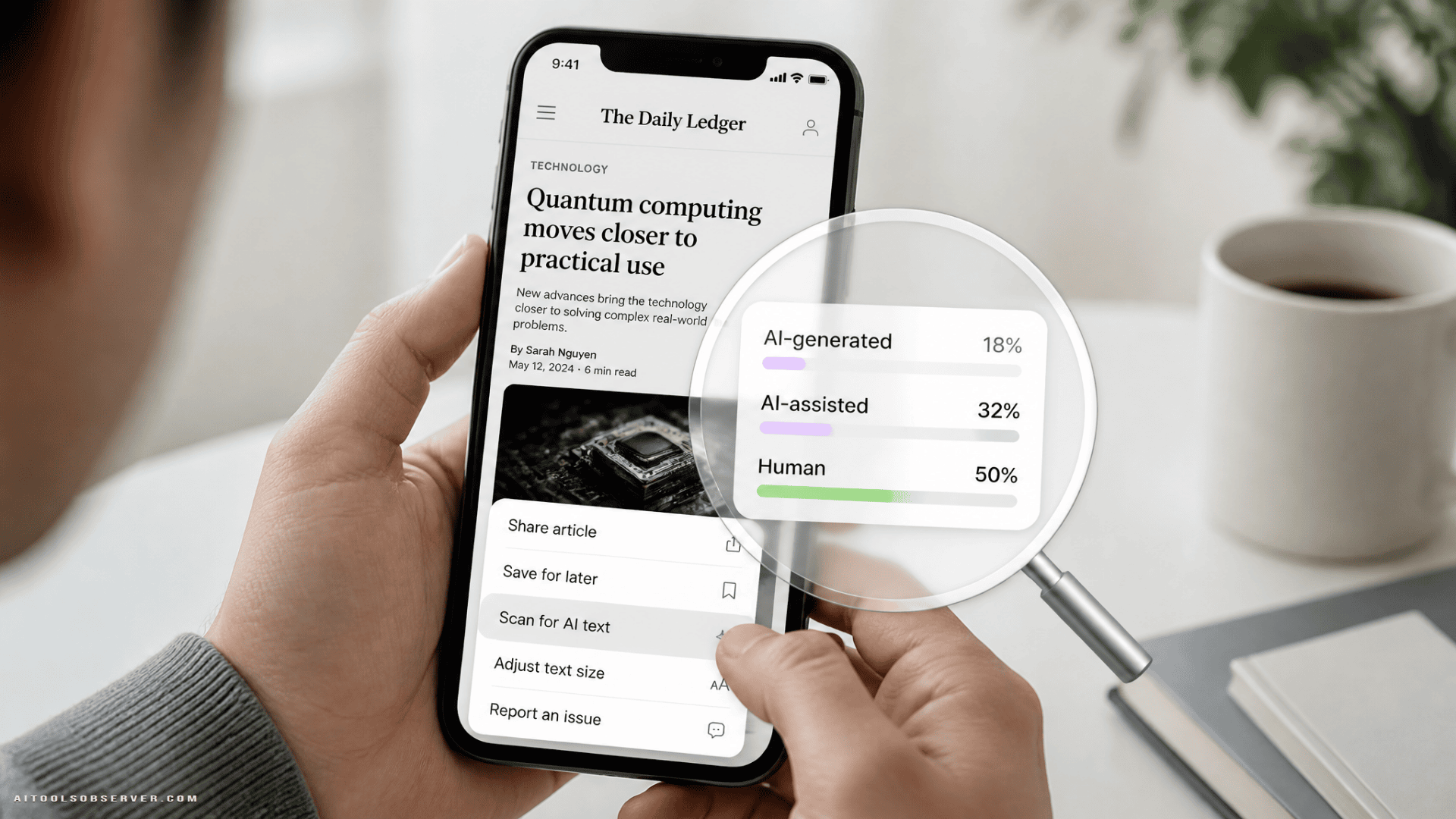
How It Works
Tap the “…” menu on any eligible piece of content and select “Scan for AI text.” Pangram’s classifier returns a breakdown: AI-generated, AI-assisted, or human. No guesswork, just percentages.
A few constraints worth knowing upfront:
- Only works on text longer than 100 words
- Only applies to content published after July 21, 2026
- Scanning is reader-initiated — nothing happens automatically
The detection is opt-in by design. Pangram doesn’t run in the background; a reader has to actively request it.
What Pangram Actually Does
Pangram isn’t using generative AI to catch generative AI. It deploys a classifier neural network trained on human-authored text from before 2021 — before LLM-generated content started saturating the internet. The idea is a clean training set, free of the very thing it’s trying to detect.
That said, the tool has real limits. It can’t tell if a writer used AI for research before drafting something themselves. As Substack CEO Chris Best put it, the problem isn’t AI assistance — it’s the mismatch between what readers expect and what they’re actually getting.
Controls for Creators
Writers aren’t just passive subjects here. They can:
- Add a disclosure statement explaining their writing process
- Run Pangram on their own drafts before publishing
- Flag incorrect classifications for review
- Disable AI detection on their content entirely
That last one is the interesting wrinkle. A creator can turn off detection regardless of what Pangram found. Substack is betting on transparency as a norm, not enforcing it as a rule.
Why This Matters Now
A recent study by digital marketing firm Graphite found that AI-generated articles now match human-written ones in volume online. That’s the context Substack is operating in — a platform built on the premise of authentic human voices, navigating a web where that’s increasingly hard to verify.
Best has signaled more AI-related features could follow, including reader preferences for the content Substack recommends — which could eventually mean filtering AI-generated content out of your feed altogether.
The Practical Takeaway
If you’re a reader, you now have a lightweight way to sanity-check what you’re reading on Substack — not perfect, but more than you had yesterday. If you’re a creator, adding a disclosure statement is a low-effort way to signal authenticity before anyone even reaches for the scan button.
Trust is easier to build proactively than to recover after a reader goes looking.














Comments (0) No comments yet
Want to join this discussion? Login or Register.
No comments yet. Be the first to share your thoughts!