


Who’s Complying (and Who Isn’t)
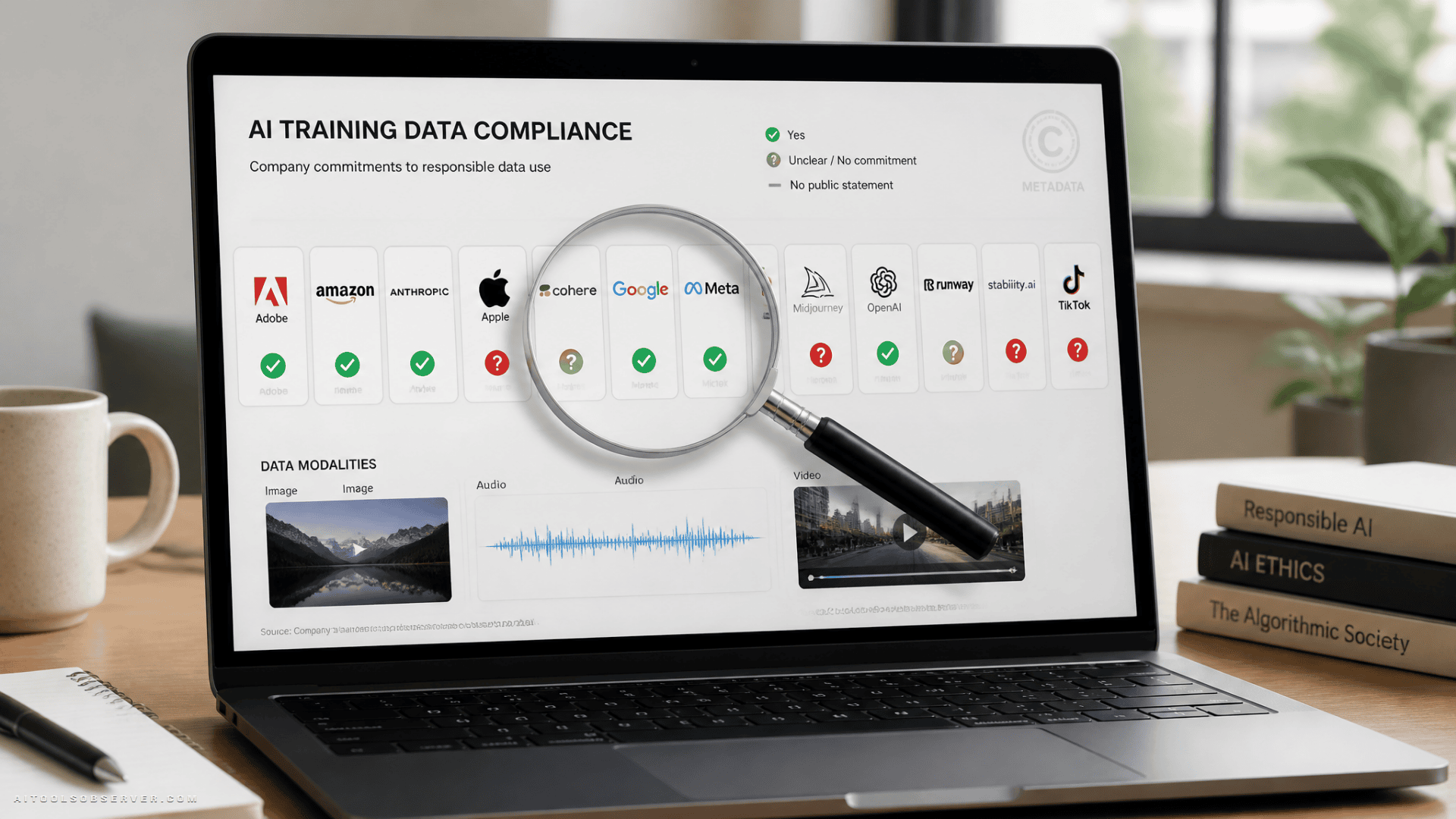
An independent review by media outlet Indicator and human rights organization WITNESS evaluated tools from 13 companies collectively reaching around 10.6 billion monthly users. The findings were uneven.
Not compliant at time of review:
- HeyGen
- Midjourney
- Mistral
- Synthesia
- xAI
Suno, an AI music company, wasn’t initially flagged as compliant but shared its tool with KQED after the report, saying it launched in compliance with the law at the start of the month.
Synthesia told KQED it has embedded the required metadata but is “still seeking clarification on a few technical points” around full implementation. The company also argued that as a B2B platform, its risk profile differs from consumer-facing apps—a reasonable point, though not yet a legal carve-out.
HeyGen, Midjourney, Mistral, and xAI did not respond to requests for comment.
Compliance ≠ Reliability
Here’s the part that matters most for anyone actually trying to use these tools: having a detection tool doesn’t mean it works well.
The review found that most tools could identify their own unedited content. But only Google and OpenAI could reliably detect their own output after it had been edited. And only Adobe and Microsoft could identify content generated by a different tool more than half the time.
That last finding is less damning than it sounds. The law doesn’t actually require companies to detect rival tools’ content—only their own. So the bar is deliberately low.
Rate Limits Are a Real Problem
Three tools cap the number of tests a user can run per session or per day. OpenAI’s verify tool reportedly blocked testers after as few as 7 queries in one session. Google and Meta capped out at 10–15 tests per day per user.
For researchers, journalists, or educators trying to verify content at scale, that’s a meaningful friction point.
The Metadata Problem
OpenAI put it plainly: “Metadata is not foolproof. It can be stripped, lost through uploads and downloads, or broken by transformations like file format changes, resizing, or screenshots.”
Microsoft echoed this, noting that editing or downstream modifications can affect whether signals remain readable.
This is the core tension in the entire compliance framework. Watermarks and metadata are useful signals—but they’re fragile ones. A screenshot alone can erase them.
What’s Coming Next
The California law currently covers photo, audio, and video. Starting in January, large online platforms—including social media and search engines—will be required to detect AI content and let users inspect it.
Anthropic, which doesn’t generate photorealistic images or video, announced it will watermark text in all new models. That puts it ahead of the current California requirements, which don’t yet cover text.
Meanwhile, Meta has started labeling ads “created or significantly edited by generative AI.” Some Instagram marketers noticed the filters flagging content made with Canva’s background remover—a sign that detection systems are already producing false positives in the wild.
The Useful Takeaway
If you’re building workflows that depend on AI content verification—for media literacy, legal review, or platform moderation—don’t treat detection tools as a solved problem. They’re a starting point, not a guarantee.
The law created a floor. Most companies are still finding it.












Comments (0) No comments yet
Want to join this discussion? Login or Register.
No comments yet. Be the first to share your thoughts!