


What changed
Trajectory is now publicly making its post-training platform available after operating with customers that include Harvey, Rogo, Decagon, Mercor, and Nvidia.
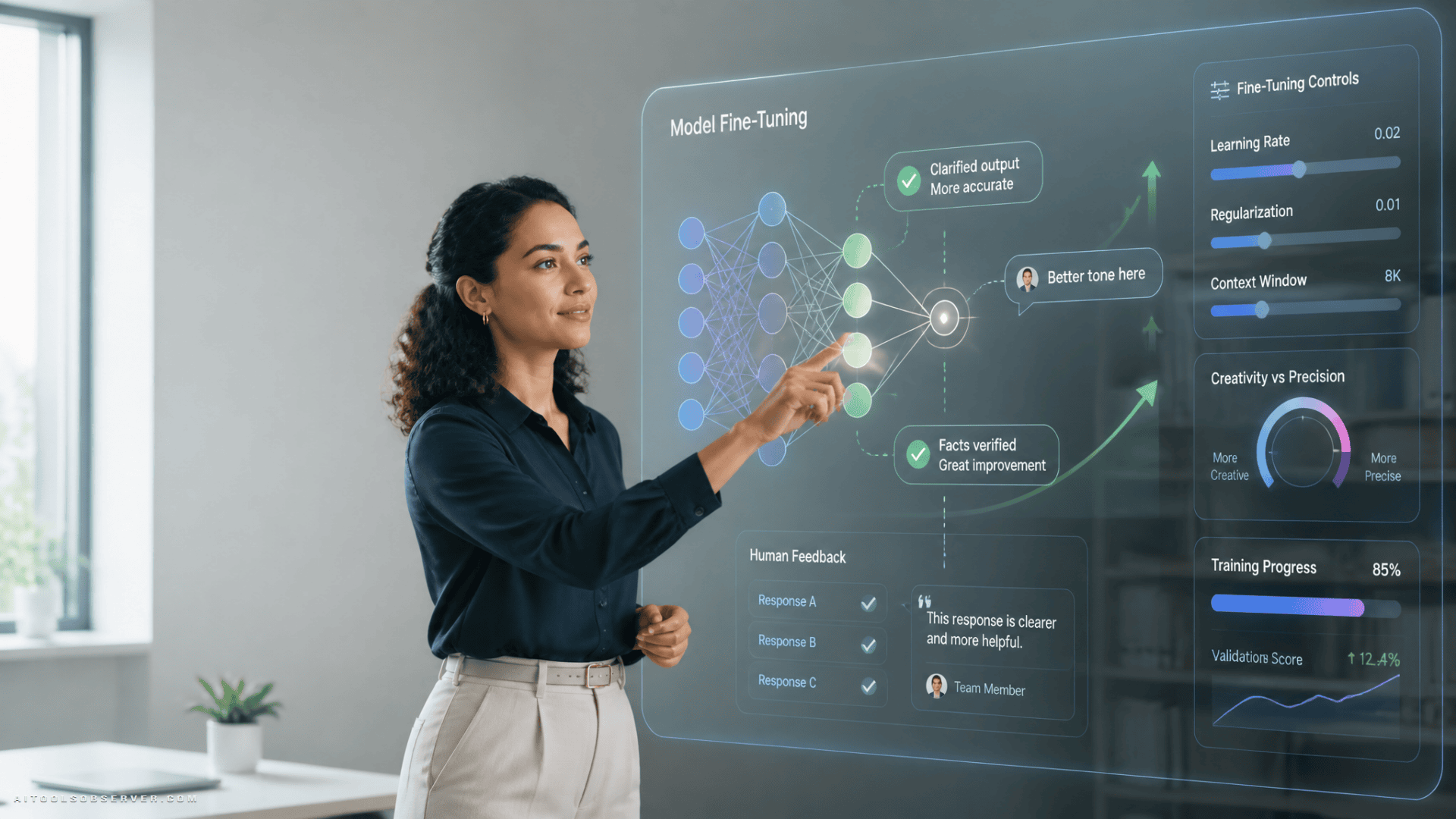
The company’s pitch is straightforward: start with an open-source model, connect it to real application workflows, collect feedback on outputs, and use that feedback to retrain the model so it gets better over time at narrow, high-value tasks.
That matters because many enterprise AI deployments stall at the same point. A model can be impressive in demos, but much less reliable when asked to review a specific contract type, follow a financial analysis method, or adapt to an organization’s standards.
Why this matters
The AI tooling market is shifting from model access to model adaptation.
For many teams, the real bottleneck is no longer getting a capable general model. It’s turning that general model into something that behaves more like an experienced specialist inside a real workflow.
Trajectory appears to be building for that exact use case:
- legal review
- financial analysis
- domain-specific knowledge work
- repeated internal tasks with clear quality standards
If that works as intended, it could help companies reduce the manual effort usually required to keep retraining or re-prompting models for the same class of problems.
The core idea: continual learning, not one-off tuning
Most people hear “fine-tuning” and think of a one-time model adjustment. Trajectory’s positioning is different.
Its platform is built around continual learning. Instead of training a model once and hoping it stays useful, businesses can feed back information from live use so the model keeps improving at specialized tasks.
That creates a more practical loop:
- A company uses an open-source model in production.
- Users provide signals about what worked and what didn’t.
- The platform turns those signals into retraining inputs.
- The model improves against the company’s own definition of quality.
That last point is important. Specialized AI is usually less about abstract intelligence and more about whether the output matches internal standards, preferred methods, and task-specific expectations.
Why human feedback is the key differentiator
Trajectory’s approach leans heavily on humans staying in the loop.
Based on the available context, the company is not framing post-training as autonomous self-improvement. Instead, it is emphasizing a system where people decide what “good” looks like and the platform helps convert that into training improvements.
That makes the product easier to understand for enterprises. It also makes the safety argument more practical.
A fully self-improving system may sound efficient, but many businesses do not want models changing behavior without clear review signals. Human-guided continual learning is slower than full automation in theory, but often more usable in regulated or high-stakes settings.
For industries like law, healthcare, and finance, that tradeoff could be exactly the point.
The practical enterprise appeal
Trajectory’s value proposition is not just better model performance. It is reduced operational complexity.
Enterprises often face three recurring problems when deploying domain-specific AI:
- prompts become fragile as workflows change
- model quality varies across edge cases
- nontechnical experts know what’s wrong, but can’t easily improve the system
Trajectory appears to be designed to close that third gap. The idea is that domain experts such as lawyers and doctors can help improve the model through feedback, without needing to run a full ML pipeline themselves.
If the platform makes that process accessible, it could speed up deployment for companies that have expertise but lack large in-house model training teams.
Why open-source model post-training is becoming a bigger category
Trajectory is entering a market that is getting more crowded for a reason.
Open-source models have become good enough that many enterprises now see them as viable starting points. But the starting point is not the finish line. The more companies adopt open-source AI, the more they need infrastructure for:
- customization
- evaluation
- feedback collection
- retraining
- ongoing improvement
That creates room for vendors focused on post-training rather than foundation model development.
The competitive pressure is real. Other startups are also working on automated post-training and fine-tuning infrastructure. That means Trajectory is not selling a brand-new idea so much as competing on execution, usability, and how well it can fit into real enterprise workflows.
The team story matters here
Many AI startup funding announcements overplay pedigree. In this case, the team background is relevant because the product sits in a technical and operational middle layer that is hard to build well.
Trajectory was founded by three Stanford classmates with experience spanning Google DeepMind and Apple. The broader team also includes people from OpenAI, Stripe, and Netflix, according to the available context.
That matters for two reasons:
- post-training infrastructure requires strong research and systems thinking
- enterprise adoption often depends on product design, not just model quality
One interesting detail is the company’s emphasis on interface design. That may sound secondary for a training platform, but it could be central to adoption. If nontechnical users are expected to guide model improvement, the workflow has to be usable by specialists, not just ML engineers.
What this means for AI buyers
If you’re evaluating enterprise AI tools, this launch is a useful reminder that model choice is only part of the stack.
A general-purpose model may be enough for broad drafting or brainstorming. But if your use case depends on repeated accuracy in one domain, the more important question is often this: how does the system learn from your team over time?
That shifts the buying criteria.
Instead of only asking about benchmark performance, companies should also ask:
- How is feedback collected?
- Who can provide that feedback?
- How often can the model improve?
- Can the system adapt to our standards, not just general tasks?
- What level of human oversight is built in?
Those questions often matter more than headline model capability once a tool enters production.
Where Trajectory fits in the AI tools landscape
Trajectory is best understood as infrastructure for specialized AI behavior, not another general chatbot layer.
Its platform is positioned for enterprises that want to turn open-source models into role-specific systems that improve through use. That places it in an increasingly important segment of the market: the layer between foundation models and real business outcomes.
For AI adopters, that segment is worth watching closely. The winners in enterprise AI may not be the companies with the biggest models, but the ones that make models easier to adapt, govern, and improve inside real organizations.
The takeaway
Trajectory’s launch matters because it focuses on the part of enterprise AI that usually gets messy fast: making a model better at your work, not just good at work in general.
If you’re comparing AI tools, keep an eye on platforms that help teams capture feedback and turn it into ongoing model improvement. In practice, that may be more valuable than starting with a slightly stronger base model.













Comments (0) No comments yet
Want to join this discussion? Login or Register.
No comments yet. Be the first to share your thoughts!