


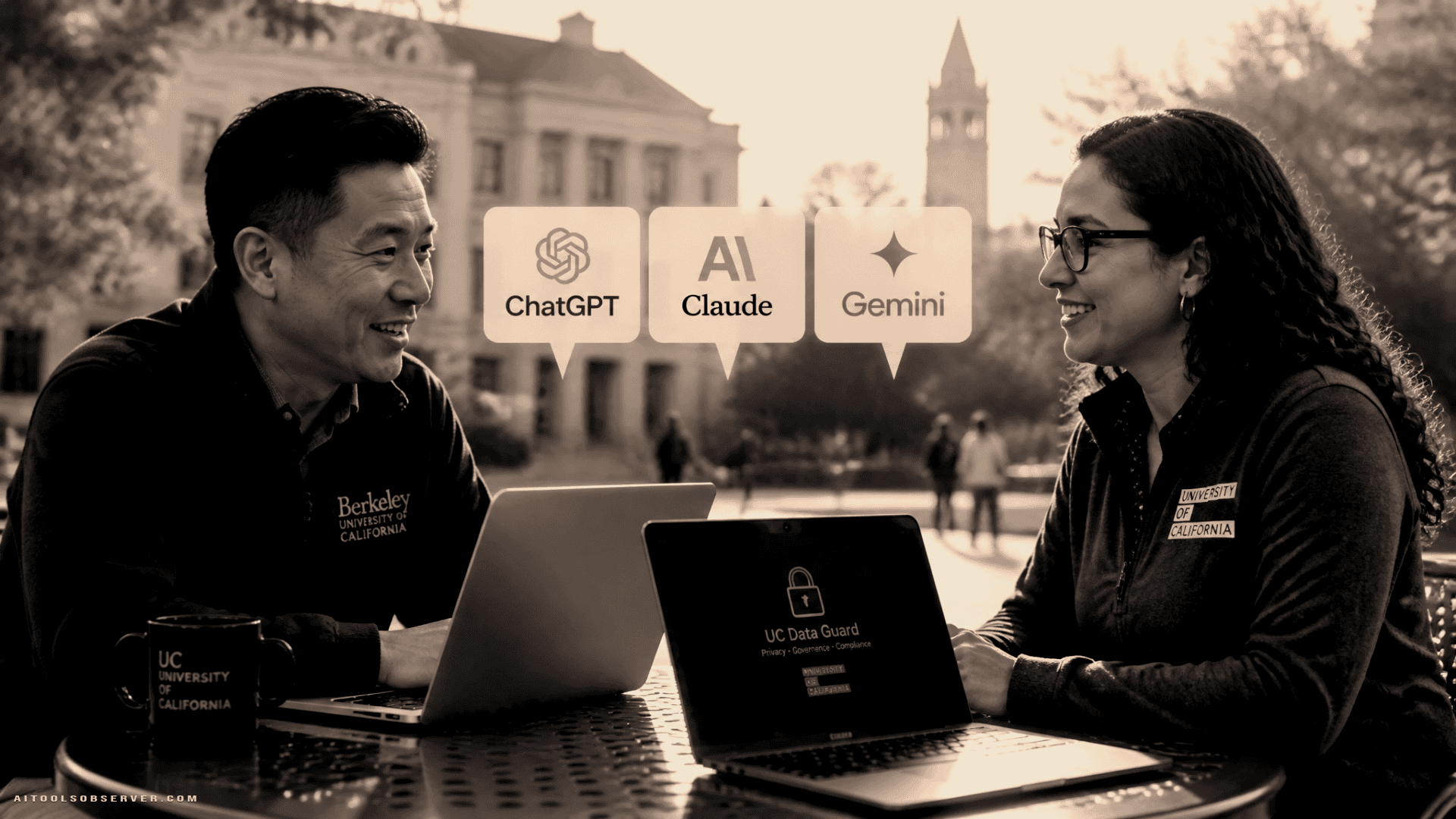
A Peer-Learning Model in a Complex Environment
The peer-based format addresses a real gap. Formal AI training programs often assume a baseline of technical confidence that many employees do not yet have. By grounding learning in conversation between colleagues, the UC model lowers the entry barrier and distributes knowledge laterally rather than top-down.
UCLA currently holds licenses with OpenAI, Gemini, Copilot, and NotebookLM. The latter three are available to students and staff at no direct cost through UCLA’s Digital and Technology Solutions infrastructure. The existence of these licenses gives the Buddy Program a concrete set of tools to work with, rather than leaving participants to navigate personal free-tier accounts.
Where the Concerns Concentrate
The program has not launched without friction. UCLA faculty have raised substantive objections across three areas: data privacy, licensing transparency, and workforce implications.
On privacy, the concern is structural. When staff input information into commercial AI models, those inputs may be used to further train the underlying systems. Campus licenses can limit this, but the precise terms are not publicly available. Tobias Higbie, chair of external relations for the Council of UC Faculty Associations, has called on the UC to publish its contracts with AI vendors so that faculty, staff, and students can understand what data protections are actually in place.
On cost, the picture is similarly opaque. Each query to a commercial model carries a cost, and the aggregate spend across a large university system is not trivial. Higbie noted that the full financial scope of these licensing arrangements remains unclear to those outside the procurement process.
On workforce, the critique is sharper. Some faculty read the program not as a learning initiative but as preparation for a reduction in human labor—a concern the UC has not directly addressed in its public communications about the program.
The Dependency Question
Hal Hershfield, a professor at the UCLA Anderson School of Management, offered a more measured framing. He acknowledged that the program encourages a degree of AI dependency but questioned whether dependency is inherently problematic. His analogy—calculators and mathematics—is useful precisely because it does not resolve cleanly. Calculators changed how math is practiced without eliminating the need for mathematical reasoning. Whether AI tools will follow a similar pattern in knowledge work remains genuinely uncertain.
What This Means for AI Tool Adoption in Institutions
The UC Buddy Program is a useful case study for any organization considering structured AI adoption at scale. A few practical observations stand out:
- Voluntary, peer-based programs reduce resistance and allow organic adoption, but they also make outcomes harder to measure and govern.
- Licensing transparency is not just a faculty concern—it is a governance requirement. Organizations that cannot answer basic questions about what their AI contracts permit are exposed to both legal and reputational risk.
- Multi-tool exposure (ChatGPT, Claude, Gemini in the same program) is realistic. Staff will encounter different tools in different contexts, and familiarity across platforms is more durable than single-tool fluency.
The UC’s approach reflects a broader tension in institutional AI adoption: the pressure to move quickly, the obligation to move carefully, and the difficulty of doing both at once. Publishing contract terms and establishing clear data governance policies would go a long way toward resolving the faculty concerns—and would make the learning program itself more credible.











Comments (0) No comments yet
Want to join this discussion? Login or Register.
No comments yet. Be the first to share your thoughts!