


The Number That Reframes Everything

At ServiceNow’s Knowledge 2026 conference, Huang delivered a figure that deserves a permanent place in any serious investor’s reference file. He stated that the compute required for agentic AI will rise at least 1,000% compared to generative AI — within just two years.
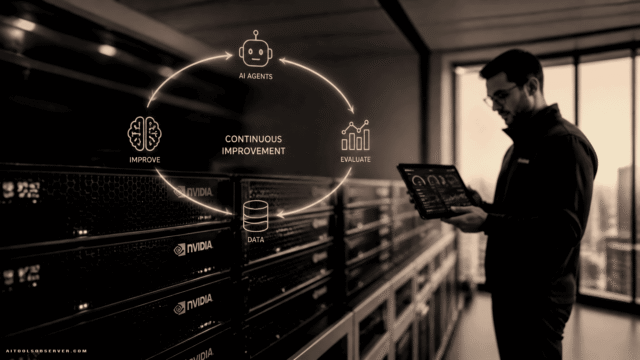
To understand why that number is structurally different from ordinary tech hyperbole, the distinction between generative and agentic AI must be clear. Generative AI is reactive: a prompt arrives, tokens burn, an answer appears, and the GPU cools. Agentic AI operates on an entirely different logic. Agents read, plan, call tools, write code, query databases, and verify their own outputs — stringing those steps together for minutes or hours at a time, often without any human in the loop. Each autonomous cycle consumes more compute than a dozen chatbot replies.
Huang’s stated vision is 10 billion digital AI agents working alongside human employees.
“The entire manufacturing line will be operated by robots, managed by more robots, and the entire factory is a robot,”
he told CNBC. He also noted he would not be surprised if his own 10x estimate is off by “a couple orders of magnitude.”
Where the Grid Already Stands

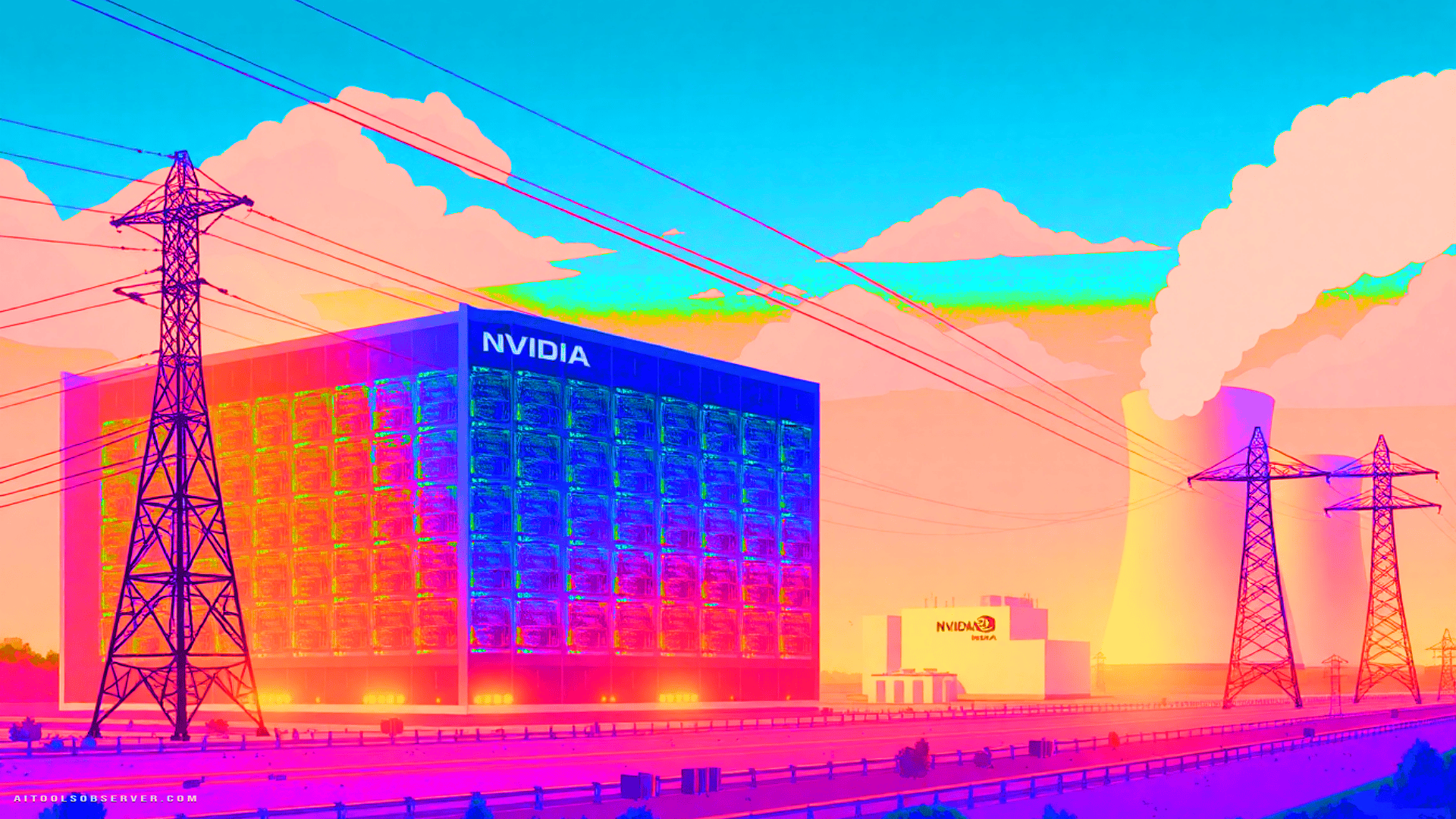
Before projecting forward, the baseline deserves attention — because it is already remarkable. According to a Business Council of Sustainable Energy report, U.S. data centers now draw approximately 41 gigawatts of power, representing a 150% increase over just five years. The Lawrence Berkeley National Laboratory projects that figure rises to between 325 and 580 terawatt-hours (TWh) by 2028, potentially accounting for up to 12% of total U.S. electricity consumption.
The IEA’s April report, Key Questions on Energy and AI, projects global data center electricity consumption doubling from 485 TWh in 2025 to 950 TWh by 2030, with AI-specific data centers tripling their share over the same period.
These are not speculative projections built on optimistic assumptions. They reflect infrastructure already under construction, contracts already signed, and hardware already shipping.
The Jevons Paradox at Scale
Efficiency gains are real and should not be dismissed. Huang has argued that Nvidia’s hardware has delivered a 100,000x improvement in performance per watt over the past decade. That is a genuine engineering achievement.
Yet the IEA data reveals the counterforce operating simultaneously. Power consumption per AI task is falling — and total consumption keeps rising, because the number of tasks is growing faster than efficiency gains can offset. This is the Jevons Paradox in its most consequential modern expression: cheaper, more efficient compute does not reduce energy demand; it expands the addressable use case until demand surges past the original baseline.
Agentic AI, running continuously across billions of autonomous workflows, is the mechanism that converts that paradox from an economic curiosity into a grid-level emergency.
The Ratepayer Is Already Paying

The grid is not waiting for agentic AI to arrive before showing strain. Dominion Energy, which serves Northern Virginia — the world’s densest concentration of data centers — proposed its first base-rate increase since 1992 in February 2025. The result: an $11.24 per month charge for a typical household beginning in 2026.
That is not a technology company absorbing infrastructure costs. That is an ordinary ratepayer subsidizing the AI buildout. In some regions, AI-driven demand is already outpacing available grid capacity, forcing companies to delay projects or install their own natural gas generators rather than wait years for grid connection approvals.
The social and political friction this creates should not be underestimated. Local backlash against data center expansion is growing in communities across Virginia, Texas, and the Pacific Northwest. Permitting timelines, community opposition, and transmission bottlenecks are becoming material risks for infrastructure deployment — not just regulatory footnotes.
Nuclear: From Fringe to Foundation

The energy implications of agentic AI have already crystallized into a concrete investment thesis. The IEA reports that the pipeline of conditional agreements between data center operators and small modular reactor (SMR) nuclear projects grew from 25 gigawatts at the end of 2024 to 45 gigawatts by April 2025. That is not a trend — that is an acceleration.
Technology companies, armed with investment-grade balance sheets and appetite for decade-long power contracts, are effectively accelerating nuclear commercialization on a timeline that regulators and utilities alone could never achieve. Google holds a power purchase agreement with Kairos Power for SMR capacity by 2030. Amazon Web Services acquired a data center campus adjacent to Talen Energy’s 2.5-gigawatt Susquehanna nuclear plant in Pennsylvania, securing 1,920 megawatts of dedicated capacity.
Cloud CapEx: The Magnitude of Commitment

The four largest cloud providers — Amazon, Microsoft, Google, and Meta — collectively committed more than $710 billion in AI infrastructure capital expenditures for 2026 alone. The IEA notes that just five technology companies now spend more on capital expenditure than the entire global oil and gas production industry.
That single comparison reframes the energy transition debate entirely. The question is no longer whether AI will reshape energy infrastructure. The question is how fast, and who captures the value.
Renewables: A Significant but Partial Answer

Renewables are accelerating alongside nuclear commitments, accounting for roughly 40% of all corporate power purchase agreements signed in 2025. Wind and solar offer speed and scalability that nuclear cannot match in the near term. However, the 24/7 continuous load profile of agentic AI workloads creates a structural preference for firm, dispatchable power — which is precisely why nuclear is attracting disproportionate strategic interest despite its longer lead times.
The Semiconductor Signal

Nvidia’s fiscal 2026 results provide the clearest quantitative anchor for this entire analysis. The company reported $215.9 billion in annual revenue, representing 65% year-over-year growth. That figure is not primarily a story about chips. It is a story about the infrastructure buildout required to run the workloads those chips enable.
Every Nvidia GPU shipped into a hyperscale data center represents a committed draw on the grid — for years. The hardware investment precedes the energy investment, but the energy investment is structurally inevitable. Investors focused solely on semiconductor valuations may be analyzing the engine while ignoring the fuel supply.
What This Means for AI Tool Adopters and Founders

For founders and operators building on top of agentic AI infrastructure, the compute cost structure is not a background variable — it is a core business model input. As agentic workloads become the default architecture for enterprise automation, the cost per task will be shaped as much by energy pricing and data center geography as by model efficiency.
Choosing AI tools and infrastructure partners with transparent compute cost structures, access to low-cost power regions, and credible energy sourcing strategies will become a meaningful competitive differentiator. The gap between teams that understand their compute cost stack and those that do not will widen as agentic workflows scale.
The Structural Takeaway

Huang’s 1,000% compute figure is not a boast about Nvidia’s hardware roadmap. It is a demand signal for every kilowatt-hour between now and 2030 — and a structural argument for repositioning across utilities, nuclear developers, natural gas operators, transmission equipment manufacturers, and grid-scale storage providers.
The transition from generative to agentic AI is not a software upgrade. It is an infrastructure buildout on the scale of electrification itself. The grid will be rebuilt around AI’s appetite. The only open question is which investors, operators, and policymakers recognize that early enough to act on it.
Follow the power lines, not just the silicon.











Comments (0) No comments yet
Want to join this discussion? Login or Register.
No comments yet. Be the first to share your thoughts!