


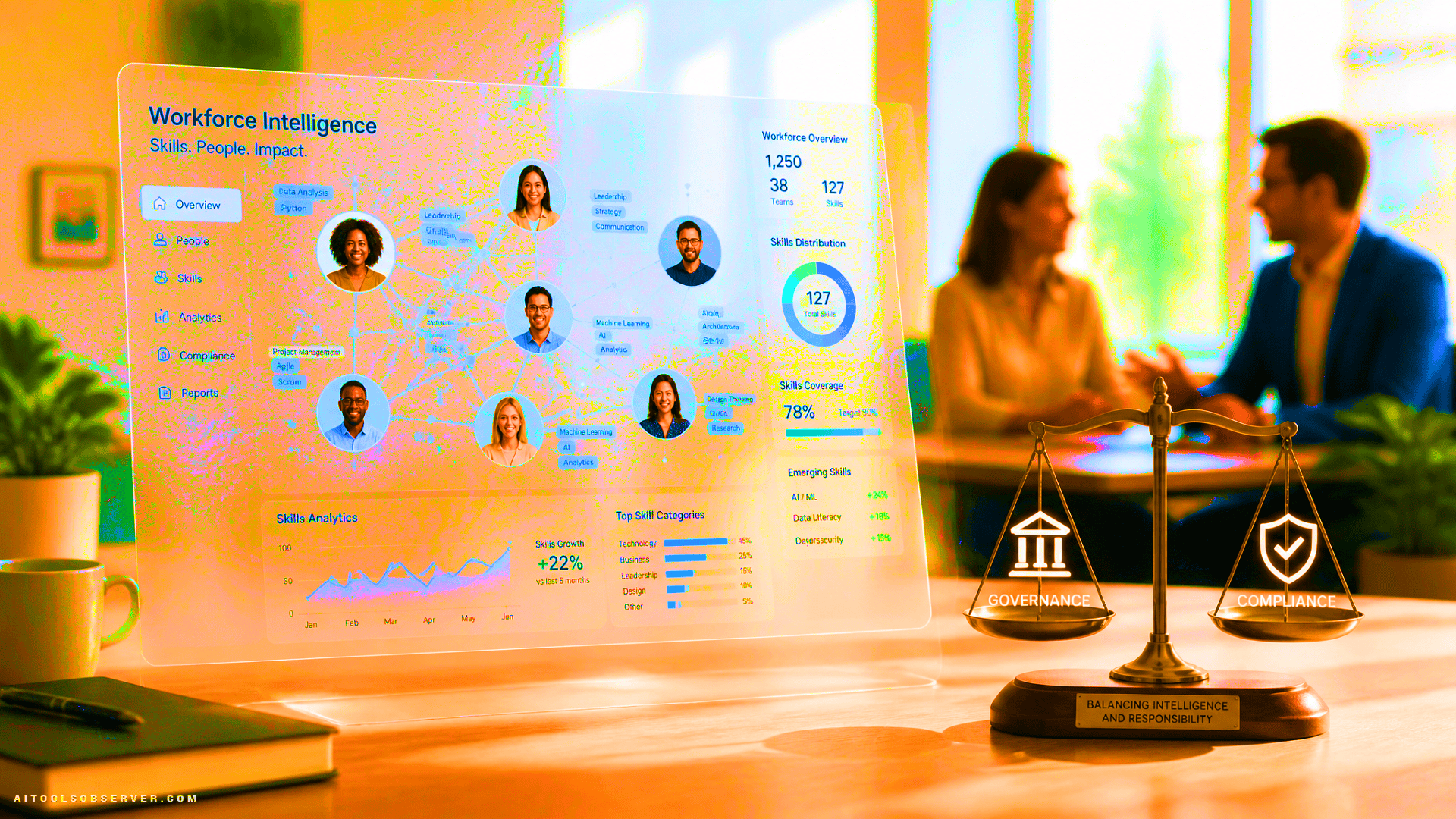
What agentic HR actually means
Agentic HR is best understood as a shift from tool-based assistance to system-level decision support. Instead of handling one task at a time, an agentic system is designed to monitor signals, interpret patterns, and recommend or trigger actions across multiple HR workflows.
In practical terms, that means a system may do more than automate repetitive work. It may identify skill gaps, suggest internal candidates for emerging needs, detect retention risk, or flag signs of team strain before those issues show up in traditional reports.
The difference is important:
- Basic HR automation completes predefined tasks
- Agentic HR connects data across workflows
- Strategic agentic HR aims to influence workforce planning and talent deployment
This is why the discussion has shifted from efficiency to governance. The more strategic the system becomes, the higher the stakes.
From job titles to capabilities
The most important architectural change in agentic HR is the move away from static job definitions. Traditional HR systems are typically organized around roles, titles, and fixed requirements. That works poorly when skill needs change faster than job descriptions do.
Agentic HR reframes the problem around capabilities. Instead of asking, “Who holds this title?”, it asks, “Who can do this work, who is close to doing it, and who is building adjacent skills?”
This matters because organizations often know only a small share of what their workforce can actually do in practice. Formal systems capture official roles and credentials, but they often miss:
- cross-functional experience
- informal expertise
- self-directed learning
- transferable skills
- emerging strengths not yet reflected in a title
A capability-based model gives HR a more realistic view of workforce readiness. It also supports internal mobility more effectively than title-based planning.
Why skills intelligence sits at the center
Skills intelligence is the layer that makes agentic HR strategically useful. It creates a dynamic inventory of workforce capabilities, ideally updated as employees learn, move between teams, and contribute in new contexts.
With that foundation, HR can do more than fill open roles. It can begin to answer harder strategic questions:
- Where are future skill shortages likely to appear?
- Which teams are overdependent on narrow expertise?
- Which employees could be redeployed with minimal upskilling?
- Where does internal talent exist but remain invisible to formal systems?
This is where agentic HR starts to resemble workforce strategy rather than workflow software. The system is no longer only processing requests. It is helping the organization model supply, demand, readiness, and risk across talent.
That said, better output depends on better input. If the underlying skills data is incomplete, stale, or inconsistent, the intelligence layer will simply produce cleaner-looking uncertainty.
What people analytics becomes in an agentic model
People analytics has traditionally been retrospective. It explains what happened: attrition rose, time-to-hire increased, engagement fell, promotions clustered in one business unit.
Agentic HR pushes that model toward continuous interpretation. It is designed to detect patterns as they form and convert those patterns into recommendations.
Examples may include:
- flagging emerging capability gaps before a role becomes hard to fill
- identifying likely internal successors based on evolving skills clusters
- spotting burnout or disengagement signals at a team level
- highlighting uneven access to development opportunities
This is powerful because it reduces the lag between signal and action. It is also risky because the closer the system gets to prediction, the easier it becomes to overtrust inferred conclusions.
HR leaders should treat these outputs as decision support, not decision replacement.
The promise and problem of culture analytics
Culture analytics is one of the most ambitious areas in agentic HR. The idea is straightforward: if culture affects retention, collaboration, and performance, then AI may help surface weak signals before they become visible in survey scores or turnover data.
Systems positioned in this area may analyze signals such as:
- engagement responses
- collaboration patterns
- communication activity
- sentiment indicators
- organizational network dynamics
The attraction is obvious. A traditional pulse survey gives periodic snapshots. A continuously monitored system appears to offer earlier warning, greater detail, and more frequent intervention points.
But this is also where technical capability collides with ethical limits. Culture analytics is not just measuring output. It can involve inferences about behavior, mood, belonging, or career risk based on data employees may not expect to be used that way.
That changes the governance burden. Once a system starts inferring human states rather than recording explicit inputs, transparency and restraint become essential.
Why bias gets worse when HR AI becomes more autonomous
Every HR AI system inherits the logic of its training data and deployment choices. In employment contexts, that data is rarely neutral. It reflects past hiring patterns, subjective performance reviews, uneven promotion systems, and organizational politics.
This means agentic HR does not remove bias by default. It can encode it, scale it, and make it harder to challenge because the output looks systematic.
The recruiting example often cited in this area remains useful for a simple reason: it showed that training on historical hiring decisions can reproduce historical exclusion. The lesson is broader than recruiting. The same risk applies to promotion scoring, retention modeling, performance prediction, and internal opportunity matching.
Three practical points matter here:
- historical data is not the same as fair data
- correlation is not the same as merit
- automated consistency is not the same as justice
The more workflows an agentic system touches, the more bias can compound across the employee lifecycle.
Compliance risk is no longer a side issue
For a long time, AI governance in HR was discussed as a best practice. That framing is no longer sufficient. In employment decisions, governance is increasingly a compliance matter.
The available context points to several emerging obligations. New York City’s Local Law 144 requires annual bias audits for automated employment decision tools used in hiring or promotion, with public disclosure requirements. Colorado’s AI law establishes reasonable care obligations for deployers of high-risk AI systems to reduce algorithmic discrimination. The EU AI Act also raises the compliance bar for AI systems used in employment-related decisions.
The broader implication is clear: if an AI system influences hiring, promotion, retention, scheduling, learning pathways, or performance-related outcomes, it may fall into a high-risk category or attract comparable scrutiny.
For HR teams, that means two things:
- you need to know where AI is being used across the stack
- you need evidence that oversight, testing, and accountability exist
This is not only about legal exposure. It is also about decision legitimacy.
What bias testing should look like in practice
Bias testing is sometimes treated as a one-time gate before launch. That is too narrow for agentic HR.
A strategic system changes over time. Data shifts, organizational behavior changes, and model outputs may affect the very workforce patterns the system later analyzes. That creates feedback loops. A model can influence decisions, then learn from the consequences of those same decisions.
A more credible approach includes:
- pre-deployment testing across protected characteristics
- ongoing monitoring for disparate impact
- threshold-based triggers for human review
- documentation of model purpose, scope, and limitations
- clear ownership when anomalies appear
This is especially important in HR because small distortions can accumulate. A slightly biased screening model, a slightly uneven promotion recommender, and a slightly skewed development engine may together create a materially unfair system.
The governance questions HR leaders need to ask
Before adopting agentic HR, leadership should ask a sharper set of questions than “Will this save time?”
More useful questions include:
- What decisions does the system influence directly or indirectly?
- What data does it use, and was that data collected for this purpose?
- Can employees understand when AI is shaping outcomes?
- Where does human review sit in the process?
- How are errors detected, escalated, and corrected?
- How is disparate impact monitored over time?
- Which systems would be considered high-risk under emerging regulation?
These questions do not slow progress. They determine whether progress is defensible, especially in areas of governance.
Four foundations for responsible agentic HR
Based on the available context, four foundations stand out.
1. Build the skills data layer first
If the goal is capability intelligence, then the underlying skills data must be reliable enough to support it. Agentic systems amplify data quality, good or bad.
A weak skills ontology, patchy employee profiles, or inconsistent learning records will produce unreliable recommendations. The result may still look polished, but the strategic value will be low.
2. Audit the full HR AI stack
Many organizations already use AI in fragmented ways: screening, scheduling, assessments, retention scoring, learning recommendations, or performance support.
A complete audit helps identify where AI is already affecting employment outcomes. It also helps classify which tools deserve stronger oversight because they touch high-risk decisions across the HR AI stack.
3. Treat bias control as an operating process
Bias testing should be continuous, not ceremonial. If an HR model affects people decisions, it should be monitored like any other critical business system.
That includes reviewing subgroup outcomes, escalation paths, and intervention procedures when patterns drift.
4. Make transparency non-optional
Employees should not have to guess when algorithmic systems shape their opportunities. If AI influences career-defining decisions, transparency is part of fair process.
That does not require exposing every technical detail. It does require clear communication about what systems are used, what data matters, and where human judgment remains responsible.
Where agentic HR is genuinely useful
Used carefully, agentic HR can be valuable in areas where pattern detection supports human judgment without replacing it.
The strongest use cases often involve:
- surfacing hidden internal talent
- mapping transferable skills
- improving workforce planning
- identifying learning needs earlier
- supporting managers with structured signals rather than opaque scores
These are not minor improvements. They can help organizations make better use of existing talent and respond faster to changing business needs.
But usefulness depends on boundaries. The closer the system gets to interpreting motivation, loyalty, emotional state, or “fit,” the more caution is required.
The core tradeoff: visibility versus dignity
Agentic HR promises better visibility into the workforce. That is the upside. The downside is that visibility can become surveillance, and inference can become overreach.
This is the central tradeoff. HR leaders want earlier signals, better planning, and fewer blind spots. Employees want fairness, context, and dignity in decisions that affect their careers.
A responsible approach does not deny either side. It accepts that workforce intelligence has value, but only if its use is constrained by governance, transparency, and human accountability.
What to evaluate before adding agentic HR to your stack
If you are comparing tools or assessing readiness, focus less on broad AI claims and more on operating discipline.
Look for clarity around:
- the unit of analysis: jobs or skills
- the system’s role: assistant, recommender, or decision-maker
- data provenance and refresh quality
- bias testing methods and review cadence
- transparency to employees and managers
- compliance posture for employment-related use cases
- human override and appeal mechanisms
These are the signals that separate workforce strategy support from automation theater.
The useful takeaway
Agentic HR becomes strategically interesting when it helps organizations understand capabilities, not just process transactions. That is the real shift: from automating HR tasks to informing workforce decisions.
The catch is simple. The more influence AI has over careers, promotions, development, and opportunity, the less acceptable vague governance becomes. If you are evaluating agentic HR, start with skills data, bias controls, and transparency. Efficiency matters, but in HR, legitimacy matters more.








Comments (0) No comments yet
Want to join this discussion? Login or Register.
No comments yet. Be the first to share your thoughts!