



Why Export Controls Are the Defining Variable Right Now
Export restrictions on advanced AI chips aren’t a background risk anymore — they’re a primary driver of valuation, supply chain decisions, and competitive positioning across the entire semiconductor stack.
The Nvidia situation made that visible in a concentrated way. But the downstream effects reach every company in the foundry, memory, and equipment chain. Understanding which companies are exposed to that risk — and which might actually benefit from it — is the more useful question right now, especially in the context of broader U.S.–China AI competition.
TSMC (TWSE:2330 / NYSE:TSM): The Infrastructure Linchpin
TSMC is Nvidia’s exclusive manufacturing partner and produces more than 90% of the world’s most advanced chips. When Nvidia moves, TSMC moves with it — the 14.5% single-session gain on November 23 made that correlation impossible to ignore.
The business fundamentals support the attention. High-performance computing now accounts for 68% of TSMC’s revenue, with data center AI chips as the primary driver. Nvidia reportedly represented 19% of TSMC’s revenue in 2025. Demand for AI chips continues to outstrip supply, which structurally favors a company with TSMC’s manufacturing scale and process leadership in AI infrastructure.
The Risk That Doesn’t Go Away
The geopolitical concentration risk is real and well-understood. TSMC’s entire advanced manufacturing base sits in Taiwan. If that single fault line ever forces customers to rethink where their most advanced chips are built — whether through conflict, coercion, or policy — the implications for margins and AI supply chains would be severe.
At a forward P/E of around 23.6, the stock appears reasonably priced relative to its position in the AI infrastructure stack. But that valuation assumes the Taiwan manufacturing base remains intact and accessible. That’s not a small assumption.
There’s also a newer potential upside: reports have emerged that Nvidia asked TSMC to consider manufacturing 3D memory chips — an entirely new business line for a company that has historically focused on logic components. If that materializes, it could meaningfully expand TSMC’s addressable market.
The practical read: TSMC is the clearest proxy for AI chip demand in the foundry space. The upside is real. So is the geopolitical concentration risk. Anyone holding or considering this stock needs a clear view on how they’re thinking about that Taiwan exposure.
Samsung Electronics (KOSE:A005930): Memory Strength, New Competitive Pressure
Samsung sits at a different part of the AI chip stack — memory, logic, and foundry capacity feeding into Nvidia’s broader ecosystem. The AI buildout has been a tailwind for high-bandwidth memory (HBM) demand, and Samsung is one of the few companies with the scale to supply it at volume.
The November 23 rally reflected that positioning. Samsung gained 10.3% in a single session as investors returned to AI-adjacent names, alongside moves in South Korea’s KOSPI.
The CXMT Variable
The more important story developing underneath the rally is China’s ChangXin Memory (CXMT). Its IPO raised approximately 57.9 billion yuan, funding new fabs and development across DDR5, LPDDR5, and HBM. That’s a direct competitive challenge to Samsung’s memory business — not an abstract future threat, but a funded, scaling rival.
Export controls cut both ways here. Restrictions on advanced chip exports to China could limit CXMT’s access to the equipment it needs to close the technology gap. That would be a meaningful advantage for Samsung. But if CXMT moves faster than expected on pricing — particularly in commodity memory segments — Samsung’s margins in those categories could compress before the HBM opportunity fully offsets the pressure.
The practical read: Samsung’s AI memory exposure is a genuine opportunity. The CXMT risk is the variable that most investors appear to be underweighting. Watch how that competitive dynamic develops before treating Samsung as a straightforward HBM beneficiary.
GlobalFoundries (GFS): The Margin Transformation Story
GlobalFoundries doesn’t manufacture the most advanced AI chips. It operates in the mainstream wafer fabrication space, generating approximately $7.1 billion in revenue from its Semiconductors segment, with a market cap around $19.8 billion.
What makes it relevant to this theme is a specific mix shift happening inside the business. Communications infrastructure and data center revenue already represent 16% of total revenue, with guidance pointing to 50–60% growth in 2026. The company has also announced plans to increase silicon photonics capacity by 10x within existing fabs.
Silicon photonics and silicon germanium are increasingly important for AI data center interconnects — the infrastructure that moves data between chips at scale. If that demand materializes as projected, GlobalFoundries could shift its revenue mix toward higher-value processes without needing to build entirely new fabs.
The Valuation Setup
After the November 23 rally, GFS was trading around $38.95 — up 9.5% on the day but still showing an estimated 11.5% fair value upside at a 17.7x forward P/E. That’s a more modest rebound than peers like Micron or Credo, which suggests less of the optimism has been priced back in.
The risk is straightforward: the margin improvement thesis depends on clients actually using that AI-focused photonics capacity at the projected scale. If adoption is slower than guided, the mix shift doesn’t happen on schedule and the valuation case weakens.
The practical read: GlobalFoundries is a lower-profile name in this theme, but the silicon photonics capacity expansion gives it a specific, trackable catalyst. The margin transformation story is plausible — it’s just not guaranteed.
What to Watch Next
Two near-term catalysts matter for the entire group:
- December 1: Jensen Huang’s closed-door transcribed interview with three House committees.
- December 3: Public testimony before the Senate Banking Committee on export-control oversight.
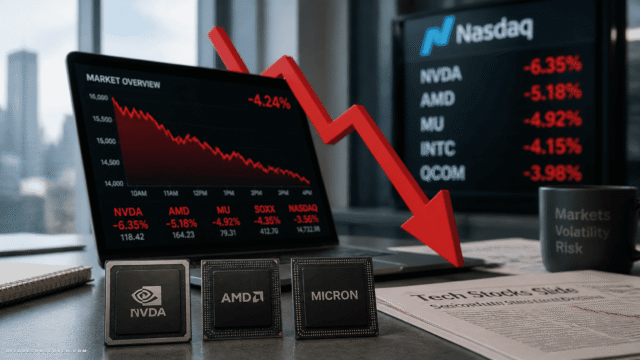
How those hearings go will directly affect sentiment across AI chip names. Regulatory risk is not uniform — the probes target Nvidia directly, but tighter export rules and equipment restrictions could reach equipment makers and foundries depending on how the policy language develops.
The broader point: the November 23 rally reset prices, but it didn’t resolve the underlying tensions. Export controls, geopolitical concentration, and new competitive entrants like CXMT are structural variables, not temporary noise.
The Takeaway
These three stocks represent three different exposure profiles within the same AI chip and export control theme:
- TSMC is the highest-conviction AI infrastructure play with the highest geopolitical concentration risk.
- Samsung has a real AI memory opportunity that a funded Chinese competitor is actively working to erode.
- GlobalFoundries is a quieter name with a specific margin transformation thesis tied to silicon photonics demand.
None of these are simple calls. The rally created entry points, but the risks that drove the selloff haven’t been resolved. The most useful thing you can do right now is be specific about which risk you’re actually comfortable holding — and which one you’re not, especially when evaluating AI stocks.














Comments (0) No comments yet
Want to join this discussion? Login or Register.
No comments yet. Be the first to share your thoughts!