


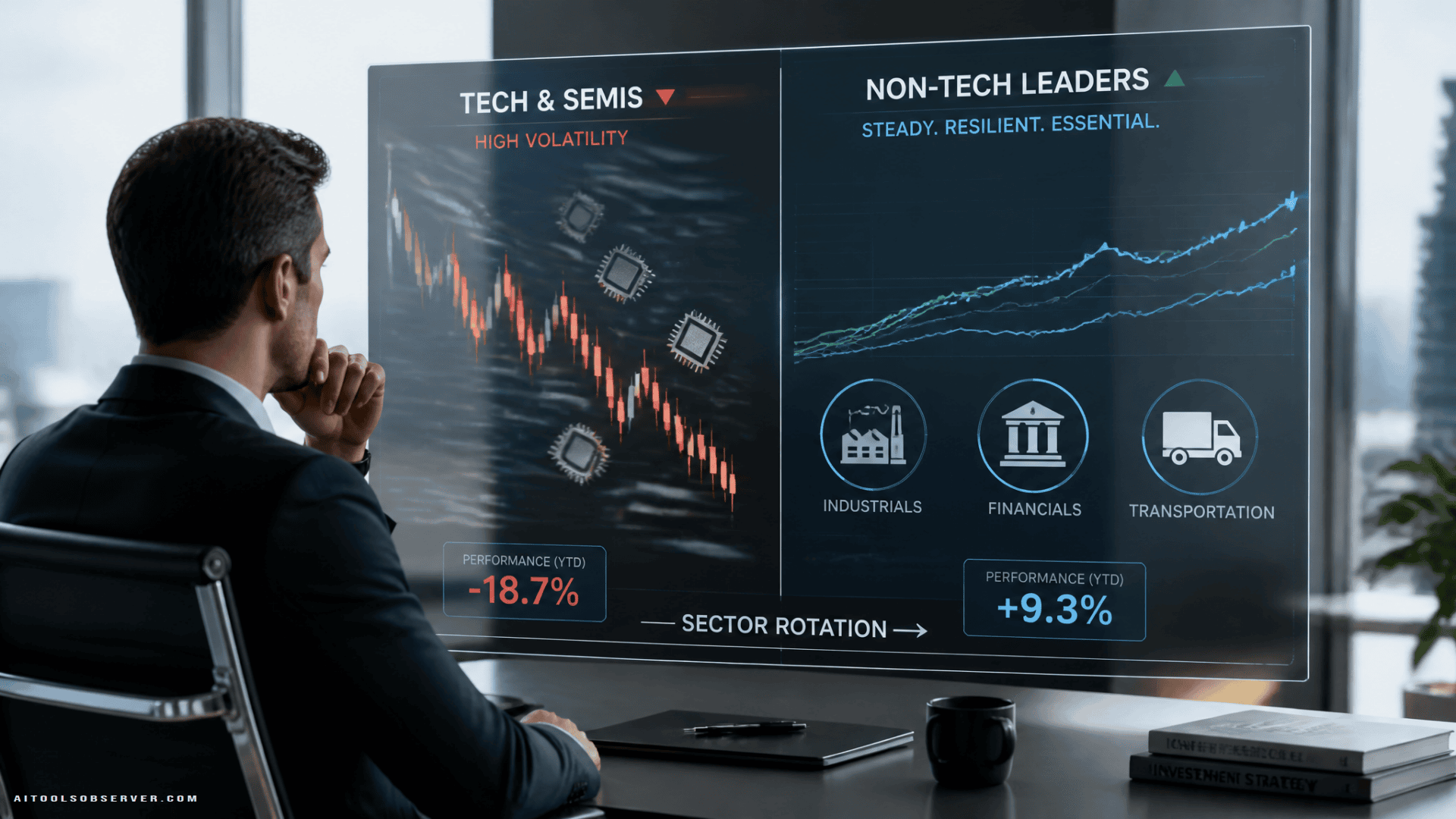
The market is separating AI conviction from AI chasing
Cramer’s position is straightforward. He appears to see AI-linked tech names as too noisy and unpredictable for aggressive new buying right now, even while staying constructive on select long-term leaders.
That is an important shift in tone because it reflects a broader pattern in overheated themes. Early in a rally, investors buy the category. Later, they start questioning price, durability, and what is already fully reflected in expectations.
In practice, that means two things can be true at once:
- AI remains a major structural investment theme
- AI stocks can still be poor short-term entries
This is the tension many investors miss. A strong long-term narrative does not guarantee a good risk-adjusted purchase today.
Why “look outside tech” is really a risk management call
Cramer’s argument is less about abandoning innovation and more about reducing exposure to concentrated volatility.
When semiconductor and AI names surge to records and then come under pressure, price action starts to dominate the conversation. Investors stop asking, “Is this company important?” and start asking, “How much downside is left if expectations reset again?”
That is where sector rotation enters the picture. Moving new money into high-quality non-tech companies can be a way to stay invested without taking full AI-trade whiplash. It is not as exciting. It is often more practical.
For risk-adjusted returns, that matters. A steadier business with lower narrative heat may offer a cleaner setup than a market leader whose valuation still needs to cool.
What this says about semiconductor sentiment
Semiconductors remain the emotional center of the AI market.
They sit closest to the infrastructure buildout, so they attract both the strongest optimism and the sharpest reversals. When confidence is high, chip names are treated as the purest AI exposure. When uncertainty rises, they become the first place investors cut risk.
This helps explain why sentiment can deteriorate quickly even without a fundamental collapse. The market starts to worry about:
- how much growth is already priced in
- whether customer spending stays elevated
- how competition could affect margins and positioning
- how long current demand levels can remain extraordinary
None of those questions invalidate the AI buildout. They simply make semiconductor stocks more sensitive to expectation changes than many investors assume.
Nvidia and Intel can still be long-term holds
One of the more useful parts of Cramer’s view is that he does not flatten the entire sector into one trade.
He remains bullish on Nvidia over the long run, pointing to its central role in the data center ecosystem. That logic fits the broader market view of Nvidia as a company tied not just to AI enthusiasm, but to the physical compute layer behind AI deployment.
The practical takeaway is that market leadership and stock timing are different questions. A company can remain strategically critical while its shares still experience violent repricing.
Cramer also reiterates a constructive stance on Intel, framing it as more than a single-line turnaround story. The appeal, based on the available context, is diversification within the chip stack: CPU exposure, advanced packaging, and foundry ambitions. That mix gives investors a different kind of AI-adjacent thesis than pure accelerator dominance.
For trend watchers, this is notable. It suggests the next phase of AI investing may reward nuance over blanket enthusiasm.
AMD’s role highlights a more competitive AI infrastructure market
Cramer’s mention that only AMD comes close to Nvidia in certain areas points to another trend worth watching: the AI infrastructure market is still leader-heavy, but not static.
That matters because the first AI market phase was defined by concentration. The next phase may be defined by comparison:
- which vendors keep pricing power
- which architectures win real deployment share
- which customers diversify supply
- which chip strategies hold up when buyers become more cost-sensitive
For AI tool buyers and operators, this is not just a stock market issue. Competition at the chip and infrastructure level eventually shapes product pricing, inference costs, and the economics of AI software categories.
Why this matters beyond public equities
It is easy to treat this as a stock-picker story. It is broader than that.
When public markets become more skeptical about AI-linked tech, the mood affects the whole ecosystem. Founders, operators, and tool buyers should pay attention because capital market sentiment often influences:
- how aggressively infrastructure gets funded
- how software companies price AI features
- how much tolerance exists for margin-light growth
- which AI categories are seen as durable versus speculative
A cooling market usually shifts attention from vision to efficiency. Companies then need to show clearer paths to revenue quality, customer retention, and cost control.
That is especially relevant in AI tools, where many products still compete on promise more than on durable workflow value.
The rotation into non-tech is also a signal about market maturity
There is a deeper trend under Cramer’s call: the AI trade is maturing.
In the early stage, nearly every AI-linked name can move together because investors are buying exposure to a broad idea. As the theme matures, capital becomes more selective. Some money rotates out not because AI is finished, but because the market wants better discipline around entry points and better compensation for risk.
This is healthy.
A market that can distinguish between long-term importance and near-term overextension is usually becoming more rational. That may not feel comfortable in the moment, but it often creates better future setups.
How to read this if you follow the AI tools ecosystem
For AiToolsObserver readers, the useful lesson is not “avoid AI.” It is to separate ecosystem conviction from valuation reflex.
A practical framework:
1. Distinguish infrastructure leaders from momentum trades
Not every stock or company rising on AI sentiment has the same strategic depth. Some are exposed to core compute demand. Others mainly benefit from temporary enthusiasm.
2. Watch where fresh money is willing to hide
If investors prefer industrials, financials, or logistics over AI-heavy tech for now, that suggests risk appetite has weakened. That often spills into private markets, software multiples, and tool vendor expectations.
3. Expect more scrutiny on actual utility
As capital gets more selective, AI products with clear workflow impact should hold up better than tools that mainly market possibility.
4. Treat volatility as information
Sharp swings in semiconductor names often reflect more than fear. They can reveal where the market thinks pricing, competition, or demand assumptions have run too far ahead.
What happens next depends on the reset
Cramer’s stance implies a waiting game. He appears willing to own select AI leaders long term, but not eager to add heavily before a broader washout or valuation reset.
That position captures the current AI market well. The long-term case remains intact, yet the path is less forgiving. Investors are no longer rewarded simply for showing up in the right theme. They need better timing, stronger balance between conviction and caution, and more respect for how quickly sentiment can turn.
For anyone comparing AI trends, that is the real shift to watch: the market is still backing AI, but it is becoming far less patient with AI excess.
Takeaway
If you are allocating fresh capital, this moment appears less about finding the loudest AI name and more about choosing where volatility is actually worth absorbing.
Cramer’s view points to a practical middle ground: keep long-term AI leaders like Nvidia and Intel on the watchlist or in the core bucket, but do not confuse strategic importance with a good immediate entry. Until the sector resets, high-quality non-tech names may offer the cleaner risk-adjusted path while the AI trade relearns discipline.













Comments (0) No comments yet
Want to join this discussion? Login or Register.
No comments yet. Be the first to share your thoughts!