


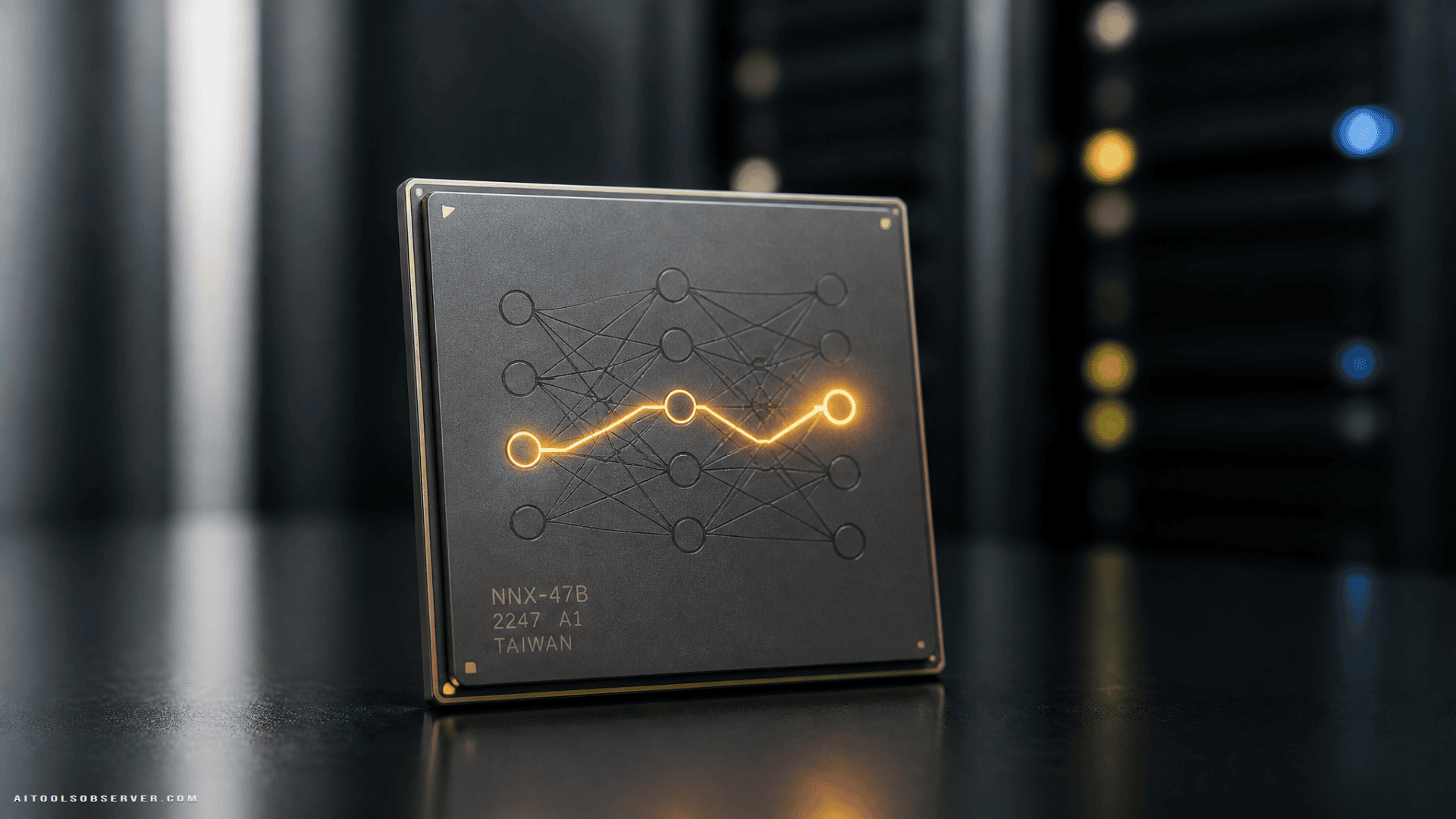
What Taalas Actually Does
Most AI chips—GPUs included—are designed to handle whatever model you throw at them. Taalas takes the opposite approach: it bakes a specific model directly into the silicon.
The tradeoff is real. You lose the ability to swap models on the fly. What you gain is speed and cost efficiency that a general-purpose chip can’t match for that specific workload. Taalas claims its chips can produce output for targeted models thousands of times faster than a traditional GPU.
Its current chip runs a small version of Meta’s Llama 3.1. The company is working on chips for larger, more advanced models. It uses an older TSMC process and on-chip SRAM memory—a deliberate design choice that prioritizes latency over cutting-edge fabrication.
Taalas had raised $219 million in venture funding before this deal. AMD didn’t disclose a purchase price.
Why AMD Is Buying This Now
The timing is pointed. This deal comes roughly seven months after Nvidia paid $20 billion for assets from Groq—itself a maker of high-performance inference chips. That remains Nvidia’s largest acquisition on record.
The inference market is heating up for a specific reason: low-latency applications. When a user expects an AI response to feel instant—think voice assistants, real-time copilots, or customer-facing tools—time-to-first-token matters enormously. GPUs aren’t optimized for that.
AMD CEO Lisa Su put it plainly at a product launch in July: “There’s no one-size-fits-all as it comes to chips.” She still expects GPUs to dominate the AI chip market overall, but the edges of that market are filling in fast.
The Bigger Pattern: AMD Is Building a Stack
This acquisition isn’t a one-off. AMD has been assembling pieces for a while:
- ZT Systems ($4.9B) — the technical foundation for rack-scale products
- Silo AI ($665M) — AI model development
- MK1 — inference software
- Taalas — hardwired inference silicon
All of this feeds into Helios, AMD’s rack-scale AI system and its most direct answer to Nvidia’s integrated server racks. Meta and Microsoft are among the first customers. AMD also announced a partnership with Cerebras in July to integrate its chips into AMD systems later this year.
The strategy is clear: don’t just sell a GPU, sell the whole rack.
What This Means for the AI Tools Ecosystem
For most builders and buyers of AI tools, this plays out in the background—but it shapes what’s available and at what price point.
Hardwired inference chips could meaningfully reduce the cost of running specific, high-volume AI workloads. If Taalas technology matures and scales inside AMD’s infrastructure, expect cloud providers to eventually offer lower-cost, lower-latency inference options for popular models.
The catch: you only get that efficiency if you’re running the model the chip was built for. As AI models proliferate and update constantly, the “hardwired” approach has real limits. It works best for stable, widely-deployed models—not the bleeding edge.
AMD is betting that enough workloads fit that description to make it worth building. Given how much Llama 3.1 is already running in production, that’s not a bad bet.
The takeaway: AMD isn’t abandoning GPUs—it’s acknowledging that inference at scale needs more than one kind of chip. Watch how quickly Taalas technology shows up in AMD’s Helios racks, and whether cloud pricing for inference starts to shift as a result.












Comments (0) No comments yet
Want to join this discussion? Login or Register.
No comments yet. Be the first to share your thoughts!