


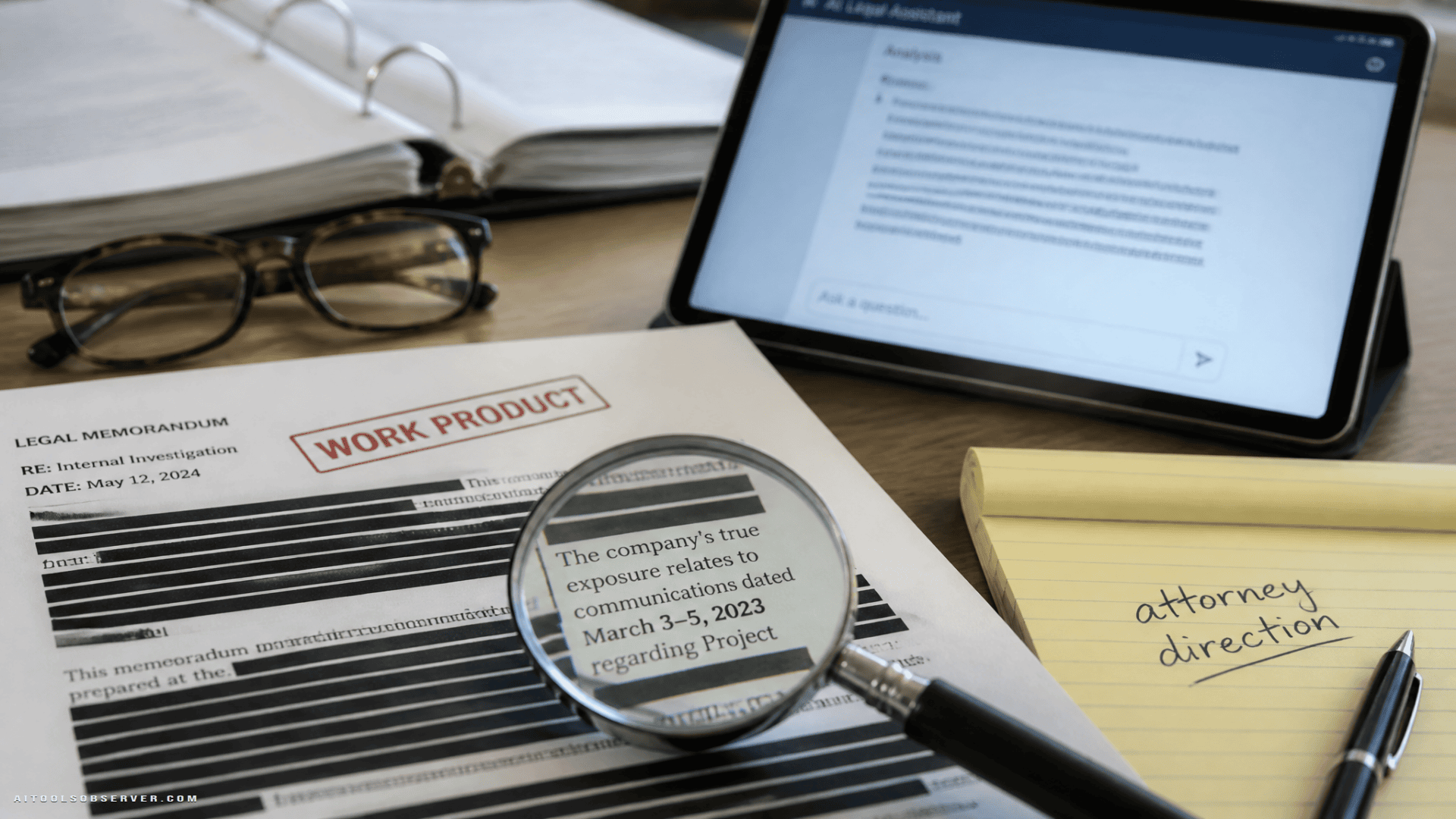
What Happened in Shealy v. Seaside
The underlying dispute arose from a commercial investment relationship. After receiving correspondence from Seaside concerning a potential default under a promissory note, Earl Wade Shealy, Jr. forwarded the documents to his romantic partner, Debbi Fields, who uploaded them to ChatGPT with instructions to analyze the situation and draft a response letter.
Critically, neither Shealy nor Fields consulted an attorney during this process—despite Shealy being represented by counsel in the underlying transaction.
When litigation followed, Shealy produced redacted correspondence and claimed the AI-generated output was protected work product. Seaside moved to compel unredacted disclosure. The court sided with Seaside.
Why the Court Rejected Work Product Protection
The court’s reasoning rested on two distinct grounds, each worth examining separately.
Fields Was Not a “Representative”
Work product doctrine protects materials prepared by or for certain representatives of a party—attorneys, consultants, agents, and insurers among them. Massachusetts does not recognize romantic partners as qualifying representatives, and the court declined to extend the doctrine to cover that relationship. The correspondence between Shealy and Fields was therefore subject to disclosure.
ChatGPT Was Not a “Representative” Either
The court went further and addressed the AI tool directly. Its reasoning was precise: ChatGPT is a tool, not a person. The output it generates does not disclose the mental impressions, conclusions, opinions, or legal theories of an attorney or qualified representative. Without attorney direction or input, there is no human strategic thinking embedded in the output—and therefore nothing that qualifies for work product protection, let alone the heightened protection afforded to opinion work product.
How This Fits the Broader Legal Landscape
The court was aware of decisions pointing in a different direction. In Morgan v. V2X, Inc. and Warner v. Gilbarco, Inc., federal courts in Colorado and Michigan extended work product protection to AI-generated output used by pro se litigants—parties acting without counsel. The reasoning there was that the AI output reflected the mental impressions of the litigant acting in the role of counsel, and that extending protection served the policy interest of leveling the playing field between represented and unrepresented parties.
The Massachusetts court found those cases inapplicable. Shealy was represented by counsel. He chose, entirely on his own initiative, to use AI through a non-attorney third party without informing or involving his attorney. That distinction collapsed the policy rationale that supported protection in the pro se cases.
The court also drew on United States v. Heppner, a February 2026 decision in which a represented criminal defendant’s independent use of an AI tool—again without counsel’s direction—fell outside the scope of both privilege and work product protection.
The pattern across these decisions is consistent: attorney direction is the operative variable, not the use of AI itself.
What This Means for AI Use in Litigation Contexts
The practical implications are specific and actionable.
Prompts are discoverable. The court’s analysis applies not only to the AI-generated output but also to the prompts used to generate it. If those prompts were not created at counsel’s direction, they may be fair game in discovery.
Routing AI queries through non-attorneys removes protection. Asking a colleague, a partner, or any non-attorney third party to run documents through an AI tool—without counsel’s involvement—does not preserve privilege or work product status. The intermediary does not transform the output into protected material.
The tool’s sophistication is irrelevant. Courts are applying established privilege frameworks without modification. The fact that a large language model can produce legally coherent analysis does not change the doctrinal analysis. What matters is whether a qualified human representative directed the work.
Anticipation of litigation raises the stakes. Once litigation is reasonably anticipated, any analytical work—AI-assisted or otherwise—should be conducted under counsel’s direction if the intent is to shield it from discovery.
The Governance Implication
For organizations that have deployed AI tools across legal, compliance, or commercial operations, Shealy v. Seaside is a prompt to review how those tools are being used when disputes are on the horizon.
The question is not whether AI can assist with legal analysis—it clearly can. The question is who is directing that analysis, and whether that person qualifies as a representative under applicable privilege doctrine.
Absent a clear answer to that question, the output—and the prompts behind it—may end up in opposing counsel’s hands.












Comments (0) No comments yet
Want to join this discussion? Login or Register.
No comments yet. Be the first to share your thoughts!