


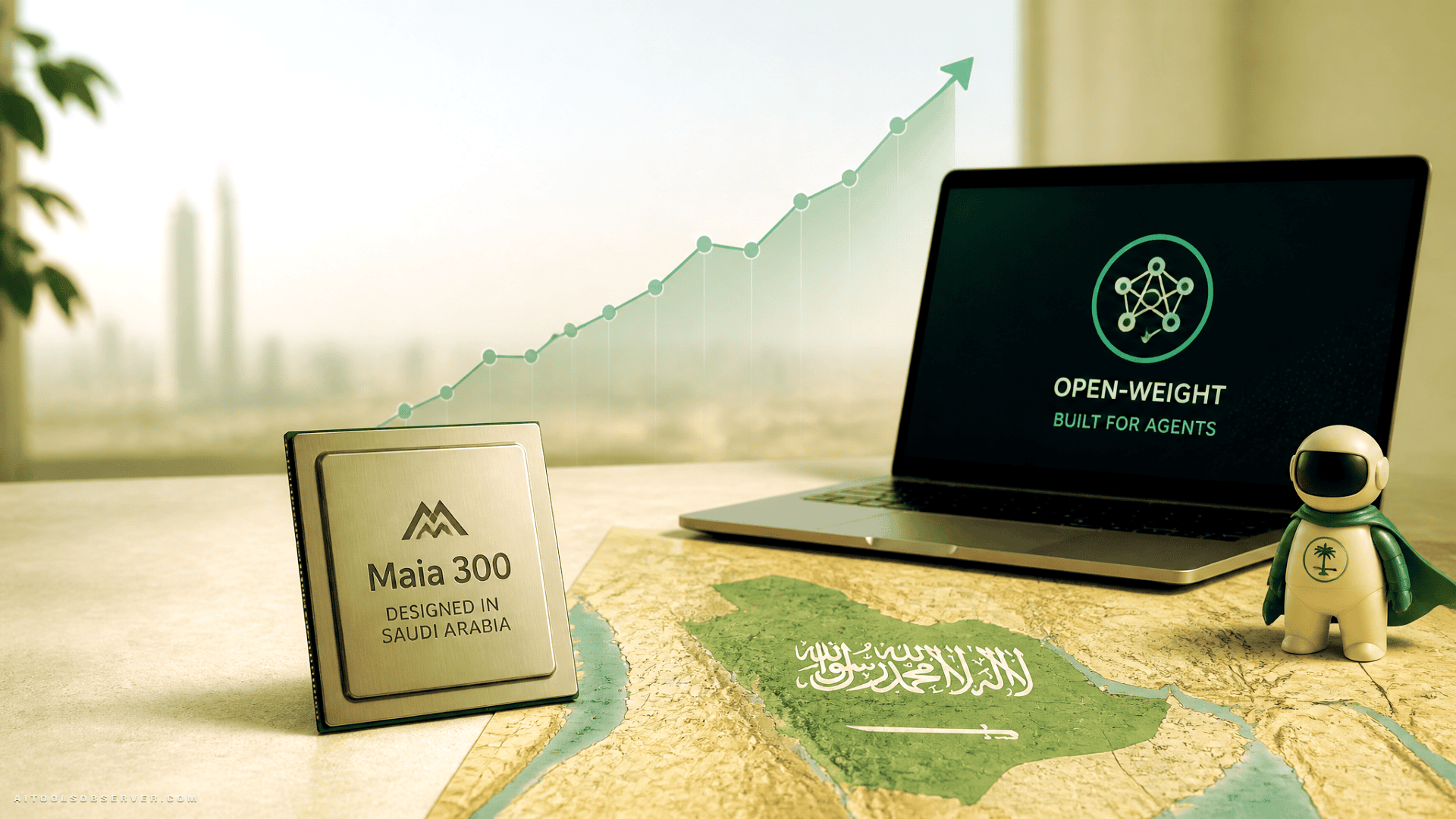
Saudi Arabia’s AI Adoption Just Doubled
Saudi Arabia’s AI tool usage hit 45.2% of the population — more than double the prior year’s figure. That’s not a gradual curve. That’s a jump.
A few details worth noting:
- ChatGPT ranked first among most-downloaded AI apps, followed by Google Gemini and DeepSeek
- The national HUMAIN platform also made the list
- Female users led adoption at 52.8%, with the 20–29 age group topping all segments at 55.7%
- Even the 60–74 age group saw internet usage climb to 92.8%, up from 88.9% the year before
The older demographic shift is particularly interesting. Narrowing digital divides at the top of the age curve tends to be slow — a 3.9 percentage point jump in one year suggests something structural is changing, not just organic curiosity.
Saudi Arabia also ranked first globally in the ITU’s Digital Readiness Framework 2025, which aligns with the broader Vision 2030 push. Government-backed adoption programs tend to accelerate numbers like these, but the underlying usage still has to happen. Both appear to be true here.
Why it matters for AI tool builders: A market that doubled adoption in a year, with a government actively promoting digital readiness, is worth watching — especially if your tool has localization or Arabic-language capabilities.
Microsoft’s Maia 300: The Slow Chip Race Heats Up
Microsoft is preparing to unveil its Maia 300 AI chip, reportedly as soon as September. This follows the Maia 200 (second-gen, 3nm, TSMC-built) unveiled in January, and the original Maia from late 2023.
The context matters here. Google is already recognizing revenue from direct TPU sales. Amazon’s Trainium chips are seeing growing adoption. Microsoft has been the slowest of the three hyperscalers to scale its in-house silicon — and it knows it.
The reported ambition for Maia 300 is significant: over 1 million units targeted, with early talks to bring Anthropic on as a customer. That last detail is notable given Anthropic’s existing ties to both Google and Amazon.
The constraint isn’t ambition — it’s manufacturing capacity. TSMC negotiations and component supply are cited as the limiting factors. Securing 300,000+ units for 2027 delivery is the near-term goal; the million-unit target is further out.
The practical read: Microsoft reducing Nvidia dependency is good for cloud pricing competition long-term. If Maia 300 performs well and lands major customers, it shifts leverage in the AI infrastructure stack — slowly, but meaningfully.
Meta’s Open-Weight Play: Muse Glimmer and a Policy Argument
Meta released Muse Glimmer, a small open-weight model designed for agentic tasks that can run locally on a Mac or PC with a single GPU. It’s not competing with GPT-4-class frontier models on raw capability — it’s competing on accessibility, cost, and deployability.
Mark Zuckerberg used the launch to make a broader argument: US AI policy is creating an uneven playing field for open-weight development, while Chinese labs — Moonshot’s Kimi K3, Alibaba’s Qwen3.8-Max, DeepSeek‘s V4-Flash — are moving fast and openly.
The open-weight vs. closed-source tension is real and growing:
- Open-weight models are cheaper, customizable, and can run offline — useful for privacy-sensitive or resource-constrained deployments
- Closed models from OpenAI, Anthropic, and Google offer more capability at the frontier, but with usage restrictions
- Hugging Face reportedly used a Chinese open-weight model to defend against a security incident because closed-source models restrict cybersecurity use cases — a concrete example of where openness has operational value
Zuckerberg also advocated for model distillation (using large models to train smaller ones) and announced a governance structure giving independent directors authority over safety criteria for model releases — a notable move given the US administration’s reported decision to skip voluntary safety testing for open-weight models.
The practical read: If you’re building on top of AI models, the open-weight ecosystem is maturing fast. Muse Glimmer’s local-first, agentic design signals where Meta thinks edge deployment is heading. Worth evaluating if your use case involves on-device inference or agentic workflows.
The Week’s Useful Takeaway
Three different stories, one common thread: the AI infrastructure layer — chips, models, adoption — is getting more distributed. Saudi Arabia isn’t waiting. Microsoft is building its own silicon. Meta is pushing models that run on your laptop.
The “AI is centralized in a few US labs” narrative is getting harder to sustain. For anyone choosing AI tools right now, that means more options, more tradeoffs, and more reason to actually compare before committing.









Comments (0) No comments yet
Want to join this discussion? Login or Register.
No comments yet. Be the first to share your thoughts!