


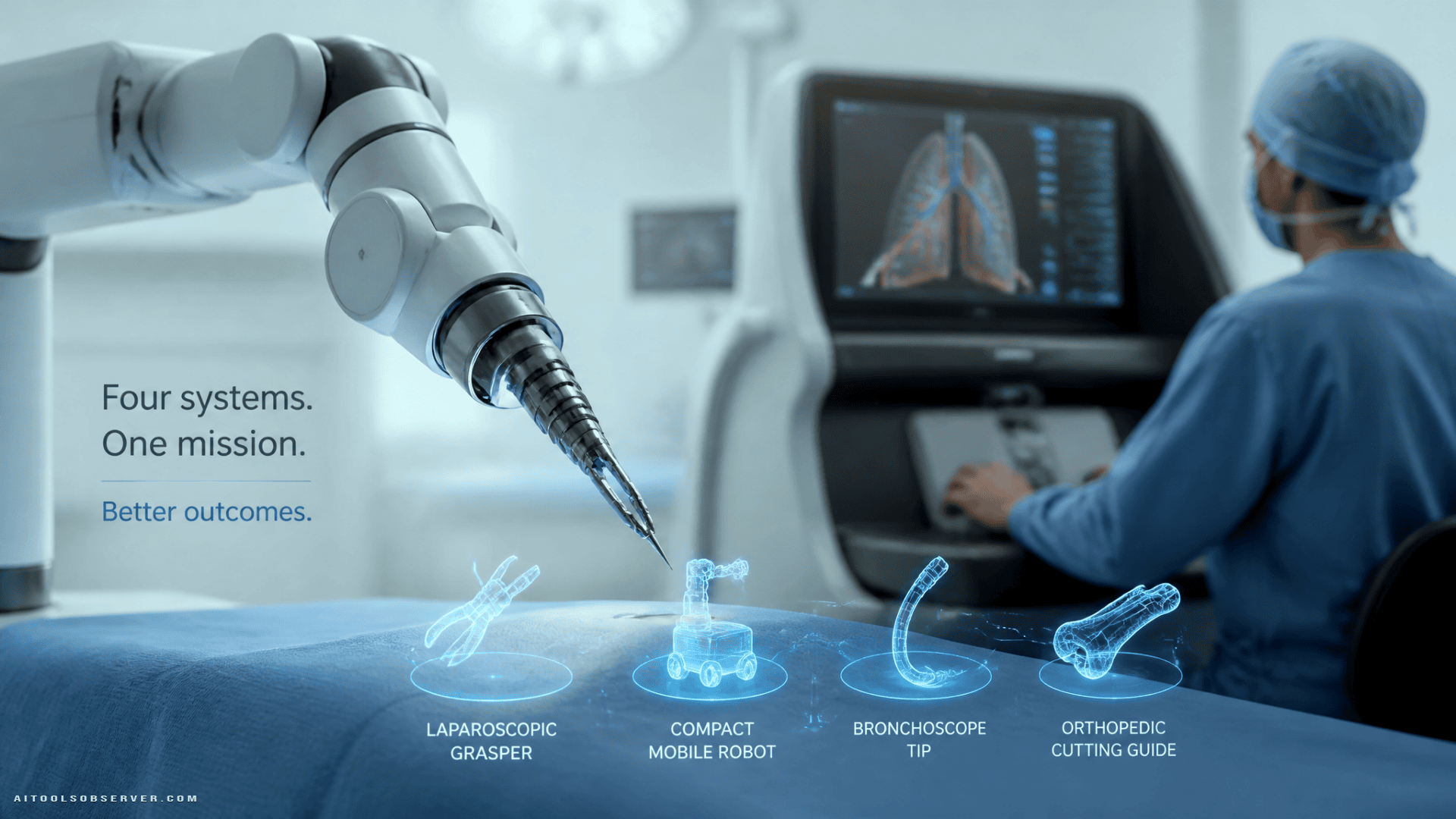
da Vinci 5: Precision at Scale
Intuitive Surgical’s da Vinci platform has been around since 2000 and has logged over 20 million procedures. The fifth-generation system raises the bar by layering AI directly into the surgical experience.
The key upgrade: haptic feedback. The system helps surgeons feel resistance and tension in real time, so they can moderate force and reduce tissue trauma. That’s paired with live data analysis during the procedure itself.
Dr. Marc Bailey, a cardiothoracic surgeon at St. Joseph’s/Candler Hospital in Savannah, Georgia, puts it plainly: “Robotic surgery has always allowed for smaller incisions and less blood loss, and we can get you walking around faster, with less pain.”
For patients, that translates to faster recovery and fewer complications. For hospitals, it means more consistent surgical outcomes across a wider range of procedures.
MIRA: Small Robot, Big Reach
Virtual Incision’s MIRA (Miniaturized In Vivo Robotic Assistant) takes a different approach to the access problem—not just access to the body, but access to the technology itself.
At under 2 pounds, MIRA is light enough to move between operating rooms without lengthy setup. That portability matters in hospitals where OR time is expensive and scheduling is tight.
MIRA is currently used in intestinal surgeries, but the roadmap is ambitious:
- AI-assisted decision-making is planned for future versions
- Remote surgery is already being tested—in 2024, Virtual Incision and NASA demonstrated MIRA’s remote capabilities aboard the International Space Station, using satellite-transmitted data
That last point isn’t just a headline. It signals where surgical robotics is heading: procedures performed across distances, with AI bridging the gap.
Ion: GPS for the Lungs
Early-stage lung cancer is notoriously hard to catch. Intuitive’s Ion system is designed specifically to help with that.
Ion is a robotic bronchoscopy tool that guides minimally invasive lung biopsies. The 2025 AI upgrade added something particularly useful: predictive navigation. The system can anticipate how a lung nodule might shift over time and reroute accordingly—functioning like a GPS that recalculates when conditions change.
Live imaging is compared against the surgical plan in real time, giving doctors the ability to adjust course without stopping the procedure. As of mid-2025, 900 Ion systems were operating across hospitals in 10 countries.
Earlier detection of lung cancer directly improves survival rates. Ion’s value isn’t just technical—it’s clinical.
Mako: Smarter Joint Replacements
Stryker’s Mako robotic arm handles one of the most common surgical categories: knee and hip replacements. The AI here is focused on planning and precision.
Before the procedure, Mako generates a patient-specific surgical plan. During surgery, real-time feedback helps surgeons stay on that plan while protecting healthy bone tissue. The result is more accurate implant alignment—which matters for joint stability and how long the implant actually lasts.
For a procedure that hundreds of thousands of patients undergo each year, even incremental improvements in alignment and recovery time add up to significant outcomes at scale.
What These Systems Have in Common
Each of these tools addresses a different surgical challenge, but they share a common pattern worth noting:
- AI augments the surgeon—it doesn’t replace judgment, it sharpens it
- Minimally invasive approaches reduce recovery time and complication risk
- Real-time data shifts surgery from a static plan to a dynamic, responsive process
The practical takeaway for anyone tracking AI in healthcare: the most meaningful applications aren’t the flashiest ones. They’re the ones quietly reducing trauma, improving alignment, and helping doctors catch problems earlier—one procedure at a time.
















Comments (0) No comments yet
Want to join this discussion? Login or Register.
No comments yet. Be the first to share your thoughts!